Choosing the wrong bat size is one of the most common and most costly equipment mistakes in youth and amateur baseball. A bat that is too long forces a hitter to compensate with their hands and arms rather than rotating through the ball with their hips and core — creating mechanical habits that undermine development long after the bat has been replaced. A bat that is too heavy slows the swing down progressively across a game as fatigue accumulates, reducing exit velocity and bat speed at exactly the moments when performance matters most. Getting the size right from the start is the single most impactful equipment decision a player or parent can make before a season begins.
The good news is that choosing the right bat size is not complicated once you understand the three variables that determine the correct selection — bat length, bat weight, and drop weight. Each of these variables affects a different aspect of swing performance, and getting all three right simultaneously is what creates the complete bat fit that allows a player to swing with maximum speed, control, and mechanical efficiency from the first at-bat of the season through the final out of the championship game. For players who want to pair their correct-size bat with the right protective equipment at the plate, ⚾ Best Baseball Batting Helmets (2026) covers the certified helmet options that complete a hitter's plate setup. And for players building a complete individual training environment around their new bat, 🏏 Best Batting Tees (2026) covers the tee options that let players develop their swing mechanics at the correct bat size before moving to live pitching.
Once you've dialed in your size, our Wood Bats collection covers every wood option by type and level.
📏 Understanding Bat Length — The Starting Point for Every Selection
Bat length is measured in inches and is the most visible sizing variable — but it is also the one most frequently selected incorrectly because players and parents often default to the longest bat a player can physically swing rather than the longest bat they can swing with proper mechanics and full bat speed.
The correct bat length allows the hitter to comfortably reach the outside corner of the plate without overextending their arms or losing hip rotation. A bat that is too long forces the hitter to extend their hands away from their body prematurely, which disconnects the swing from the core rotation that generates real bat speed and exit velocity. A bat that is too short leaves the outside corner inaccessible without the hitter stepping toward the plate, which creates a different set of mechanical problems.
Two useful starting points for finding the correct bat length:
The arm-length method — place the knob near the center of the chest and extend the bat toward the outstretched hand. If the player can comfortably reach the end of the barrel, the length may be within a workable range. Treat this as a quick starting check rather than a definitive sizing test.
The height and weight chart method — use the player's height and weight to identify a reasonable starting length range, then confirm that choice by checking swing control, barrel accuracy, and whether the player can maintain normal mechanics at game speed.
General bat length guidelines by age and height:
Players 3 to 4 feet tall typically use 26 to 27-inch bats. Players 4 feet to 4 feet 4 inches typically use 28 to 29-inch bats. Players 4 feet 4 inches to 4 feet 8 inches typically use 29 to 30-inch bats. Players 4 feet 8 inches to 5 feet typically use 30 to 31-inch bats. Players 5 feet to 5 feet 4 inches typically use 31 to 32-inch bats. Players 5 feet 4 inches to 5 feet 8 inches typically use 32 to 33-inch bats. Players 5 feet 8 inches and above typically use 33 to 34-inch bats at the adult competitive level.
These are starting point ranges — individual swing mechanics, arm length relative to height, and hitting style all influence the final length selection within any given range.
⚖️ Understanding Bat Weight and Drop Weight
Bat weight is measured in ounces and is directly related to bat length through the concept of drop weight — one of the most important and most misunderstood numbers in youth baseball equipment selection.

What is drop weight?
Drop weight is the numerical difference between the bat's length in inches and its weight in ounces. A 30-inch bat that weighs 20 ounces has a drop weight of -10 (written as -10 or drop 10). A 32-inch bat that weighs 29 ounces has a drop weight of -3. The larger the negative number, the lighter the bat is relative to its length — and the easier it is to swing with maximum bat speed.
Drop weight matters because it determines how much the bat's weight affects swing mechanics across a full game. A player using a bat that is too heavy for their current strength level will swing slower, make weaker contact, and develop compensatory mechanics that undermine their development. A player using a bat that is appropriately weighted for their strength will swing at maximum speed with proper mechanics on every at-bat — which builds both performance and correct habits simultaneously.
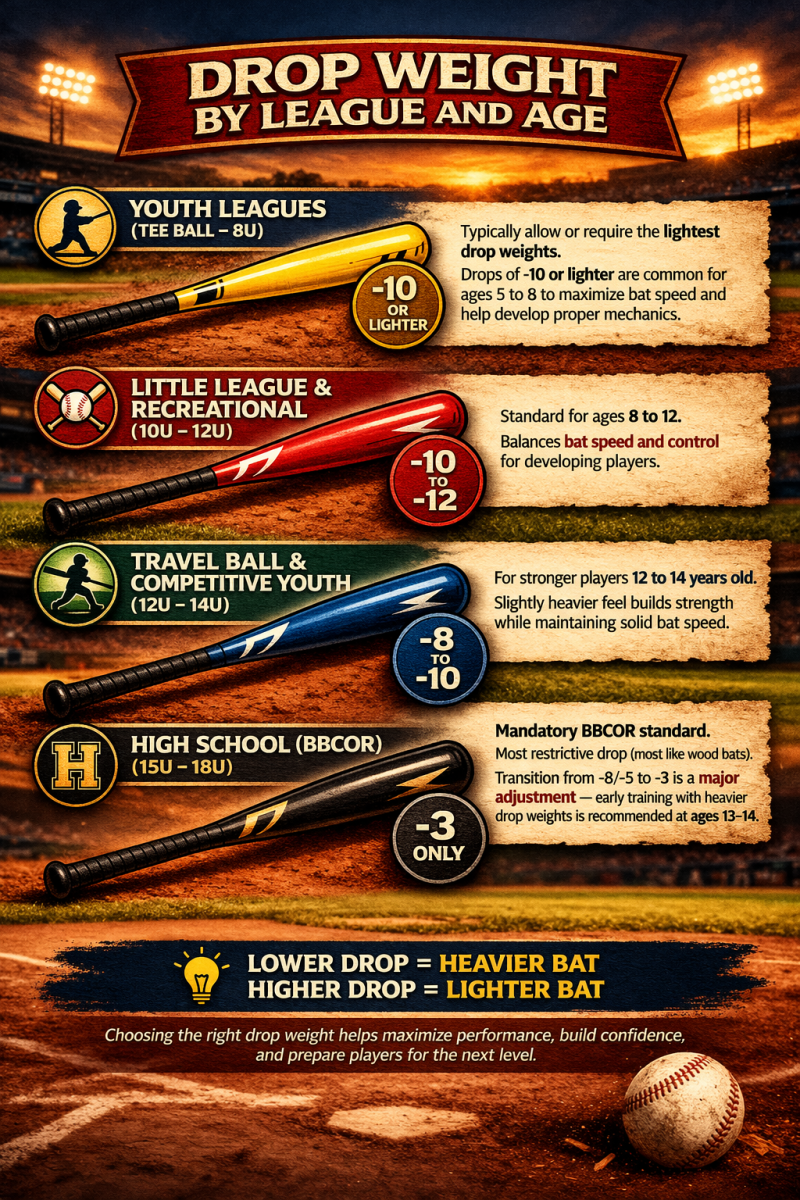
Drop weight by league and age:
Drop weight should be selected around the player's strength, swing control, and league rules rather than age alone. Younger players generally use lighter bats, while stronger and more physically developed players can gradually move toward heavier drop weights as long as they maintain bat speed and normal mechanics.
Under the USABat standard, there is no universal drop-weight limit. A certified USABat is approved regardless of drop weight unless the player's specific league or division adds its own restrictions. Little League rules, for example, vary by division, so parents should confirm the exact rules that apply before buying.
USSSA competition also uses age- and division-specific bat rules. USSSA-certified bats use the 1.15 BPF standard in applicable youth divisions, while older divisions introduce heavier drop limits and eventually BBCOR requirements. Always check the player's current USSSA division rather than choosing a drop solely from an age chart.
For the 2026 high school season, non-wood bats remain governed by the BBCOR .50 standard and the familiar -3 requirement. USA Baseball has announced that beginning with the 2028 NFHS season, approved USABat -4, -5, and -6 bats will also become eligible for high school play alongside BBCOR options. That future rule change does not alter the current 2026 requirements.
🏷️ Understanding Bat Certifications — USA, USSSA, and BBCOR
Bat certification is the variable that many players and parents overlook entirely until they show up to a game with a non-compliant bat and cannot play. Every organized baseball league requires bats to meet a specific certification standard — and bats that do not carry the correct certification stamp are not permitted in game play regardless of size, brand, or cost.
USA Baseball (USABat)
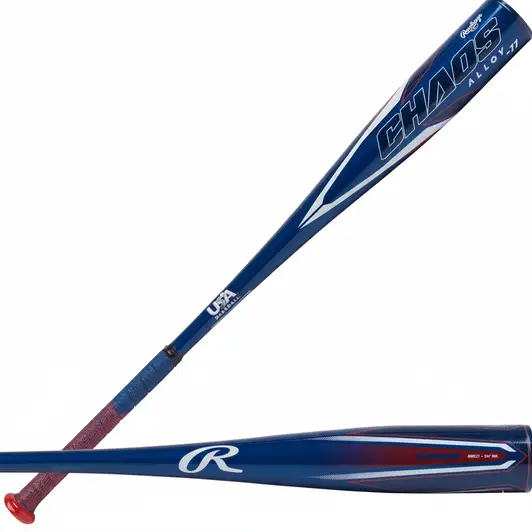
USABat establishes a wood-like performance standard for youth non-wood bats. Certified metal, composite, and multi-piece wood bats carry the USA Baseball mark, while solid one-piece wood bats may be permitted without it. USABat itself does not impose a drop-weight limit, but individual leagues and divisions may have additional size or equipment rules.

USSSA
USSSA baseball uses its own certification system built around the USSSA 1.15 BPF standard for applicable youth bats. Bat restrictions can change by age and division, so players should confirm the current USSSA rule for their specific team or tournament rather than assuming every USSSA-certified bat is legal in every age
BBCOR
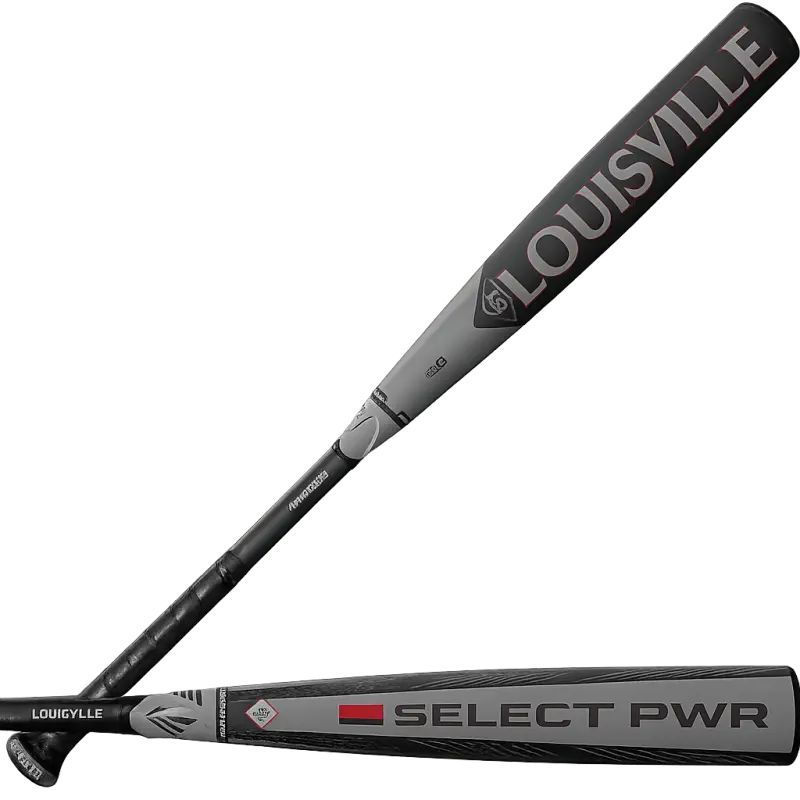
BBCOR governs non-wood bats used in current high school and collegiate baseball and limits bat performance under the BBCOR .50 standard. For the 2026 season, the familiar -3 requirement remains in place for high school non-wood bats. Starting in 2028, NFHS will expand its permitted options to include qualifying USABat -4, -5, and -6 bats along with BBCOR-certified bats.
Key certification rules to remember:
Always confirm the player's specific league and division before purchasing. Bat legality is determined by the rules of the competition being played — not simply by the certification stamped on the barrel.
🪵 Wood vs Aluminum vs Composite — How Bat Material Affects Size Selection
The material of the bat affects how the size variables feel and perform — and understanding the material differences helps players make better decisions when selecting between options at the same size specification.
Wood bats:
Wood bats generally provide more direct feedback on contact and typically offer less forgiveness away from the barrel's optimal contact area than many non-wood designs. Balance, barrel profile, wood species, and turn model can all affect how a wood bat feels, so two bats with the same listed length and weight may still swing differently.

Aluminum bats:
Alloy bats are game-ready immediately and do not require a break-in period. Their barrel size, balance, stiffness, and vibration characteristics vary considerably by model, so alloy construction alone does not determine how forgiving or easy a bat will be to swing.
Composite bats
Composite construction allows manufacturers to tune barrel size, balance, vibration control, and flex in ways that differ from alloy designs. Some composite bats require a break-in process while others are designed for immediate use, and cold-weather recommendations also vary by manufacturer and model. Follow the specific manufacturer's instructions rather than assuming every composite bat requires the same number of break-in swings or has the same temperature limit.

📊 Quick Reference Bat Size Chart
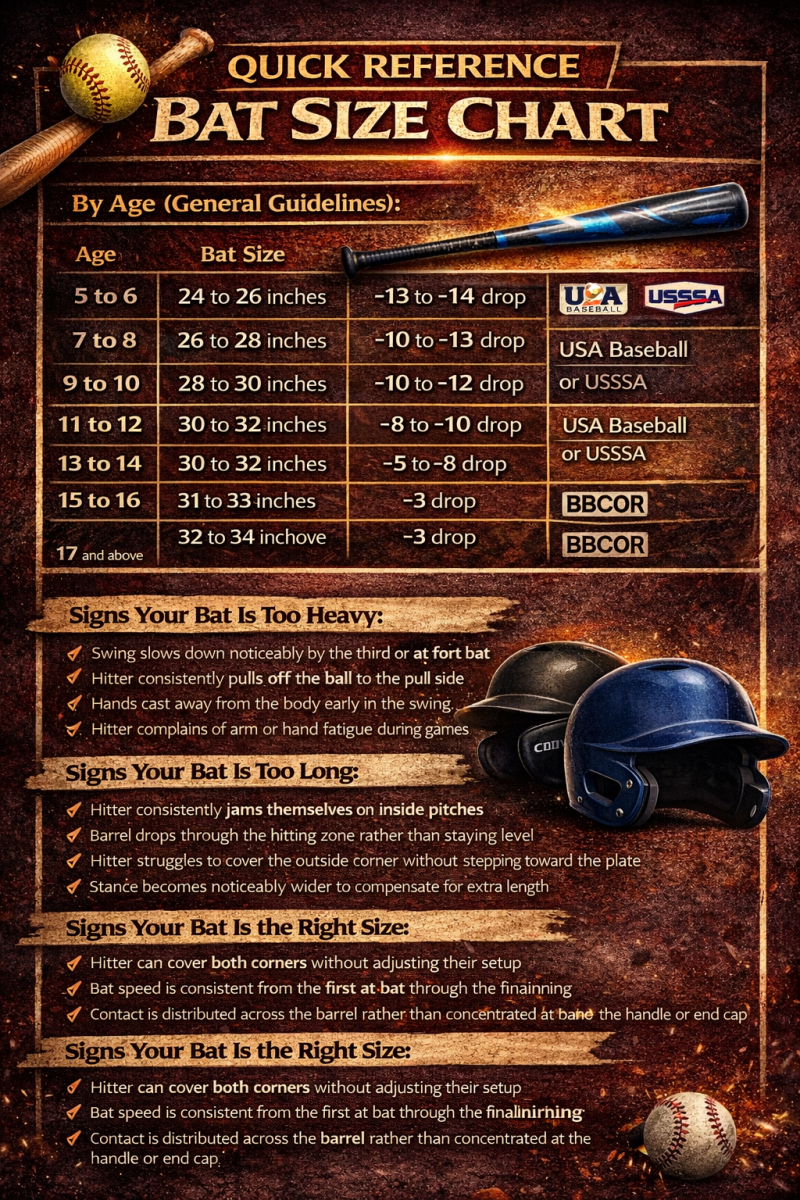
Possible Signs Your Bat May Be Too Heavy:
- Swing slows down noticeably by the third or fourth at-bat
- Hitter consistently pulls off the ball to the pull side
- Hands cast away from the body early in the swing
- Hitter complains of arm or hand fatigue during games
Possible Signs Your Bat May Be Too Long:
- Hitter consistently jams themselves on inside pitches
- Barrel drops through the hitting zone rather than staying level
- Hitter struggles to cover the outside corner without stepping toward the plate
- Stance becomes noticeably wider to compensate for extra length
Signs the Bat Size Is Working Well:
- Hitter can cover both corners without adjusting their setup
- Bat speed is consistent from the first at-bat through the final inning
- Contact is distributed across the barrel rather than concentrated at the handle or end cap
- Hitter can drive the ball to all fields without mechanical adjustment
❓ FAQ
How do I know if my bat is too heavy?
- Your swing speed slows noticeably by the third or fourth at-bat as fatigue accumulates from fighting the weight.
- You consistently pull off the ball or cast your hands away from your body early in the swing.
Can I use the same bat for practice and games?
- Yes, provided the bat is legal for the player's competition and appropriate for the practice environment.
- Composite-bat break-in recommendations vary by model, so follow the manufacturer's instructions rather than assuming every composite bat needs a fixed number of practice hits before game use.
What drop weight should a 12-year-old use?
- There is no single correct drop weight for every 12-year-old. Drop 10 and drop 8 are common possibilities, but the right choice depends on the player's strength, swing control, bat length, and league rules.
- Choose the heaviest bat the player can control at game speed without slowing the swing or changing normal mechanics.
When should a player transition to BBCOR?
- For players entering competition that currently requires BBCOR, begin practicing with the heavier bat early enough to adjust before games begin rather than making the switch at the first official practice.
- For 2026 and 2027 high school play, BBCOR remains the primary non-wood standard. NFHS rules expand in 2028 to permit qualifying USABat -4, -5, and -6 bats as additional options.
Does bat length affect bat speed?
- Yes. Increasing bat length can increase the swing radius, but it also increases the amount of bat the hitter has to control.
- A longer bat does not automatically create more power. The better length is one the hitter can control through the entire zone without sacrificing bat speed, timing, or mechanics.
🧢 Final Thoughts
Getting bat size right is the foundation of everything a hitter develops — and the investment of a few minutes in proper sizing pays dividends across every at-bat of the entire season. The right length puts the barrel where the ball is. The right weight keeps swing speed consistent from the first pitch to the last out. The right certification keeps the player on the field and in compliance with their league's rules. Get all three right and the bat becomes exactly what it should be — an extension of the hitter that accelerates development rather than fighting against it.
For players who want to complete their plate equipment setup with quality hand protection, check out 🏆 The Complete Batting Gloves Guide for the batting glove options that give every hitter the grip confidence their swing deserves. And for everything else across our baseball and softball coverage, visit 📝 Diamond Sports Equipment Blog & Gear Reviews for our full library of buying guides, equipment reviews, and gear comparisons updated all season long.