A baseball batting helmet that does not fit correctly is not providing the protection it was certified to deliver — and yet incorrectly fitted helmets are one of the most common equipment problems at every level of youth and recreational baseball. A helmet that sits too high on the head leaves the temple and forehead exposed. A helmet that is too large shifts on contact, reducing its ability to manage and distribute impact force across the shell the way its certification testing requires. A helmet that is too tight creates pressure point discomfort that distracts players from the pitch and encourages them to loosen or remove the helmet between at-bats rather than wearing it correctly through every moment on the field.
Getting helmet fit right is one of the simplest and most impactful equipment decisions in baseball — and one that requires about two minutes of measurement and one deliberate try-on session to execute correctly. The result is a helmet that disappears during play, stays precisely in position through the full swing and every baserunning situation, and delivers the certified protection its NOCSAE stamp guarantees without requiring adjustment, loosening, or any conscious awareness from the player wearing it. Once you've got your size, the 🪖 Best Baseball Helmets for Players (2026) ranks the top picks to choose from. And for catchers who need to size their helmet alongside their batting helmet, ⛑️ Best Catcher's Helmets & Masks (2026 Guide) covers the catcher-specific sizing considerations that differ from standard batting helmet fit.
⚾ What You Should Know About Helmet Sizing
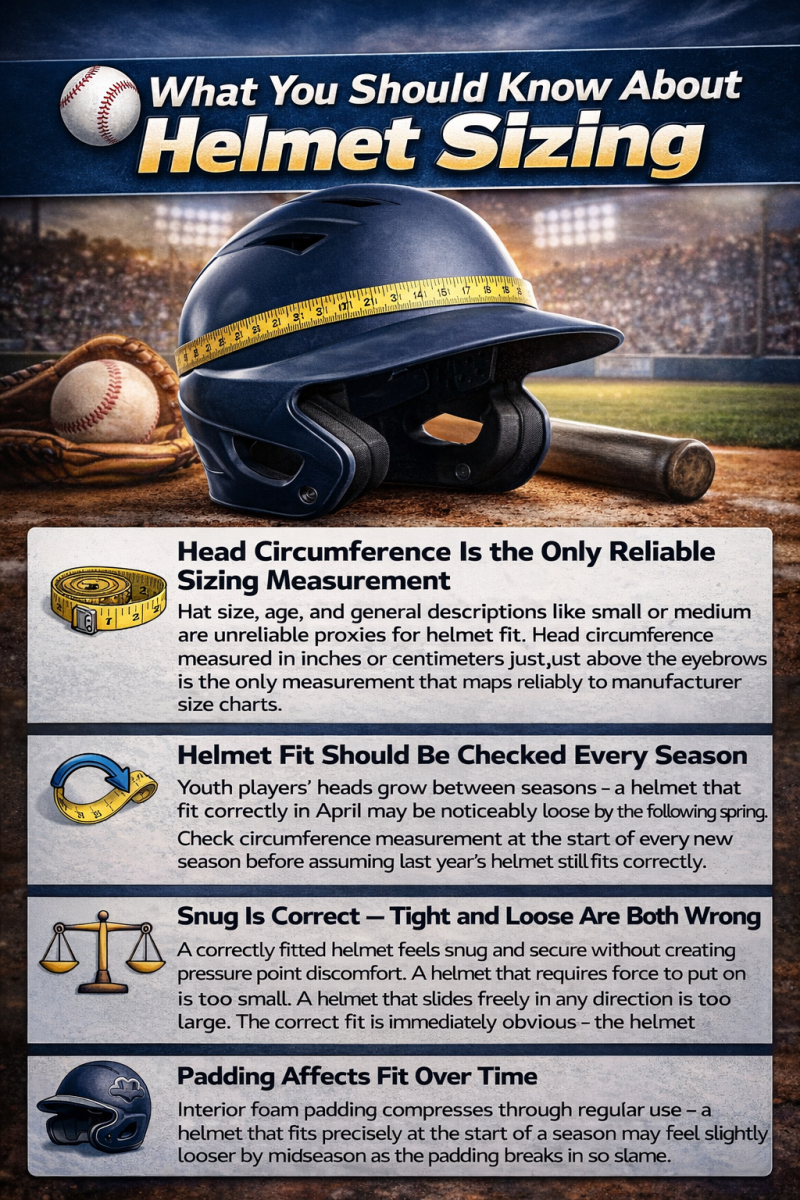
📏 Head Circumference Is the Only Reliable Sizing Measurement
Hat size, age, and general descriptions like small or medium are unreliable proxies for helmet fit. Head circumference measured in inches or centimeters just above the eyebrows is the only measurement that maps reliably to manufacturer size charts and produces a correctly fitted helmet.
🔄 Helmet Fit Should Be Checked Every Season
Youth players' heads grow between seasons — a helmet that fit correctly in April may be noticeably loose by the following spring. Check circumference measurement at the start of every new season before assuming last year's helmet still fits correctly.
⚖️ Snug Is Correct — Tight and Loose Are Both Wrong
A correctly fitted helmet feels snug and secure without creating pressure point discomfort. A helmet that requires force to put on is too small. A helmet that slides freely in any direction is too large. The correct fit is immediately obvious — the helmet stays in position under light pressure without pinching any part of the head.
🧢 Padding Affects Fit Over Time
Interior foam padding compresses through regular use — a helmet that fits precisely at the start of a season may feel slightly looser by midseason as the padding breaks in. Replacement padding inserts are available for most helmet models and restore the original snug fit when the foam has compressed beyond its useful thickness.
⚾ How to Size a Baseball Helmet Correctly
Step 1 — Measure Head Circumference
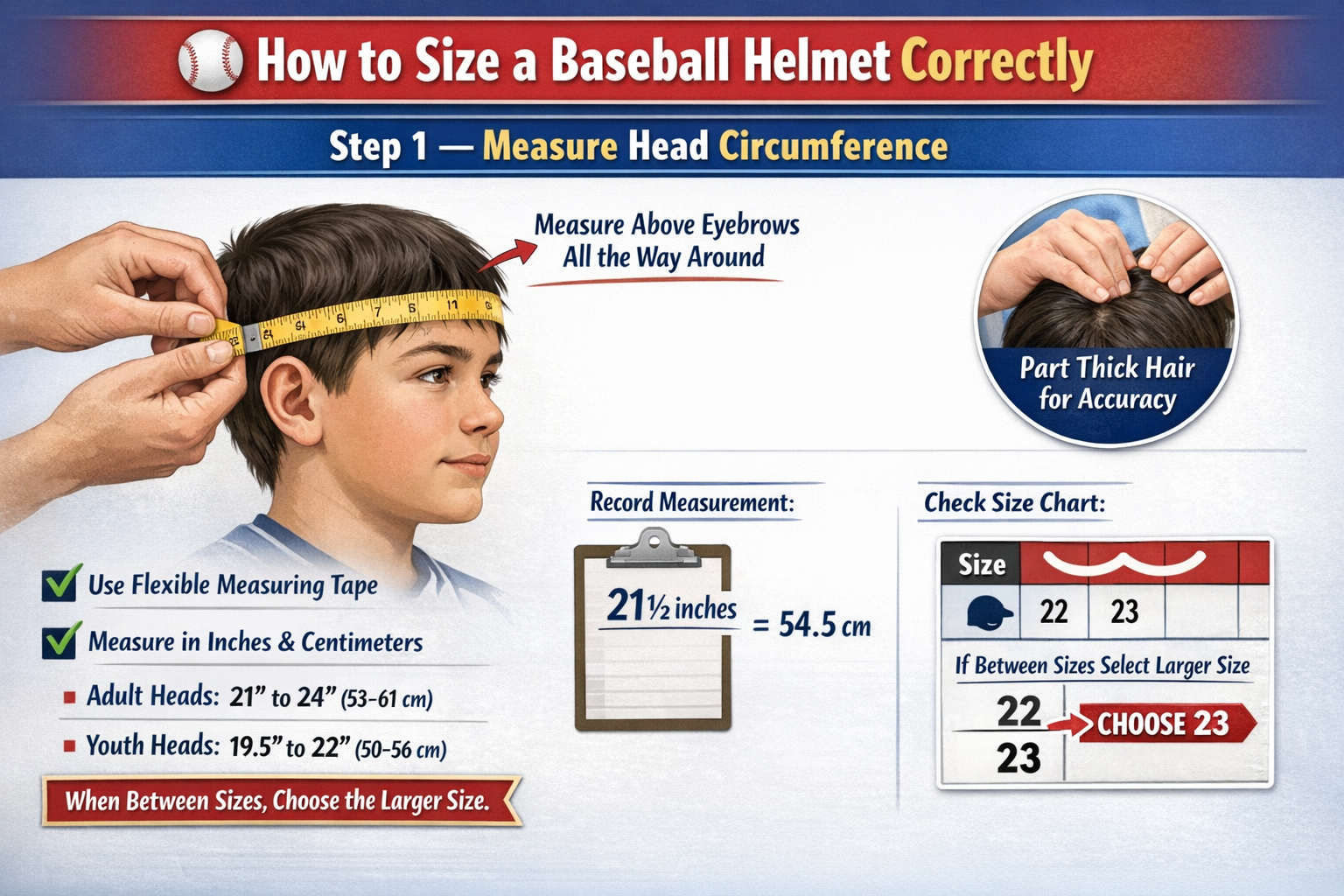
Use a flexible measuring tape — the kind used for clothing measurements rather than a rigid construction tape. Position the tape just above the eyebrows at the widest point of the head, running it around the full circumference above the ears and across the back of the head at the widest point. The measurement should be taken with the tape sitting flat against the head without compressing the hair significantly — if the player has thick hair that adds meaningful volume, part the hair flat before measuring for the most accurate result.
Record the measurement in both inches and centimeters since different helmet manufacturers use different unit conventions in their size charts. Most adult heads measure between 21 and 24 inches in circumference. Most youth heads measure between 19.5 and 22 inches. If the measurement falls between two sizes on the manufacturer's chart, always select the larger size — a helmet that is slightly large can be adjusted with replacement padding inserts while a helmet that is too small cannot be made to fit correctly regardless of padding adjustments.
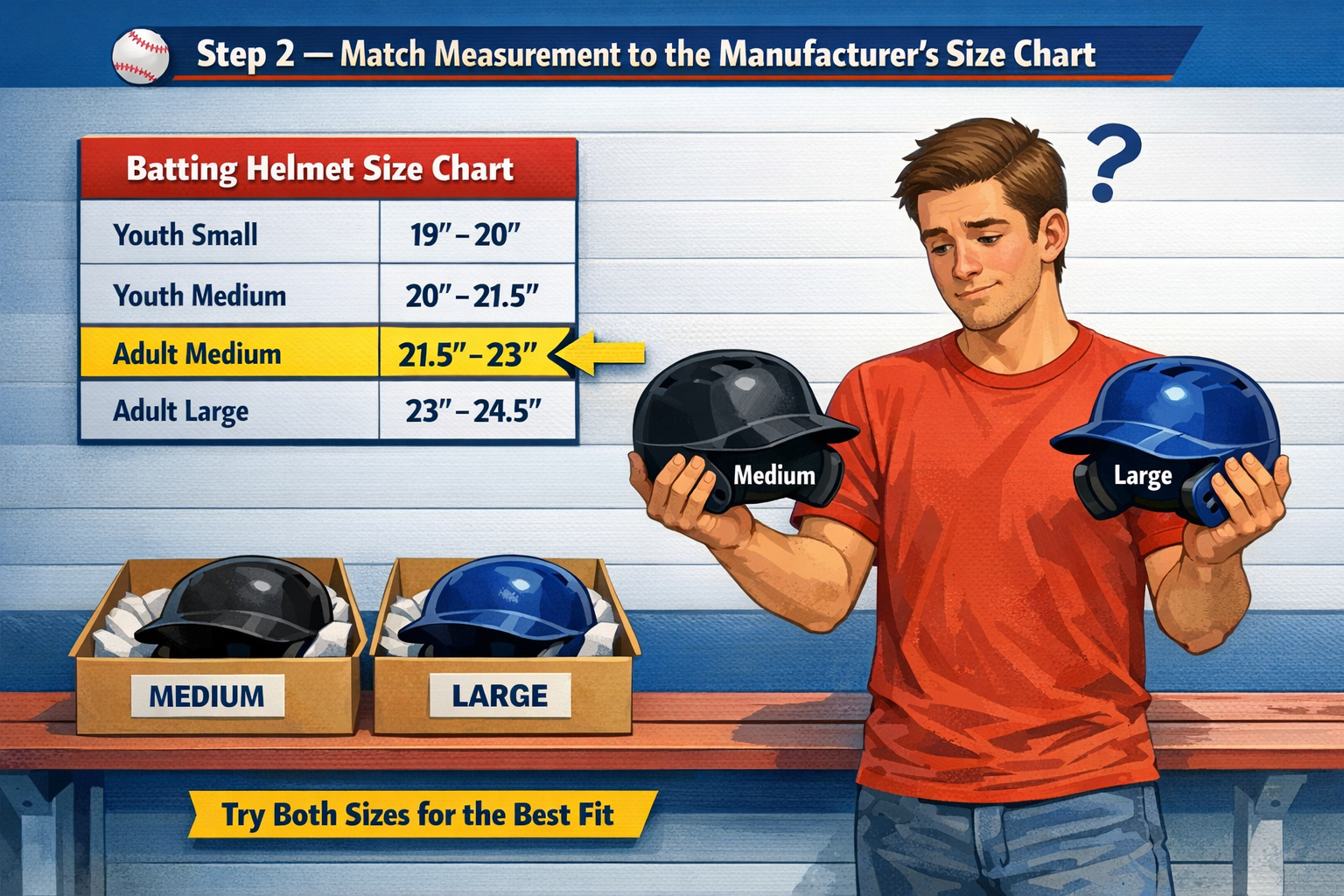
Step 2 — Match Measurement to the Manufacturer's Size Chart
Every helmet manufacturer publishes a size chart that maps head circumference measurements to specific helmet sizes. These charts vary by brand — a Medium from one manufacturer does not necessarily match a Medium from another. Always use the specific size chart for the exact helmet model being purchased rather than assuming size consistency across brands or even across different models from the same brand.
Most batting helmet size charts use three to five size categories — Youth Small, Youth Medium, Youth Large, Adult Small through Adult Extra Large — with circumference ranges that overlap slightly at the boundaries. A measurement that falls in the overlap zone between two sizes warrants trying both sizes to determine which produces the snug-but-comfortable fit that correct sizing requires.
Step 3 — Perform the Fit Test
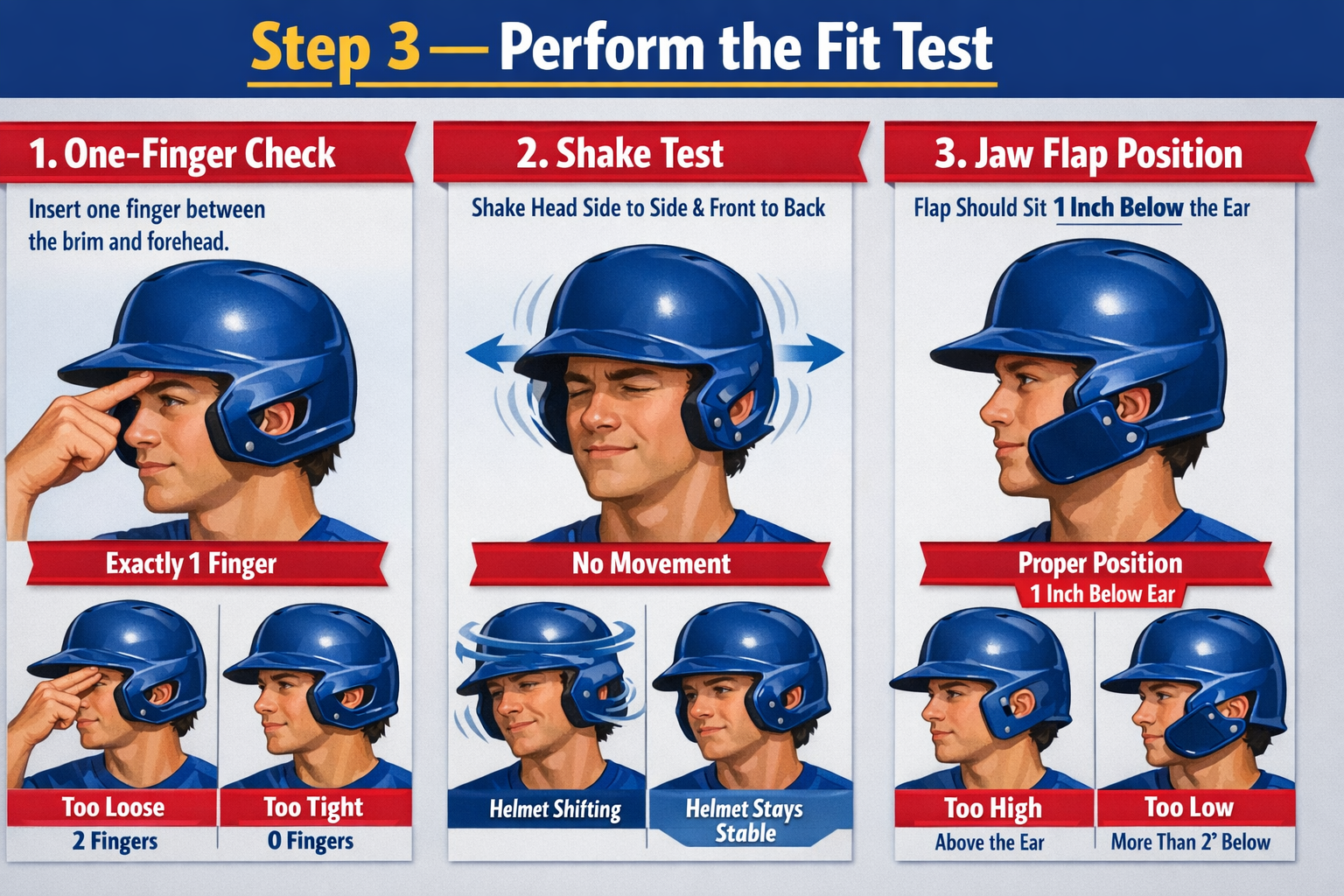
Put the helmet on and perform three simple checks before confirming the fit is correct.
First — the one-finger check. Insert one finger between the brim of the helmet and the forehead. There should be room for exactly one finger — not two fingers and not zero fingers. Two fingers means too large. Zero fingers means too tight.
Second — the shake test. With the helmet correctly positioned on the head, shake the head side to side and front to back. A correctly fitted helmet stays precisely in position with no lateral movement or front-to-back rocking. Any visible shifting indicates the helmet is too large for the head circumference.
Third — the jaw flap position check. The jaw flap on single or dual-flap helmets should sit approximately one inch below the ear on the covered side. If the jaw flap sits above the ear or more than two inches below it the helmet is not properly sized for the player's head dimensions regardless of how the crown fits.
🎯 Putting It Into Practice
The three-step process — measure, match to size chart, perform the fit test — takes less than five minutes and should be repeated at the start of every new season for youth players whose heads are still growing. For players who are also sizing helmets for softball use alongside baseball, 🪖 Best Softball Helmets w/Masks (2026 Guide) and 🪖 Best Slowpitch Softball Helmets (2026) cover the softball-specific helmet options where the same sizing process applies directly. Helmet sizing is identical across baseball and softball formats — the circumference measurement and fit test produce the same result regardless of which sport the helmet is certified for.
❌ Common Helmet Sizing Mistakes
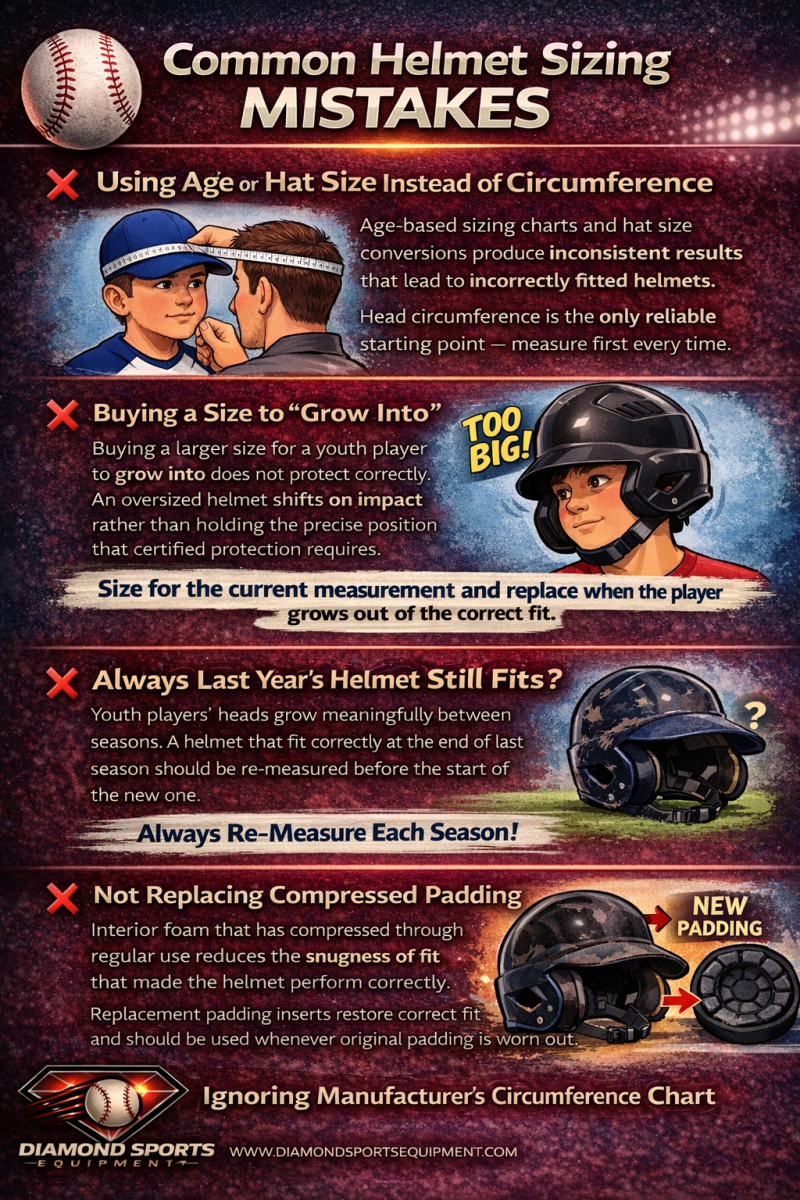
Using age or hat size instead of circumference measurement
Age-based sizing charts and hat size conversions produce inconsistent results that lead to incorrectly fitted helmets. Head circumference is the only reliable starting point — measure first every time.
Buying a larger size for a youth player to grow into
An oversized helmet does not protect correctly — it shifts on impact rather than maintaining the precise position that certified protection requires. Size for the current measurement and replace when the player grows out of the correct fit.
Assuming last year's helmet still fits
Youth players' heads grow meaningfully between seasons. A helmet that fit correctly at the end of last season should be re-measured before the start of the new one — assuming continued correct fit without checking is one of the most common youth equipment errors coaches and parents make.
Not replacing compressed padding
Interior foam that has compressed through regular use reduces the snugness of fit that originally made the helmet perform correctly. Replacement padding inserts restore correct fit and should be used whenever the original padding has compressed to the point where the helmet shifts during the shake test.
Relying on brand size labels instead of circumference charts
Size label consistency does not exist across helmet manufacturers. A Youth Large from Rawlings and a Youth Large from Easton may differ by a full inch in circumference coverage. Always use the specific manufacturer's circumference chart for every helmet purchase.
❓ FAQ
How do I measure my child's head for a baseball helmet?
- Use a flexible measuring tape positioned just above the eyebrows running around the widest point of the head above the ears.
- Record the measurement in inches and match to the specific manufacturer's size chart for the helmet model being purchased.
What does NOCSAE certification mean on a baseball helmet?
- NOCSAE certification means the helmet has passed standardized impact testing that verifies it absorbs and distributes contact force within safe limits.
- All organized baseball leagues require NOCSAE-certified helmets — never use an uncertified helmet regardless of how well it fits.
How tight should a baseball helmet fit?
- Snug enough that it stays in place under the shake test without shifting — but not so tight that it creates pressure point discomfort that encourages the player to remove it.
- The one-finger check between brim and forehead confirms correct fit — exactly one finger of space with the helmet properly positioned.
When should I replace a baseball helmet?
- Replace immediately after any direct impact regardless of visible damage — internal foam compression from impact reduces certified protection even without visible shell cracking.
- Replace when padding has compressed to the point where the helmet passes two fingers between the brim and forehead under the one-finger check.
Can I add extra padding to make a large helmet fit correctly?
- Replacement padding inserts can close small fit gaps — typically up to about a quarter inch of additional circumference coverage.
- Padding cannot correct a helmet that is fundamentally too large — if the shake test shows significant shifting, the helmet needs to be replaced with the correct size rather than padded into approximate fit.
🧢 Final Thoughts
Correctly sizing a baseball helmet is one of the simplest and most impactful equipment decisions in the game — and one of the most frequently shortcut by players and parents who rely on age estimates, last season's helmet, or brand size labels instead of the two-minute measurement process that produces a genuinely correct fit. Measure the circumference, match to the specific manufacturer's chart, perform the three-part fit test, and the helmet becomes the invisible certified protection that every player deserves from the first pitch of the season through the final out of the championship.
For players who are also selecting their glove alongside their helmet this season, check out 🧤 Best Baseball Gloves for Every Player (2026) for the fielding glove options that complete a competitive player's full defensive setup. And for everything else across our baseball and softball coverage, visit 📝 Diamond Sports Equipment Blog & Gear Reviews for our full library of buying guides, product comparisons, and equipment reviews updated all season long.