Softball is not one game — it is two distinctly different competitive formats that share a field shape, a ball size, and a general set of defensive positions while differing in almost every other meaningful way. The pitching mechanics are completely different. The pace of the game is completely different. The equipment requirements are different. The competitive formats and league structures are different. And the athletic demands placed on players — the specific skills that determine who wins and loses at a high level — are different enough that a player who excels in one format does not automatically transfer their performance to the other without meaningful adjustment.
The confusion between fastpitch and slowpitch is one of the most common points of equipment misalignment that parents and new players encounter — purchasing slowpitch equipment for a fastpitch league, selecting the wrong bat certification for the game being played, or showing up to a fastpitch tryout having only experienced the slower arc of recreational slowpitch play. Understanding what actually separates these two games — not just the obvious pitching speed difference but the equipment requirements, competitive culture, and athletic demands that make each format unique — helps players and families make better equipment decisions and better format choices from the start. For players who have already committed to slowpitch and want to build their complete setup, 🥎 Building A Complete Slowpitch Softball Kit covers every slowpitch equipment decision in the right order. And for players who want to understand the specific protective requirements of slowpitch play, 😷 Best Slowpitch Softball Fielding Masks covers the fielding protection that pitchers and infielders should consider in the slowpitch format.
🥎 What You Should Know About the Two Formats

⚡ Pitching Speed Is the Most Obvious Difference — But Not the Most Important One
Fastpitch pitchers deliver the ball underhand at speeds ranging from 40 miles per hour at the youth level to 70 miles per hour at the elite collegiate level. Slowpitch pitchers deliver a consistent arc that peaks between 6 and 12 feet above the plate before descending into the hitting zone. The speed difference is real — but the format differences in equipment, rules, and competitive structure are equally significant for players choosing between the two games.
🎯 Fastpitch Is Pitching and Defense Dominated
Fastpitch softball at competitive levels is a pitching-dominated game where the quality of the pitcher determines outcomes more than any other single factor. Dominant fastpitch pitching generates strikeouts, weak contact, and defensive plays at a rate that makes pitching development the highest-priority athletic investment for serious fastpitch programs.
🏆 Slowpitch Is Offense and Depth Dominated
Slowpitch softball at competitive levels is an offense-dominated game where hitting ability, lineup depth, and defensive consistency determine outcomes rather than pitching dominance. The consistent, predictable arc of slowpitch pitching means every hitter gets a fair opportunity to drive the ball — making hitting quality and defensive execution the primary competitive differentiators.
📋 Equipment Certification Requirements Differ Between Formats
Fastpitch bats carry USA/ASA or USA+USSSA certification. Slowpitch bats carry USSSA, USA, NSA, or ISA certification depending on the specific league format. These certifications are not interchangeable — using the wrong certified bat creates violations regardless of how well the bat performs athletically.
🥎 The Key Differences Explained
Pitching
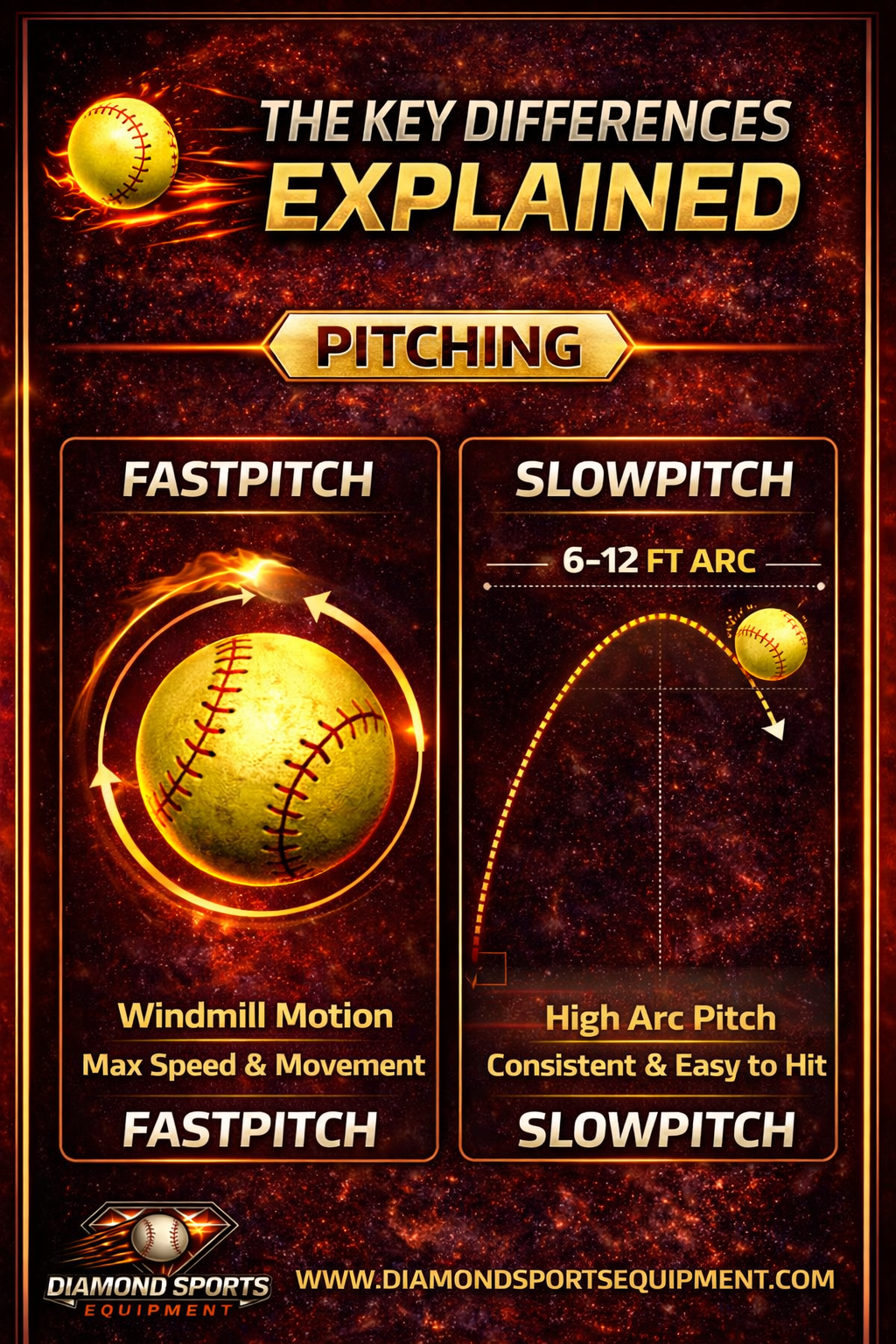
Fastpitch pitching uses a windmill delivery — the pitcher's arm rotates in a full circle before releasing the ball underhand at the hip. This delivery generates velocity, movement, and spin that creates the same competitive challenge for hitters that baseball pitching does. Rise balls, drop balls, change-ups, and curveballs are all part of the fastpitch pitcher's arsenal — and reading pitch movement in fractions of a second is the primary offensive challenge that fastpitch hitters develop through years of competitive at-bats.
Slowpitch pitching uses a simple underhand toss that must arc between 6 and 12 feet above the plate — creating a consistent, predictable delivery that gives every hitter adequate time to prepare their swing. There is no movement, no spin, and no velocity variation in legal slowpitch pitching. The pitch is designed to be hit — and the competitive challenge of slowpitch shifts entirely from the pitcher-hitter confrontation to the quality of contact and defensive execution that follows.
The Ball
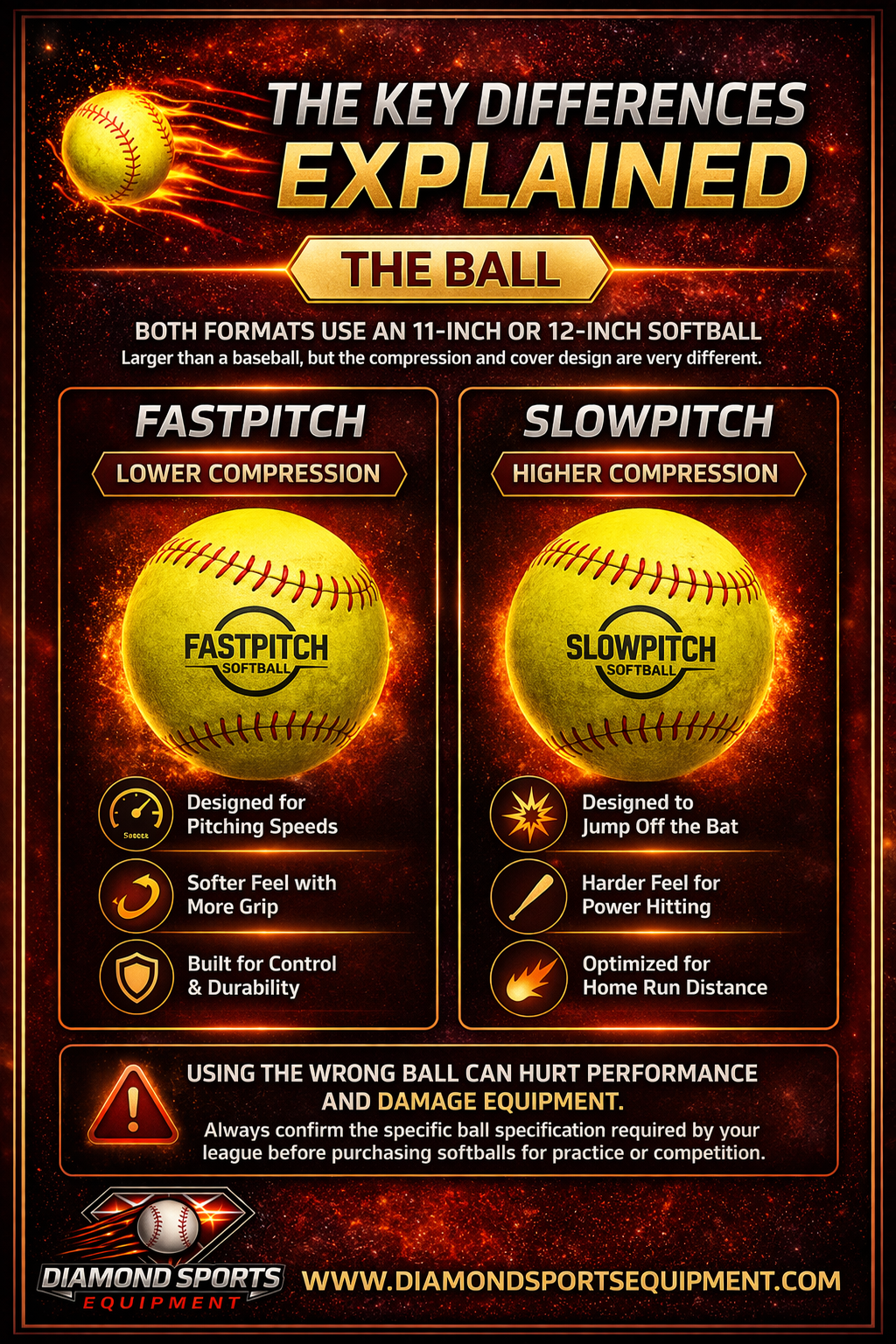
Both fastpitch and slowpitch use an 11-inch or 12-inch softball — larger than a baseball in both cases. However the compression and cover characteristics of fastpitch and slowpitch softballs differ significantly. Slowpitch softballs use higher compression specifications that are designed to jump off a composite bat barrel on contact — generating the home run distances that competitive slowpitch offense celebrates. Fastpitch softballs use lower compression specifications appropriate for the pitching speeds and contact velocities of competitive fastpitch play.
Using a slowpitch ball in a fastpitch game or vice versa creates both performance problems and potential equipment damage — always confirm the specific ball specification required by your league before purchasing softballs for practice or competition.
The Glove
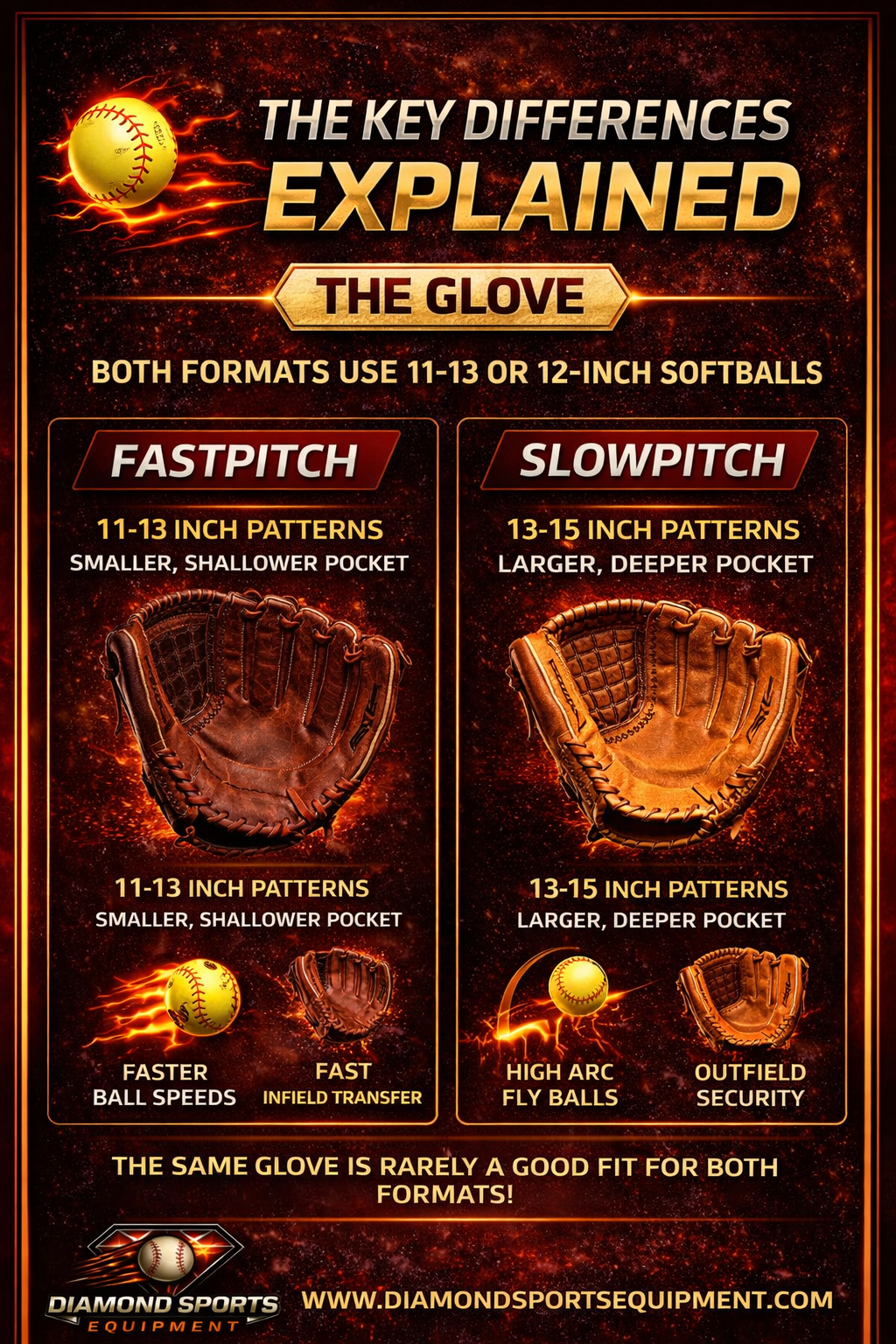
Fastpitch gloves use 11 to 13-inch patterns with position-specific pocket depths calibrated for the faster ball speeds and transfer demands of competitive fastpitch defense. Infield gloves prioritize fast transfers. Outfield gloves prioritize deep pocket security. The ball arrives faster in fastpitch — and glove construction reflects the quicker reaction time demands that faster ball speeds create.
Slowpitch gloves use 13 to 15-inch patterns with deeper pockets appropriate for the larger ball and higher arc fly ball trajectory of slowpitch defense. The same glove used for fastpitch infield defense is typically too small and too shallow for slowpitch outfield use — and players who compete in both formats benefit from format-specific gloves for each game.
The Bat
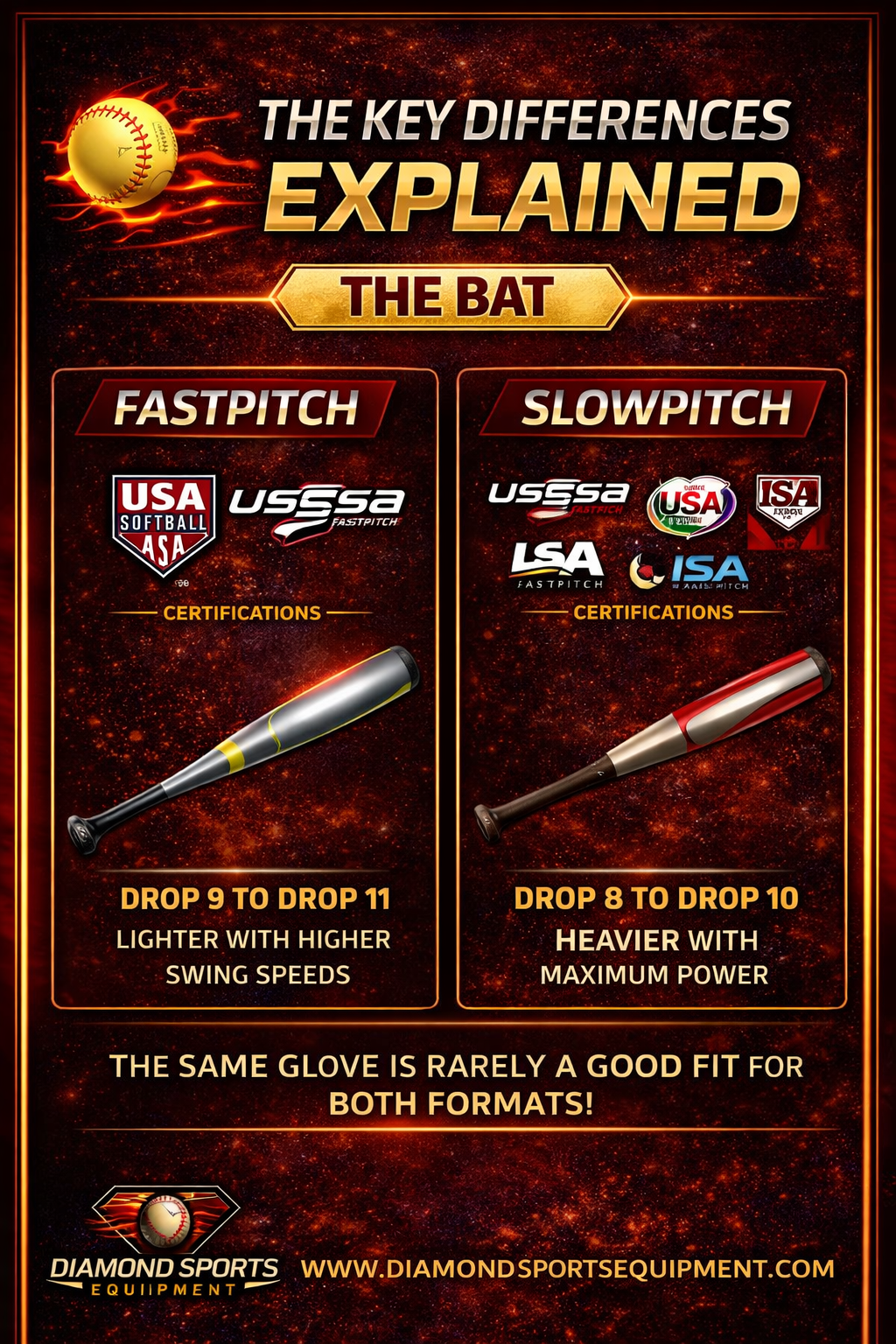
Fastpitch bat certifications — USA/ASA and USSSA fastpitch — are built around the lower compression fastpitch ball and the faster pitch speeds of the windmill delivery. Fastpitch bats typically use lighter drop weights — drop 9, drop 10, drop 11 — that allow female players to generate swing speed through the faster pitch timing that fastpitch hitting demands.
Slowpitch bat certifications — USSSA slowpitch, USA slowpitch, NSA, and ISA — are built around the higher compression slowpitch ball and the consistent arc pitch that gives hitters time to generate maximum power. Slowpitch bats typically use heavier construction — drop 8 to drop 10 in most formats — that allows power hitters to add swing weight for maximum exit velocity on the predictable arc they have time to load against.
🎯 Putting It Into Practice
The format choice between fastpitch and slowpitch comes down to three practical questions — what competitive structure the player wants to participate in, what athletic skills they want to develop, and what equipment investment they are prepared to make for the specific format. Fastpitch demands pitching development, reaction time training, and equipment calibrated for speed. Slowpitch rewards hitting power, defensive consistency, and equipment calibrated for the larger ball and higher arc demands of the format. For players who have committed to fastpitch and want to understand the specific helmet requirements of the format, 🪖 Best Fastpitch Softball Helmets (2026) covers the certified helmet options with face mask coverage that most competitive fastpitch leagues require. And for players building their complete slowpitch offensive setup, 🧤 Slowpitch Batting Gloves for 2026 covers the grip and hand protection options that serious slowpitch hitters invest in for tournament play.
❌ Common Format Confusion Mistakes
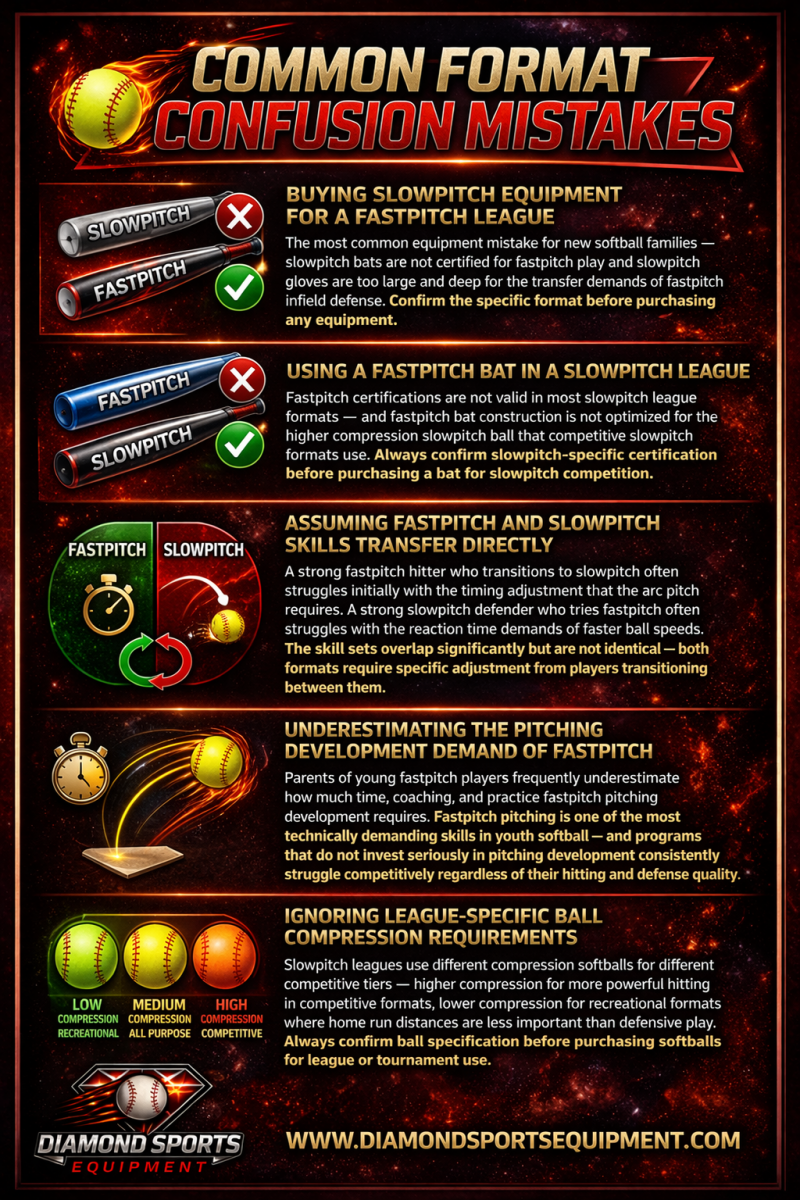
Buying slowpitch equipment for a fastpitch league
The most common equipment mistake for new softball families — slowpitch bats are not certified for fastpitch play and slowpitch gloves are too large and deep for the transfer demands of fastpitch infield defense. Confirm the specific format before purchasing any equipment.
Using a fastpitch bat in a slowpitch league
Fastpitch certifications are not valid in most slowpitch league formats — and fastpitch bat construction is not optimized for the higher compression slowpitch ball that competitive slowpitch formats use. Always confirm slowpitch-specific certification before purchasing a bat for slowpitch competition.
Assuming fastpitch and slowpitch skills transfer directly
A strong fastpitch hitter who transitions to slowpitch often struggles initially with the timing adjustment that the arc pitch requires. A strong slowpitch defender who tries fastpitch often struggles with the reaction time demands of faster ball speeds. The skill sets overlap significantly but are not identical — both formats require specific adjustment from players transitioning between them.
Underestimating the pitching development demand of fastpitch
Parents of young fastpitch players frequently underestimate how much time, coaching, and practice fastpitch pitching development requires. Fastpitch pitching is one of the most technically demanding skills in youth softball — and programs that do not invest seriously in pitching development consistently struggle competitively regardless of their hitting and defense quality.
Ignoring league-specific ball compression requirements
Slowpitch leagues use different compression softballs for different competitive tiers — higher compression for more powerful hitting in competitive formats, lower compression for recreational formats where home run distances are less important than defensive play. Always confirm ball specification before purchasing softballs for league or tournament use.
❓ FAQ
Which is harder — fastpitch or slowpitch softball?
- Fastpitch is athletically more demanding — the pitching speed, reaction time requirements, and pitching development investment make it the more technically challenging format.
- Slowpitch is more accessible for recreational adult players who want competitive play without the pitching development demands of fastpitch formats.
Can I use the same glove for both fastpitch and slowpitch?
- Not ideally — fastpitch infield gloves are too small and shallow for slowpitch outfield use, and slowpitch gloves are too large and deep for fastpitch infield transfer demands.
- A 13-inch moderate pocket design serves as a reasonable compromise for players who compete in both formats without dedicated format-specific gloves.
What age do players typically start fastpitch?
- Most organized fastpitch programs start at age 8 to 10 with machine or coach pitch formats before transitioning to windmill pitching around age 10 to 12.
- Slowpitch is more commonly an adult recreational format — though youth slowpitch programs exist in some recreational league structures.
Are the rules the same in fastpitch and slowpitch?
- Most basic rules are the same — three strikes, three outs, four balls, standard base running and fielding rules apply in both formats.
- Key differences include pitching delivery rules, arc height requirements in slowpitch, stealing base rules which differ significantly between formats, and extra player and co-ed roster rules that slowpitch formats commonly use.
What is the biggest equipment difference between the two formats?
- The bat certification is the most critical equipment difference — fastpitch and slowpitch certifications are not interchangeable and using the wrong certification creates automatic violations.
- Glove size is the second most important difference — the larger patterns and deeper pockets of slowpitch gloves do not serve fastpitch defensive demands, and fastpitch gloves are too small for slowpitch outfield use.
🧢 Final Thoughts
Fastpitch and slowpitch are two distinct games that reward different athletic skills, demand different equipment investments, and create different competitive experiences for players at every level. Understanding the key differences — pitching mechanics, ball compression, equipment certification, and competitive format — before making equipment purchases prevents the costly mismatches that send players into competition with gear that was built for the wrong game. Whether you choose fastpitch for its pitching-dominated competitive challenge or slowpitch for its offense-first recreational format, the right equipment decision starts with knowing exactly which game you are actually playing.
For players who want to complete their full protective setup for either format, check out 🛡️ Elbow Guards for Every Hitter (2026) for the arm protection options that serve competitive hitters across both softball formats. And for everything else across our baseball and softball coverage, visit 📝 Diamond Sports Equipment Blog & Gear Reviews for our full library of buying guides, product comparisons, and equipment reviews updated all season long.
Add comment
Comments