Slowpitch softball is one of the most accessible and enjoyable competitive sports available for adult recreational players — and one of the most frequently approached with mismatched equipment that limits performance without the player ever identifying the gear as the source of the problem. A player swinging a bat with the wrong certification for their league, fielding with a baseball glove that pops the bigger softball on aggressive catches, wearing cleats that have accumulated enough fatigue by the fifth inning to affect their movement confidence, and protecting their head with a helmet that fits loosely enough to shift on contact is not experiencing the game that proper equipment enables. Every one of those problems is solved by one intentional equipment decision made correctly at the right stage of the kit-building process.
This guide walks through every piece of a complete slowpitch softball kit in the order that decisions should be made — starting with the highest-impact offensive investment and working through every defensive and protective piece that completes a player's full setup. The goal is not to spend the maximum possible on every category but to make the right decision in each one so the complete kit serves the player's specific league format, playing schedule, and competition level without any single piece working against the others. For players who want to go deeper on the bat selection decision specifically, 🥎 How to Choose a Slowpitch Bat covers certification, construction, and weight distribution in full detail. And for players who want the complete glove selection breakdown alongside this kit guide, 🧤 How to Choose a Slowpitch Glove covers every glove decision from size through leather quality in the correct order.
🥎 What You Should Know Before Building Your Kit
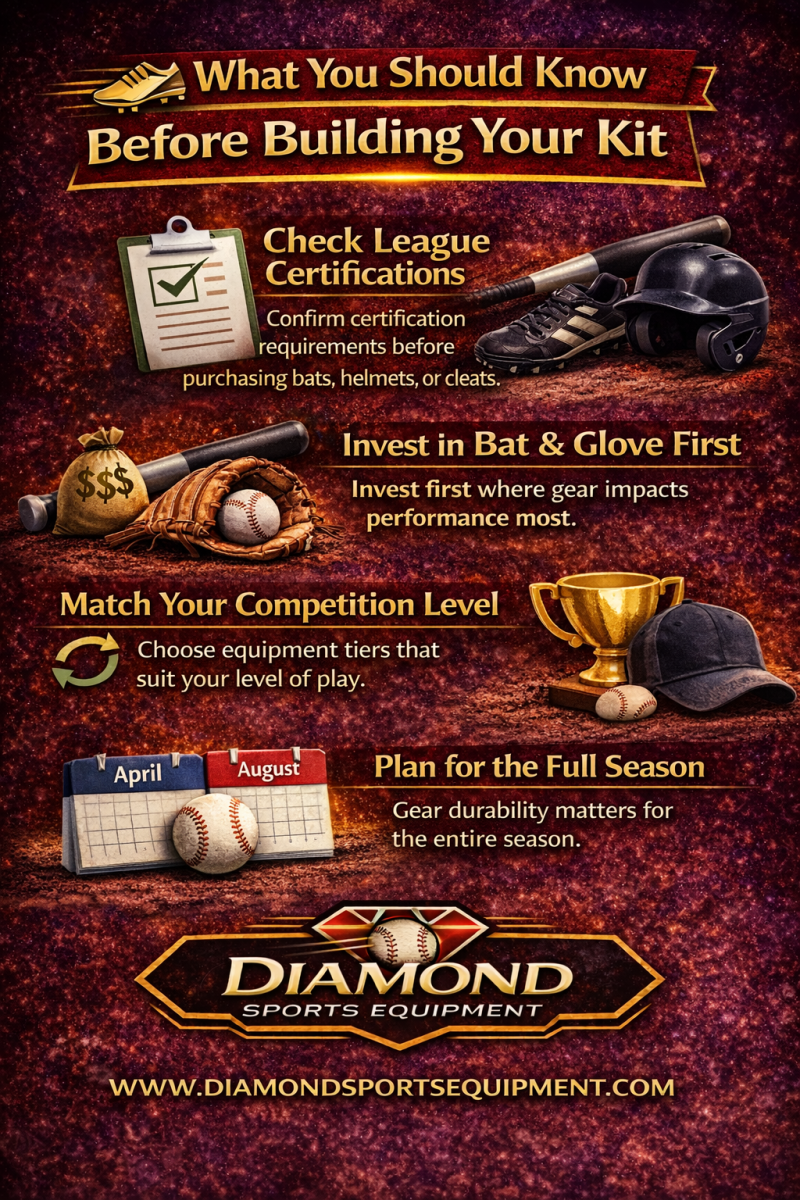
📋 League Certification Determines Every Equipment Decision
Before purchasing any piece of equipment confirm your league's specific certification requirements for bats, helmets, and cleats. Using non-certified equipment creates violations that force mid-season replacements — always confirm first and purchase second.
💰 Prioritize Investment Where It Affects Performance Most
The bat and glove are the two pieces of equipment that most directly affect on-field performance — invest here first and work outward to supporting equipment. Cleats, helmets, and accessories complement a strong bat and glove investment rather than compensating for weak ones.
🔄 Build for Your Competition Level Not Your Aspirations
Recreational once-a-week players do not need the same construction tier as competitive tournament players who compete multiple days per week. Match every equipment decision to actual usage frequency and competition level to avoid overspending on performance features the player cannot fully utilize.
📅 Plan for the Full Season Not Just Opening Day
Equipment that performs well in April needs to hold up through August tournament finals. Durability through extended use should be part of every construction tier decision — especially for cleats and gloves that accumulate the most physical stress through a full competitive season.
🥎 How to Build Your Complete Slowpitch Kit
Piece 1 — The Bat
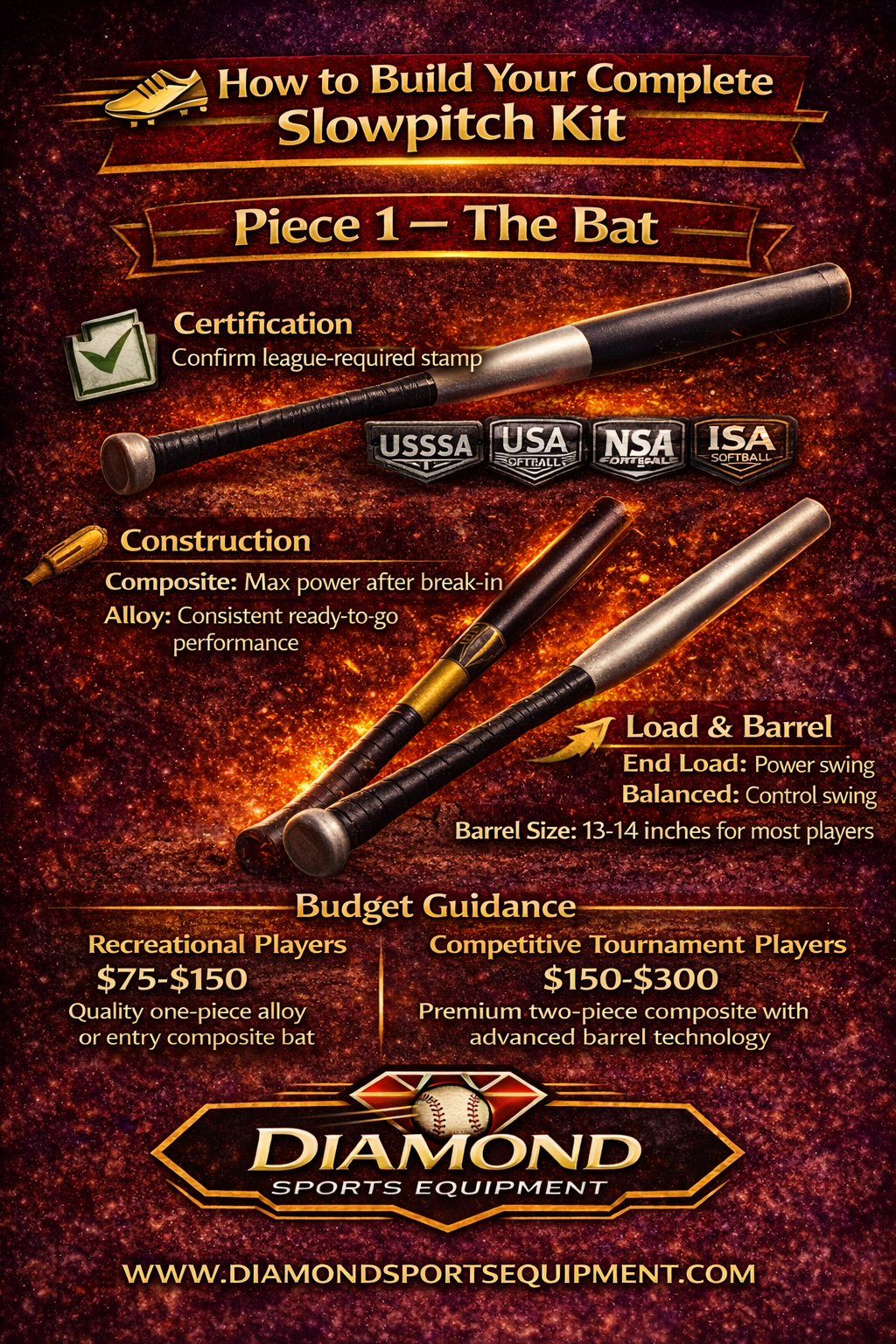
The bat is the highest-impact investment in a slowpitch kit and the decision that most directly determines offensive performance. Start with certification — confirm the exact stamp your league requires before evaluating any other bat feature. Then choose construction — two-piece composite for maximum pop after break-in or one-piece alloy for immediate consistent performance. Then decide between end load and balanced based on your swing strength and hitting philosophy. Then confirm barrel size — 13 to 14 inches for most players with 14-inch barrels providing more forgiveness on off-center contact.
Budget guidance: Recreational players — $75 to $150 for a quality one-piece alloy or entry composite. Competitive tournament players — $150 to $300 for a premium two-piece composite with advanced barrel technology.
Piece 2 — The Glove
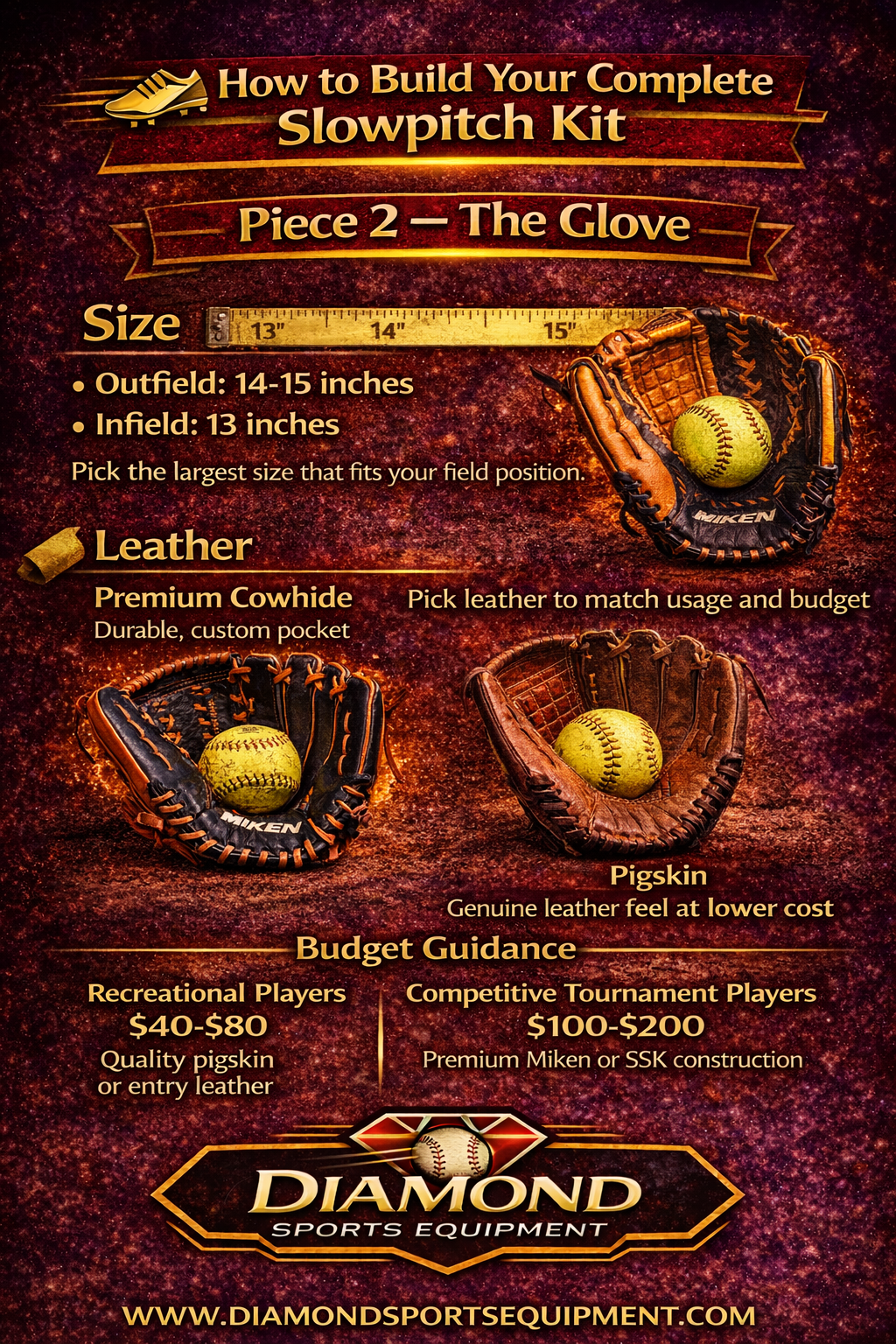
The glove is the highest-impact defensive investment and the decision most frequently made incorrectly by slowpitch players who default to a baseball or fastpitch glove that fits their hand without serving the larger softball. Size first — 13 to 15 inches depending on position. Outfielders need 14 to 15 inches for maximum fly ball coverage. Infielders can use 13-inch designs. Then choose leather — premium cowhide for serious tournament players who want a pocket that develops and holds through multiple seasons, pigskin for recreational players who want genuine leather feel at accessible price points.
Budget guidance: Recreational players — $40 to $80 for quality pigskin or entry leather. Competitive tournament players — $100 to $200 for premium Miken or SSK construction that develops a deep personalized pocket through a full season.
Piece 3 — The Cleats
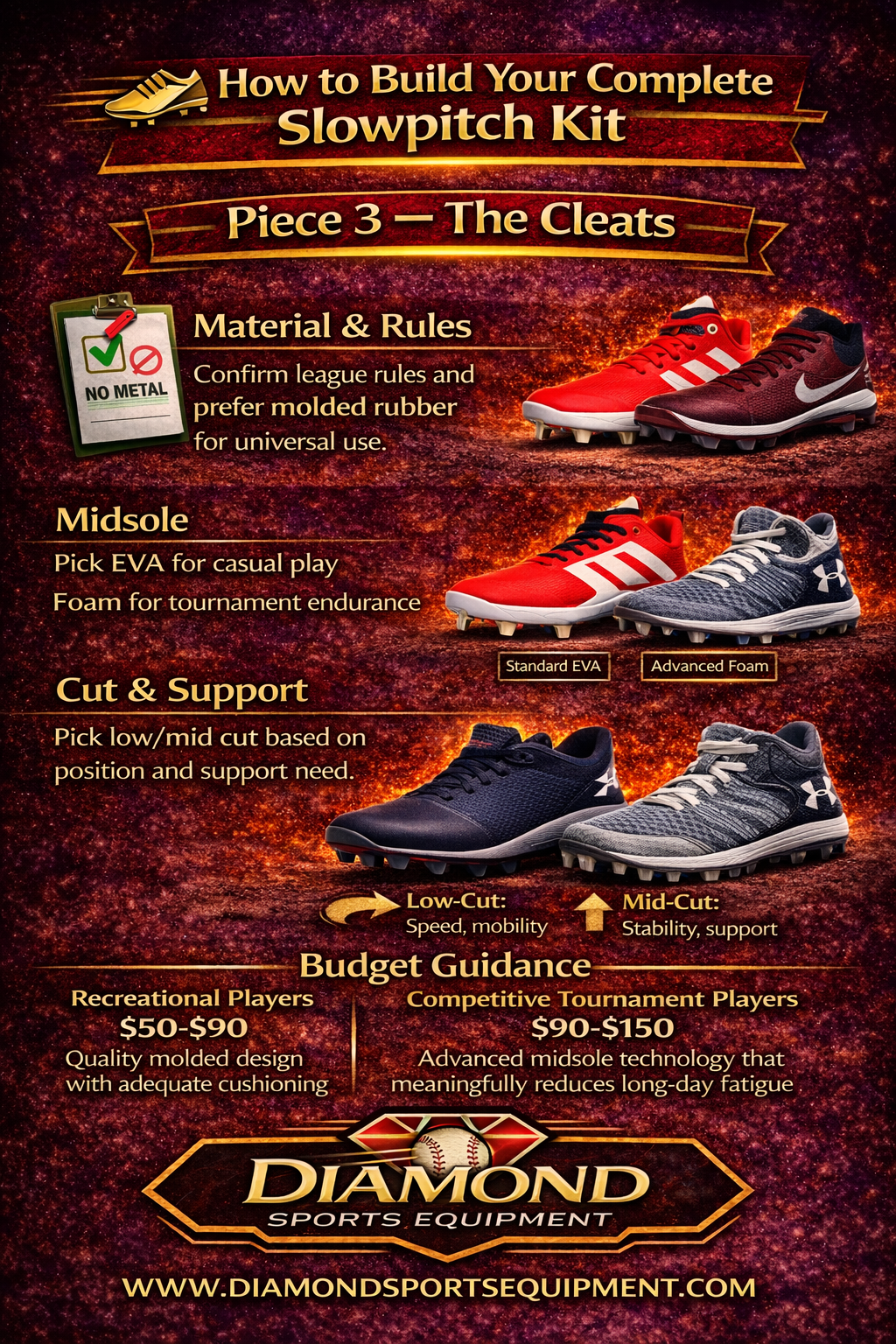
Cleat selection for slowpitch starts with league rules — most recreational formats prohibit or discourage metal, making molded rubber or TPU the practical universal choice. Then choose midsole technology based on competition frequency — standard EVA for occasional recreational play, advanced Fresh Foam or similar compounds for players who compete in multi-game tournament days where fatigue accumulation affects late-round performance. Then decide between low-cut and mid-cut based on position and ankle support preferences.
Budget guidance: Recreational players — $50 to $90 for quality molded design with adequate cushioning. Competitive tournament players — $90 to $150 for advanced midsole technology that meaningfully reduces long-day fatigue.
🎯 Putting It Into Practice
The three core pieces — bat, glove, and cleats — form the foundation of every slowpitch kit. Get those three right and every other equipment decision is a refinement rather than a foundation correction. For players who want to shop specific glove options after working through this guide, 🧤 Slowpitch Softball Gloves for 2026 covers the strongest options across every construction tier. And for players finalizing their cleat selection alongside their complete kit, 👟 Best Slowpitch Softball Cleats (2026) covers the molded and TPU options that serve the specific long-day demands of competitive slowpitch play.
✅ Completing the Kit — Helmet and Accessories
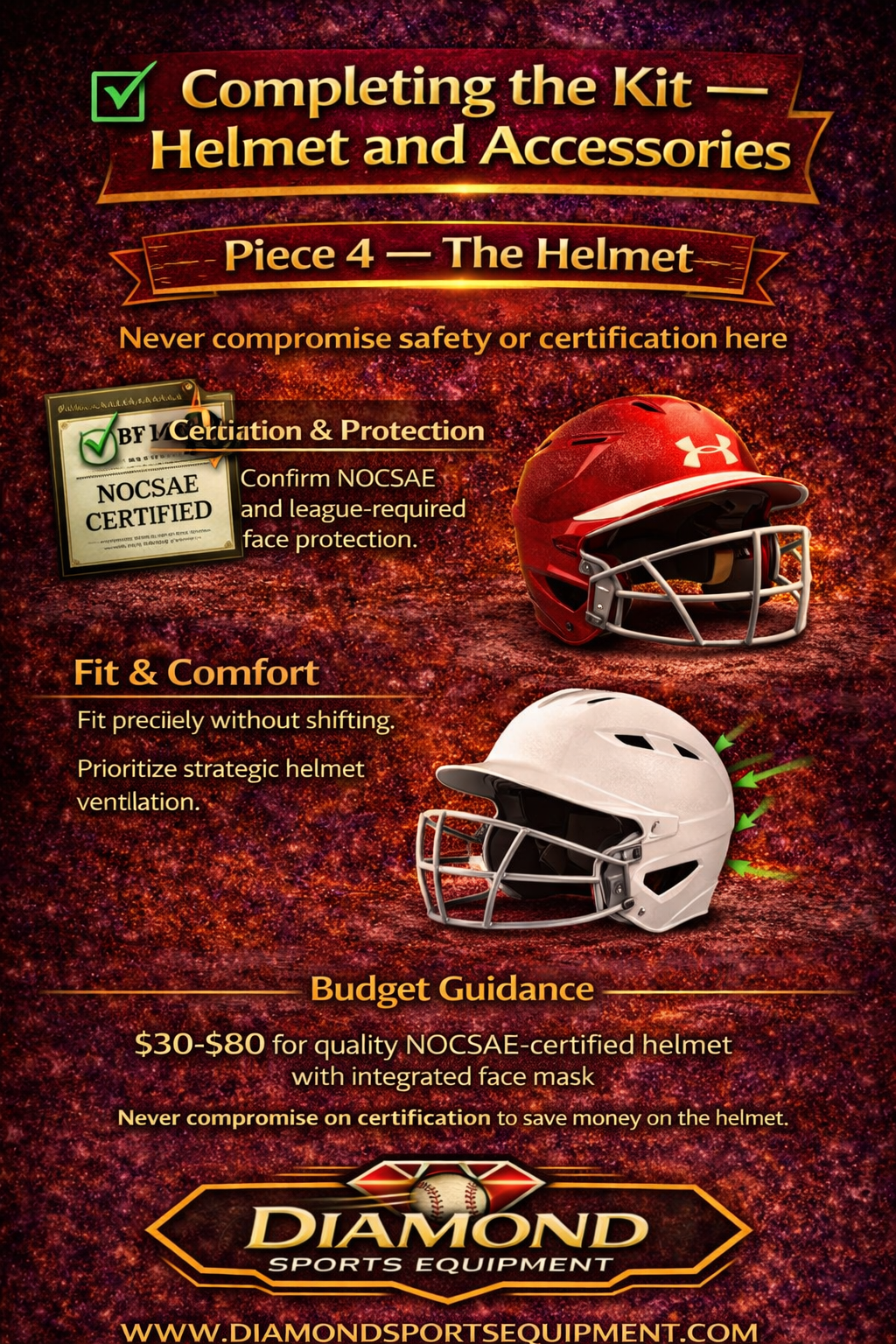
Piece 4 — The Helmet
The helmet is the most important safety investment in any softball kit — and the one piece where the minimum acceptable standard should always be exceeded rather than met precisely. Confirm NOCSAE certification, then confirm your league's face mask requirements — many slowpitch leagues now recommend or require face mask coverage that base helmet designs do not include. Fit precisely — a correctly fitted helmet stays in place through the full swing without shifting. Ventilation matters for long summer tournament days — helmets with strategic vent placement reduce heat accumulation that affects concentration in later rounds.
Budget guidance: Any level — $30 to $80 for a quality NOCSAE-certified helmet with integrated face mask. Never compromise on certification to save money on the helmet.
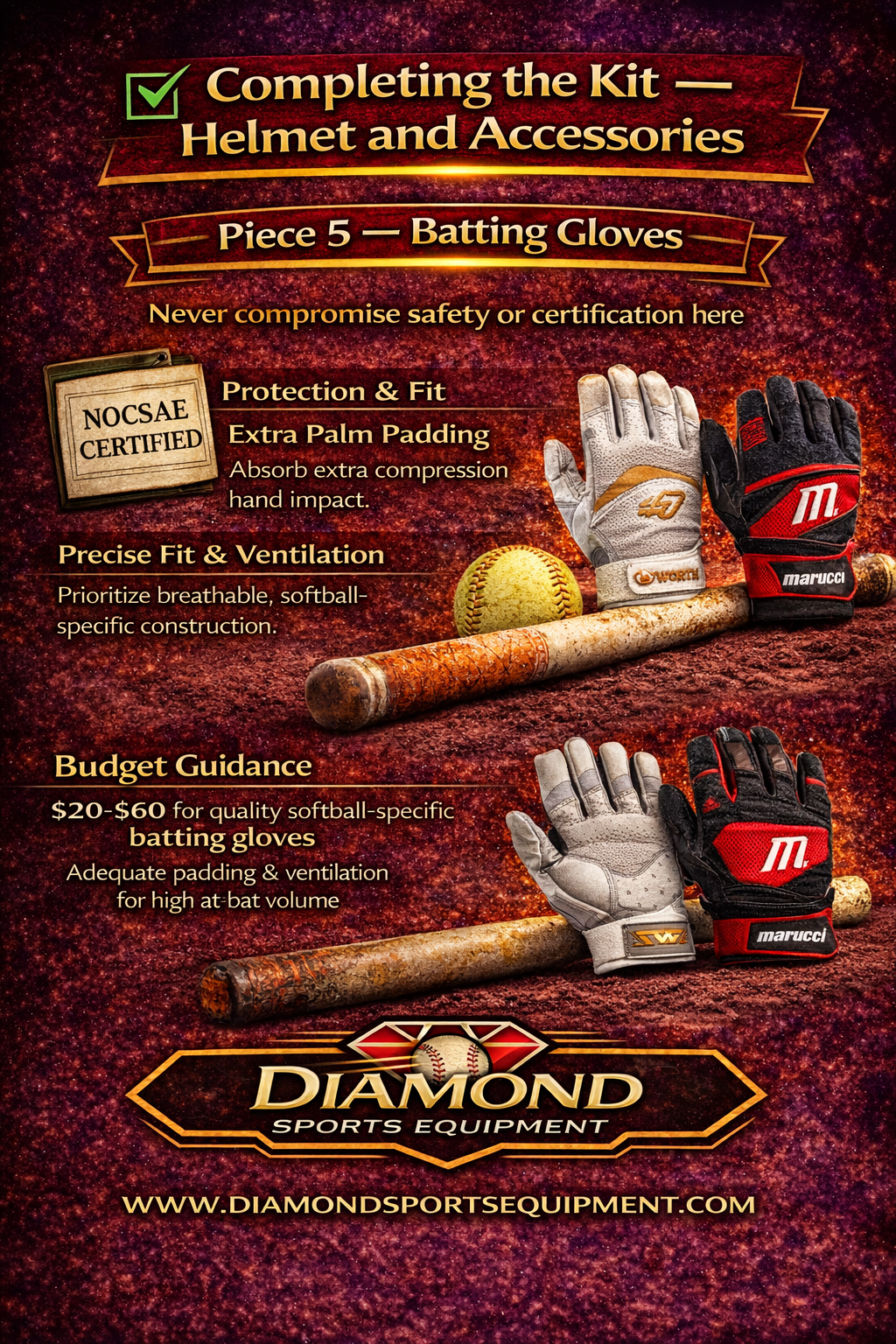
Piece 5 — Batting Gloves
Batting gloves are the most overlooked performance accessory in slowpitch and one of the most impactful for players who take high at-bat volumes through tournament days. Slowpitch-specific designs with extra palm padding absorb the higher compression ball impact that accumulates as hand sting and blister development through long competitive days. Fit precisely — excess material in the palm or finger stalls reduces grip sensitivity and bat control. Breathable back-of-hand construction reduces heat buildup between at-bats during warm summer tournament play.
Budget guidance: Any level — $20 to $60 for quality softball-specific batting gloves with adequate palm padding and breathable construction.
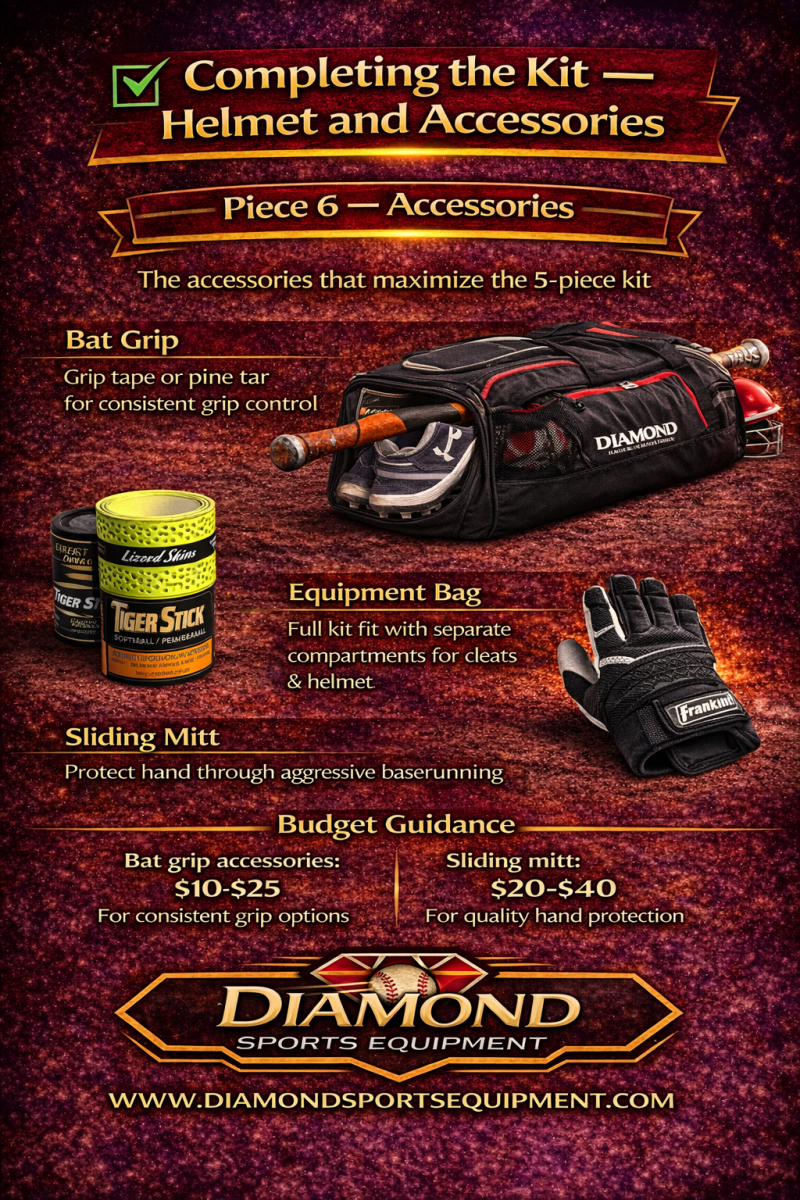
Piece 6 — Accessories
The final layer of a complete slowpitch kit covers the accessories that support the five core pieces — bat grip tape or pine tar for consistent grip in varying weather conditions, a quality equipment bag that fits the full kit comfortably with separate compartments for cleats and helmet, and a sliding mitt for players who run the bases aggressively and want hand protection on slides that metal or aluminum bases can catch unexpectedly.
Budget guidance: Bat grip accessories — $10 to $25. Equipment bag — already covered in the bags series. Sliding mitt — $20 to $40 for quality hand protection on aggressive baserunning.
❌ Common Slowpitch Kit Building Mistakes
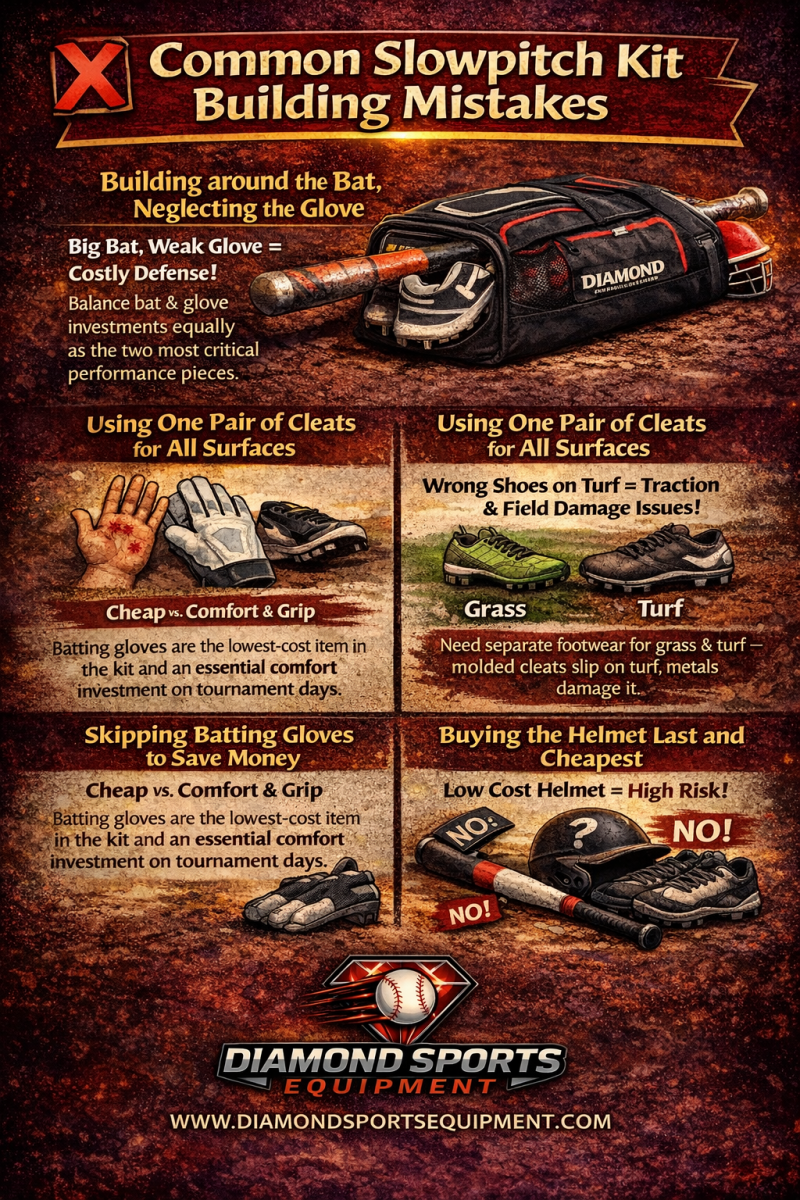
Building around the bat and neglecting the glove
A premium bat paired with a baseball glove that pops the softball creates defensive limitations that cost more runs than the offensive bat investment recovers. The bat and glove should receive equal investment attention as the two highest-impact performance pieces in the kit.
Using one pair of cleats for all surfaces
Players who compete on both natural grass and artificial turf fields need surface-appropriate footwear for each. Wearing molded cleats designed for grass on turf creates traction limitations — and wearing metal on turf creates both traction problems and potential field damage violations.
Skipping batting gloves to save money
Batting gloves are the lowest-cost item in the full kit and one of the highest-impact comfort investments for players who take 20 or more at-bats across a tournament day. The blister and hand sting prevention alone is worth the investment at any competition level.
Buying the helmet last and cheapest
The helmet is the safety-critical piece of the kit — every other investment becomes secondary to certified head protection. Never treat helmet selection as the place to recover budget spent elsewhere in the kit.
Not confirming certification before any purchase
League certification requirements affect bat, helmet, and cleat selections simultaneously. Confirming all three requirements before beginning the kit-building process prevents the mid-season replacements that non-compliant equipment forces.
❓ FAQ
How much does a complete slowpitch softball kit cost?
- A recreational kit with quality equipment across all six pieces typically runs $250 to $500 depending on construction tiers chosen.
- A competitive tournament kit with premium bat, leather glove, and advanced midsole cleats typically runs $500 to $900 for the complete setup.
What is the most important piece of equipment to invest in first?
- The bat — it directly determines offensive performance and the certification requirement makes it the first decision that defines every subsequent purchase.
- The glove is a close second — defensive limitations from the wrong glove show up on every routine play throughout the season.
Can I use equipment from previous baseball seasons for slowpitch?
- Cleats and batting gloves from baseball are generally usable in slowpitch with adequate performance.
- Gloves and bats from baseball typically do not serve slowpitch well — the glove is too small and the bat certification may not be valid for your slowpitch league.
How often should I replace slowpitch equipment?
- Bats last two to three seasons for composite and longer for alloy with proper care. Gloves last multiple seasons with proper conditioning. Cleats typically need replacement every one to two seasons depending on usage frequency.
- Replace any helmet that has taken a direct impact regardless of visible damage.
Do I need different equipment for different slowpitch leagues?
- Potentially yes — different leagues use different certification standards for bats. Confirm each league's specific bat certification before competing in any new format.
- Cleats and helmets typically meet requirements across most slowpitch formats with standard NOCSAE certification and molded construction.
🧢 Final Thoughts
Building a complete slowpitch softball kit is a six-piece investment made in the right order — bat and glove first as the highest-impact performance pieces, cleats and helmet as the foundation of confident movement and certified safety, and batting gloves and accessories as the refinements that complete a setup built to perform from the first at-bat of the season through the final out of the championship. Every piece in the kit serves a specific purpose — and every piece chosen correctly makes every other piece more effective by eliminating the equipment limitations that undermine performance when the kit is built incorrectly.
For players who want to complete their helmet selection alongside this kit guide, check out 🪖 Best Slowpitch Softball Helmets (2026) for the certified options that complete a slowpitch player's full protective setup. And for everything else across our baseball and softball coverage, visit 📝 Diamond Sports Equipment Blog & Gear Reviews for our full library of buying guides, product comparisons, and equipment reviews updated all season long.