Fastpitch softball bat selection is one of the most consequential equipment decisions a player or parent makes — and one of the most frequently made incorrectly for the same reasons that baseball bat selection goes wrong. The wrong certification creates automatic violations. The wrong drop weight creates swing speed loss that undermines the offensive performance the bat was purchased to improve. The wrong material either limits the performance ceiling or creates break-in demands that prevent the bat from reaching that ceiling before the season is half over. And the wrong length creates the mechanical compensations that coaches spend entire seasons correcting without ever identifying the equipment as the root cause.
Fastpitch bat selection has an additional layer of complexity that baseball bat selection does not — the drop weight range that competitive fastpitch formats use is significantly lighter than baseball equivalents, the specific certification landscape has evolved in ways that create confusion between USA, ASA, and USSSA stamps, and the windmill pitching delivery that fastpitch hitters face demands specific swing timing adjustments that affect which bat weight and length combination serves each hitter most effectively. Getting all of these decisions right requires working through them in the correct order — certification first, then length and drop weight, then material, then barrel size, then brand within the correctly specified configuration. For players who want to compare the baseball bat selection process alongside this fastpitch guide, 🦇 How to Choose a Baseball Bat covers the baseball-specific certification and construction decisions that apply similar principles to a different format. And for players who want to understand how the fastpitch game's unique demands differ from slowpitch before making their bat selection, 🥎 Fastpitch vs Slowpitch: What's the Difference? covers every key format difference that affects equipment decisions.
🥎 What You Should Know Before Choosing a Fastpitch Bat

📋 USA/ASA and USSSA Are Not the Same Certification
USA/ASA certification is the standard for most recreational and competitive fastpitch leagues including high school and collegiate play. USSSA fastpitch certification serves specific tournament formats that permit higher performance specifications. These certifications are not interchangeable — always confirm the exact stamp your specific league requires before evaluating any bat feature.
⚖️ Fastpitch Drop Weights Run Lighter Than Baseball
Fastpitch bats typically range from drop 8 to drop 13 — significantly lighter than the drop 3 BBCOR requirement for high school baseball. The lighter drop weights reflect the different swing timing demands of windmill pitching and the different strength profiles of female fastpitch players at various competitive levels.
🪵 Composite Performance Ceiling Requires Break-In
Premium fastpitch composite bats reach their performance ceiling after 150 to 200 intentional break-in hits — not before. A composite bat used in competition before completing break-in never shows what it is actually capable of. Players who purchase composite bats close to the season start need to complete break-in before the first competitive at-bat.
🌡️ Temperature Affects Composite Bat Safety
Never use a composite fastpitch bat in temperatures below 60°F — cold composite fibers become brittle and can crack permanently on contact. This is the most commonly ignored equipment rule in youth fastpitch and the most expensive mistake to make with a premium composite investment.
🥎 How to Choose the Right Fastpitch Bat
Step 1 — Confirm League Certification
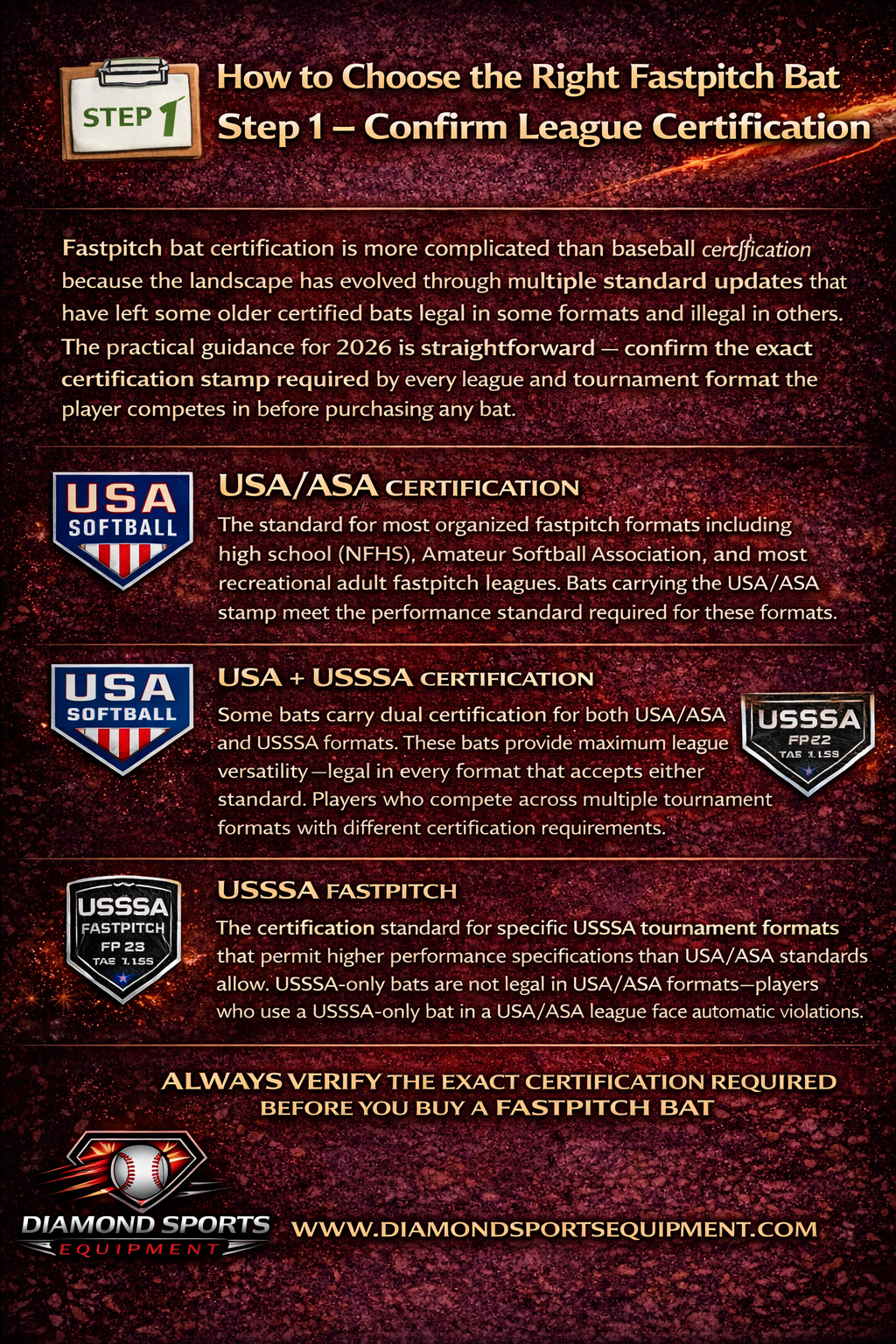
Fastpitch bat certification is more complicated than baseball certification because the landscape has evolved through multiple standard updates that have left some older certified bats legal in some formats and illegal in others. The practical guidance for 2026 is straightforward — confirm the exact certification stamp required by every league and tournament format the player competes in before purchasing any bat.
USA/ASA certification — the standard for most organized fastpitch formats including high school (NFHS), Amateur Softball Association, and most recreational adult fastpitch leagues. Bats carrying the USA/ASA stamp meet the performance standard required for these formats. This is the most broadly applicable fastpitch certification for players who compete across multiple league formats.
USA + USSSA certification — some bats carry dual certification for both USA/ASA and USSSA formats. These bats provide maximum league versatility — legal in every format that accepts either standard. Players who compete across multiple tournament formats with different certification requirements benefit specifically from dual-certified options.
USSSA fastpitch — the certification standard for specific USSSA tournament formats that permit higher performance specifications than USA/ASA standards allow. USSSA-only bats are not legal in USA/ASA formats — players who use a USSSA-only bat in a USA/ASA league face automatic violations. Always confirm which specific USSSA fastpitch standard applies to the tournament format being entered.
Step 2 — Select Length and Drop Weight
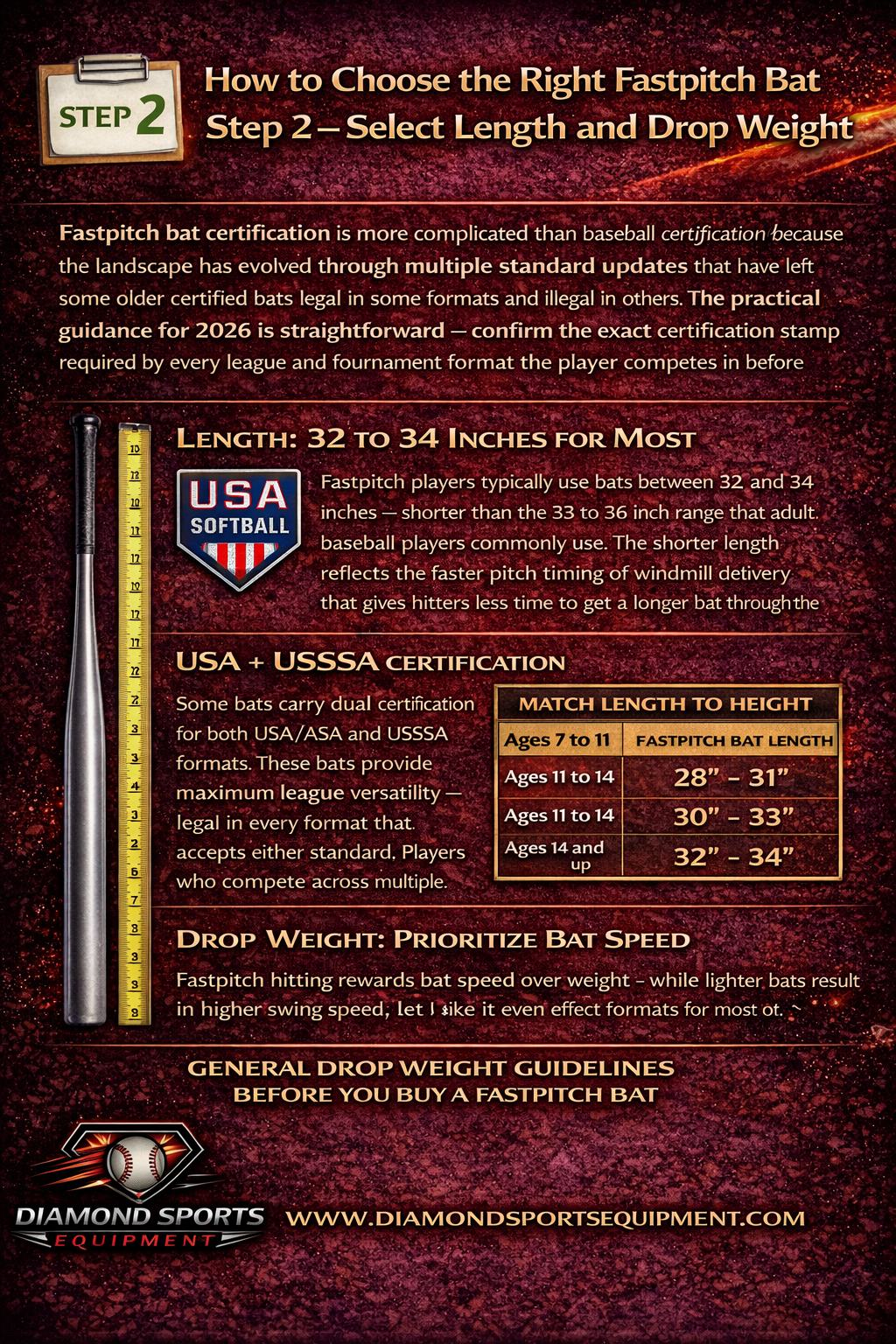
Fastpitch bat length selection follows the same height and reach-based process as baseball — measure the player's height, confirm arm reach, and match to the manufacturer's sizing chart for the specific bat model. The practical guidelines for fastpitch are slightly different from baseball because the windmill pitching delivery creates different timing demands that affect optimal bat length.
Most competitive fastpitch players use bats between 32 and 34 inches — shorter than the 33 to 36-inch range that adult baseball players commonly use. The shorter length reflects the faster pitch timing of windmill delivery that gives hitters less time to get a longer bat through the zone consistently.
Drop weight selection is where fastpitch bat selection most commonly goes wrong. The most common mistake is selecting a bat that is too heavy under the assumption that more weight generates more power. The physics of fastpitch hitting reward swing speed over raw bat weight — a drop 11 bat swung at full speed generates more exit velocity for most fastpitch players than a drop 8 bat that reduces swing speed by 10 percent.
General drop weight guidelines by age and competition level:
Ages 10 and under: Drop 12 to drop 13 — maximum swing speed for developing players whose strength is still building.
Ages 11 to 14: Drop 10 to drop 12 — adequate resistance for developing swing strength without compromising the swing speed that fastpitch timing demands.
High school competitive: Drop 8 to drop 10 — matches the strength development and swing mechanics of competitive high school fastpitch players.
Adult competitive: Drop 8 to drop 10 — appropriate for the strength and swing mechanics of serious adult fastpitch competition.
Step 3 — Choose Material
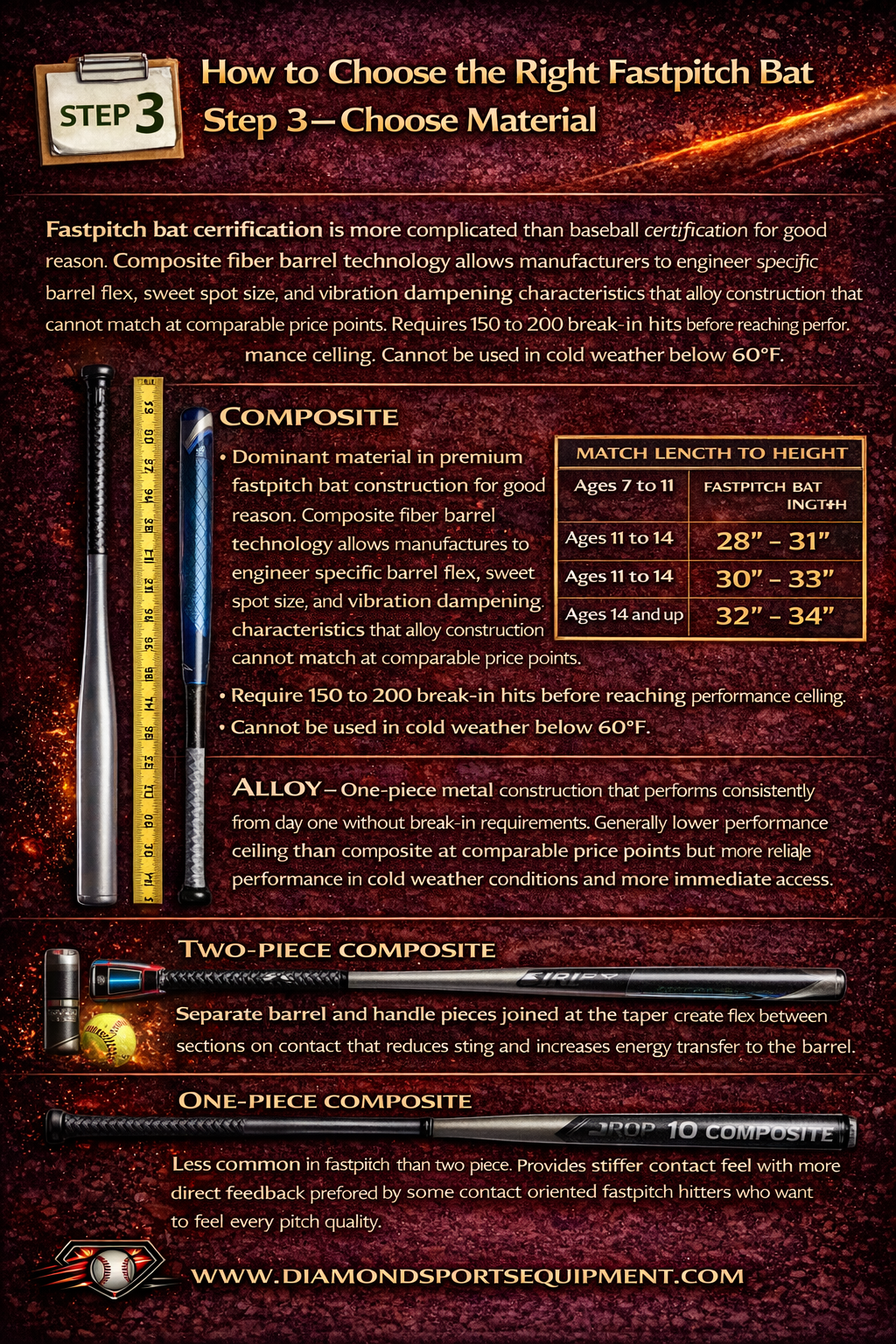
Composite — the dominant material in premium fastpitch bat construction for good reason. Composite fiber barrel technology allows manufacturers to engineer specific barrel flex, sweet spot size, and vibration dampening characteristics that alloy construction cannot match at comparable price points. Requires 150 to 200 break-in hits before reaching performance ceiling. Cannot be used in cold weather below 60°F. The correct choice for serious competitive fastpitch players who have adequate preparation time and compete in warm weather conditions.
Alloy — one-piece metal construction that performs consistently from day one without break-in requirements. Generally lower performance ceiling than composite at comparable price points but more reliable performance in cold weather conditions and more immediately accessible for players who need a game-ready bat without preparation time. The correct choice for players who compete in early-season cold weather tournaments or who purchase mid-season without adequate break-in time.
Two-piece composite — the most common construction in premium fastpitch competitive bats. Separate barrel and handle pieces joined at the taper create flex between sections on contact that reduces sting and increases energy transfer to the barrel. Preferred by most serious competitive fastpitch power hitters.
One-piece composite — less common in fastpitch than two-piece. Provides stiffer contact feel with more direct feedback preferred by some contact-oriented fastpitch hitters who want to feel every pitch quality.
🎯 Putting It Into Practice
The three foundational decisions — certification, length and drop weight, material — narrow the appropriate bat field dramatically before brand, barrel size, or price enter the conversation. A 14-year-old travel ball player who needs USA/ASA certification, a 33-inch length, drop 10 weight, and two-piece composite construction for a tournament starting in three weeks has a clearly defined specification that eliminates most available bats before any product comparison begins — and a three-week timeline that makes break-in completion before the first game a realistic preparation goal. For players who want to see their glove options alongside this bat selection guide, 🧤 Fastpitch Softball Gloves for 2026 covers the defensive equipment decisions that complete a competitive fastpitch player's full field package. And for players finalizing their helmet alongside their bat selection, 🪖 Softball Batting Helmets (2026) covers the certified helmet options that complete a fastpitch player's full plate equipment.
✅ Steps 4 and 5 — Barrel Size and Brand
Step 4 — Select Barrel Size
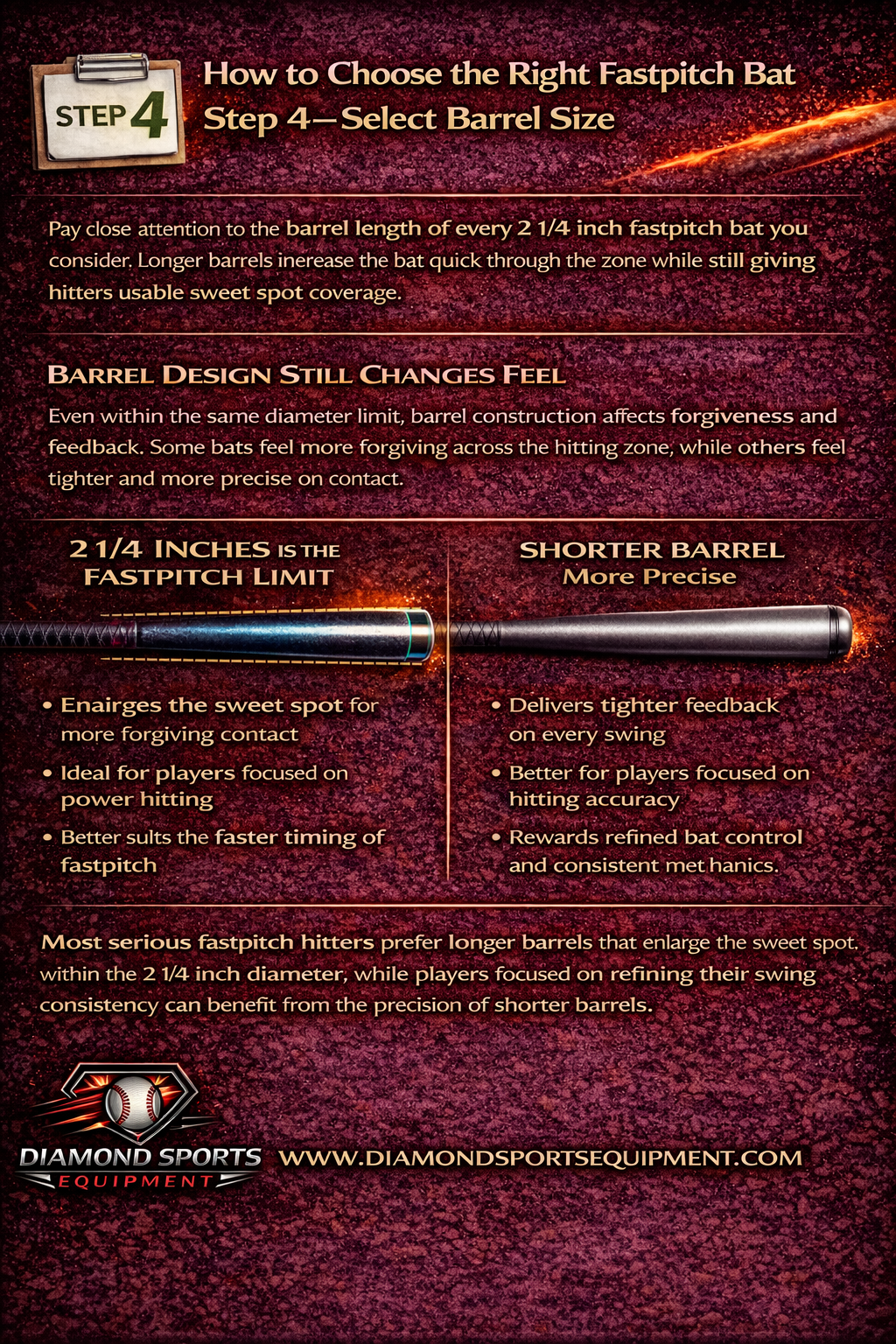
Fastpitch bats use a maximum barrel diameter of 2 1/4 inches — smaller than the 2 5/8-inch maximum of baseball bats. Within that diameter limit, barrel length affects sweet spot coverage in the same way as baseball construction. Longer barrels provide more sweet spot surface area that forgives off-center contact. Shorter barrels provide more precise contact feedback for players who want to develop consistent contact quality rather than masking imprecision with extended barrel coverage.
Most competitive fastpitch players prefer larger barrel designs that maximize the sweet spot surface area available within the 2 1/4-inch diameter limit — the forgiveness advantage on off-center contact matters more in the faster timing environment of fastpitch hitting than in the more controlled timing of slowpitch.
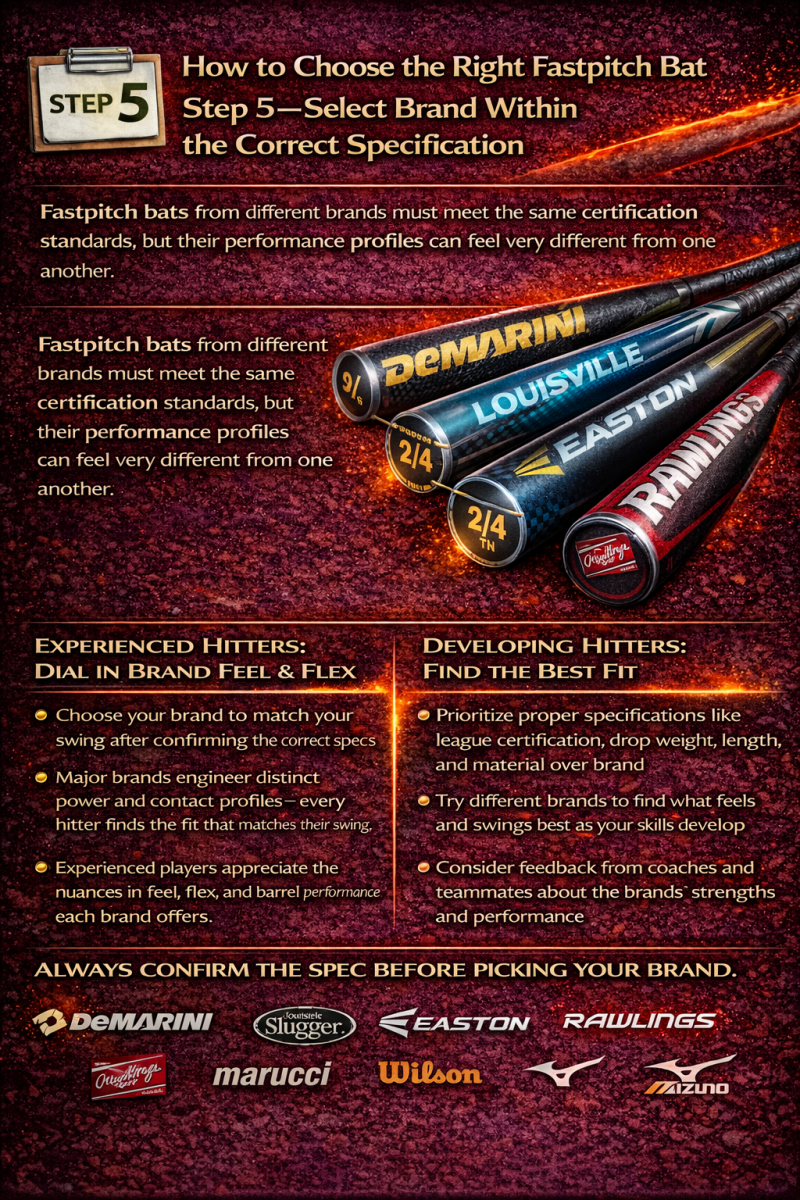
Step 5 — Select Brand Within the Correct Specification
Brand selection in fastpitch bats follows the same guidance as baseball — choose within the correctly specified configuration, not before it. The major fastpitch bat brands — DeMarini, Louisville Slugger, Easton, Rawlings, Marucci, and others — all deliver meaningfully different feel, flex characteristics, and barrel performance within the same certification and material specification. These differences matter to experienced fastpitch hitters who have developed swing preferences through years of competitive at-bats.
For developing players who have not yet established strong brand preferences, prioritize the specification criteria over brand loyalty. For experienced competitive players who know which brands' construction philosophy matches their swing mechanics, confirm the specification first and then select the best available option within that brand's lineup.
❌ Common Fastpitch Bat Buying Mistakes
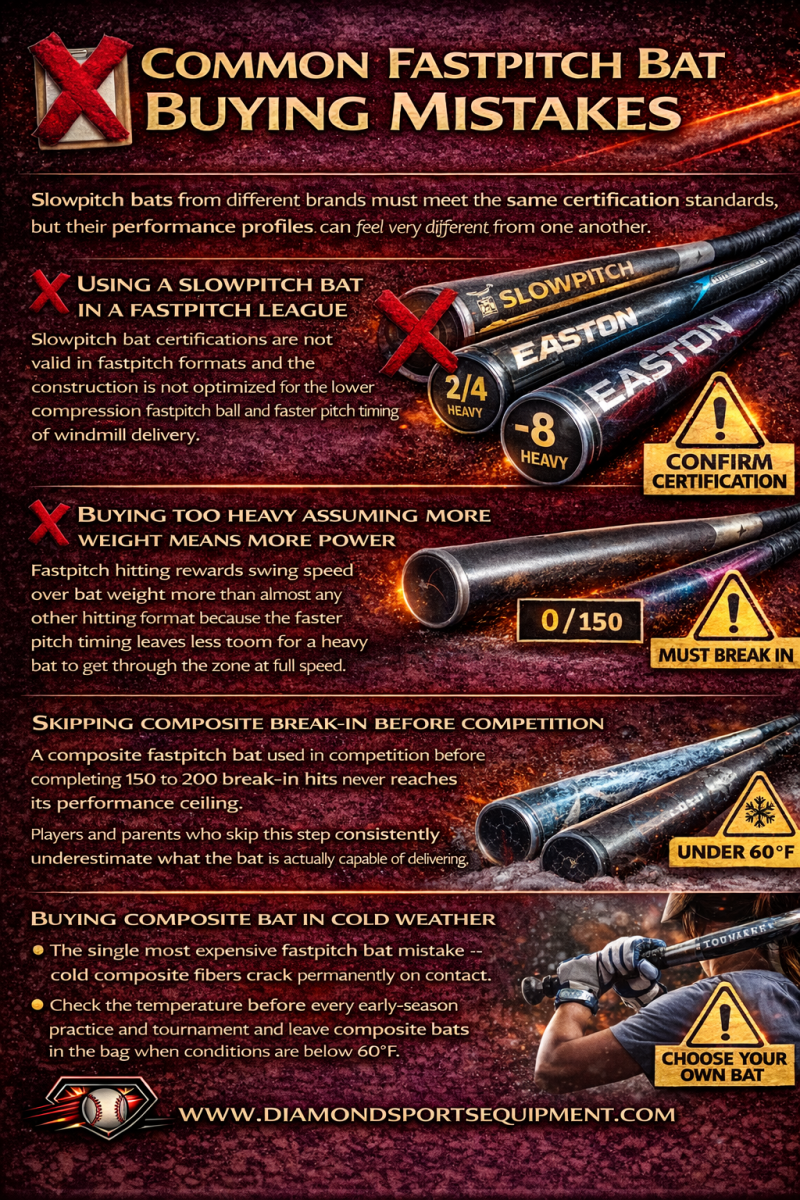
Using a slowpitch bat in a fastpitch league
Slowpitch bat certifications are not valid in fastpitch formats and the construction is not optimized for the lower compression fastpitch ball and faster pitch timing of windmill delivery. Confirm fastpitch-specific certification before any purchase.
Buying too heavy assuming more weight means more power
Fastpitch hitting rewards swing speed over bat weight more than almost any other hitting format because the faster pitch timing leaves less room for a heavy bat to get through the zone at full speed. Always err toward the lighter end of the appropriate drop range if swing speed sustainability is uncertain.
Skipping composite break-in before competition
A composite fastpitch bat used in competition before completing 150 to 200 break-in hits never reaches its performance ceiling. Players and parents who skip this step consistently underestimate what the bat is actually capable of delivering.
Using a composite bat in cold weather
The single most expensive fastpitch bat mistake — cold composite fibers crack permanently on contact. Check the temperature before every early-season practice and tournament and leave composite bats in the bag when conditions are below 60°F.
Buying based on what the best player on the team uses
The best player's bat is optimized for her specific strength, swing mechanics, and hitting approach. Those factors may differ significantly from another player's requirements — the right bat for the best player is not automatically the right bat for every player on the roster.
❓ FAQ
What is the difference between USA/ASA and USSSA fastpitch certification?
- USA/ASA is the standard for most organized fastpitch including high school and recreational adult — the most broadly applicable certification for multi-format players.
- USSSA fastpitch permits higher performance specifications for specific tournament formats — USSSA-only bats are not legal in USA/ASA formats.
What drop weight should my daughter use for fastpitch?
- Ages 10 and under: drop 12 to 13. Ages 11 to 14: drop 10 to 12. High school and adult competitive: drop 8 to 10.
- Always prioritize swing speed over bat weight — a lighter bat swung at full speed outperforms a heavier bat that reduces swing speed.
How long does composite fastpitch bat break-in take?
- 150 to 200 hits rotating the barrel a quarter turn between swings on a tee or soft toss — typically one to two weeks of intentional daily preparation.
- Never use a composite bat in competition or in cold weather below 60°F during the break-in period.
Can I use my fastpitch bat for slowpitch recreational play?
- Technically yes in recreational formats where certification is not strictly enforced — but fastpitch bat construction is not optimized for the higher compression slowpitch ball.
- For serious slowpitch competition always use a slowpitch-certified bat designed for the specific ball compression and arc of the format.
How do I know when to replace a fastpitch bat?
- Replace composite bats when the barrel develops a dead spot that no longer produces the trampoline feel of a properly broken-in composite — typically after one to two seasons of heavy competitive use.
- Replace alloy bats when dents or barrel deformation affect the swing feel or contact sound noticeably.
🧢 Final Thoughts
Choosing the right fastpitch softball bat comes down to five decisions made in the right order — certification first, length and drop weight second, material third, barrel size fourth, and brand within the correct specification fifth. Get those five right and the bat becomes the offensive tool that gives every fastpitch hitter the swing speed, barrel performance, and timing confidence to drive the ball with authority from the first at-bat of the season through the final out of the championship.
For players who want to complete their full protective plate setup alongside their new bat, check out 🛡️ Elbow Guards for Every Hitter (2026) for the arm protection that completes a competitive hitter's full plate equipment package. And for everything else across our baseball and softball coverage, visit 📝 Diamond Sports Equipment Blog & Gear Reviews for our full library of buying guides, product comparisons, and equipment reviews updated all season long.
Add comment
Comments