Slowpitch softball is a game built around offense — and the bat is the single most important piece of equipment a slowpitch player owns. Unlike fastpitch or baseball where bat speed and timing dominate the hitting equation, slowpitch gives hitters a consistent, predictable pitch arc that rewards players who have matched their bat correctly to their swing mechanics, strength level, and league certification requirements. The right slowpitch bat makes the ball jump off the barrel with authority on contact. The wrong one — whether it is too heavy, too light, the wrong certification, or the wrong construction for the player's swing — takes power away from hits that should be leaving the yard.
The slowpitch bat market in 2026 covers a wider range of construction technologies, certification standards, barrel sizes, and weight distributions than any other bat category in baseball or softball. Understanding what each of these variables actually does — and how they interact with each other and with the individual player's swing — is the foundation of making a buying decision that delivers real performance improvement rather than just a new bat in the bag. For players who are ready to shop specific options after working through this guide, 🦇 Slowpitch Bats: Composite vs Alloy (2026) covers the strongest options across every construction tier and certification standard. And for players building their complete slowpitch setup alongside their bat selection, 🧤 Top Slowpitch Softball Gloves (2026) covers the glove options that complete a slowpitch player's full equipment package.
🥎 What You Should Know About Slowpitch Bats
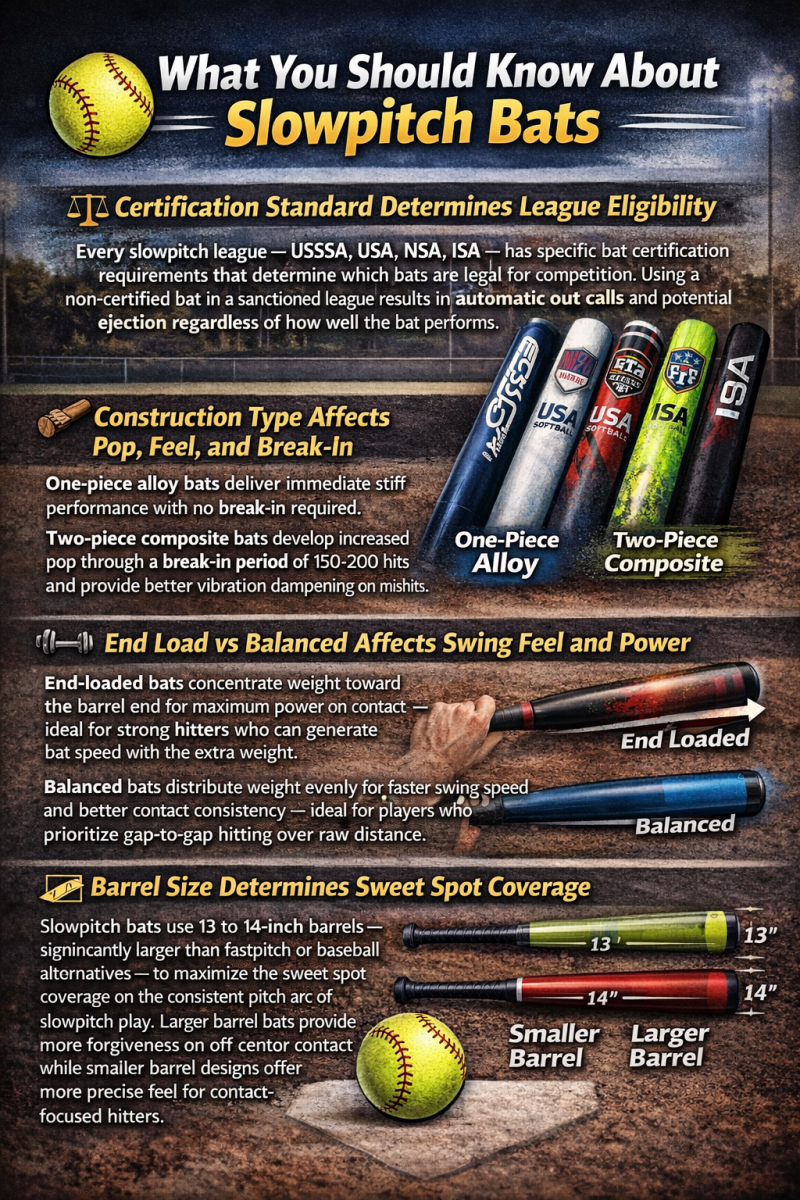
⚖️ Certification Standard Determines League Eligibility:
Every slowpitch league — USSSA, USA, NSA, ISA — has specific bat certification requirements that determine which bats are legal for competition. Using a non-certified bat in a sanctioned league results in automatic out calls and potential ejection regardless of how well the bat performs.
🪵 Construction Type Affects Pop, Feel, and Break-In:
One-piece alloy bats deliver immediate stiff performance with no break-in required. Two-piece composite bats develop increased pop through a break-in period of 150 to 200 hits and provide better vibration dampening on mishits. Knowing which construction matches your preferences and patience level prevents buyer's remorse mid-season.
🏋️ End Load vs Balanced Affects Swing Feel and Power:
End-loaded bats concentrate weight toward the barrel end for maximum power on contact — ideal for strong hitters who can generate bat speed with the extra weight. Balanced bats distribute weight evenly for faster swing speed and better contact consistency — ideal for players who prioritize gap-to-gap hitting over raw distance.
📏 Barrel Size Determines Sweet Spot Coverage:
Slowpitch bats use 13 to 14-inch barrels — significantly larger than fastpitch or baseball alternatives — to maximize the sweet spot coverage on the consistent pitch arc of slowpitch play. Larger barrel bats provide more forgiveness on off-center contact while smaller barrel designs offer more precise feel for contact-focused hitters.
🏆 How to Choose the Right Slowpitch Bat
Step 1 — Confirm Your League's Certification Requirements
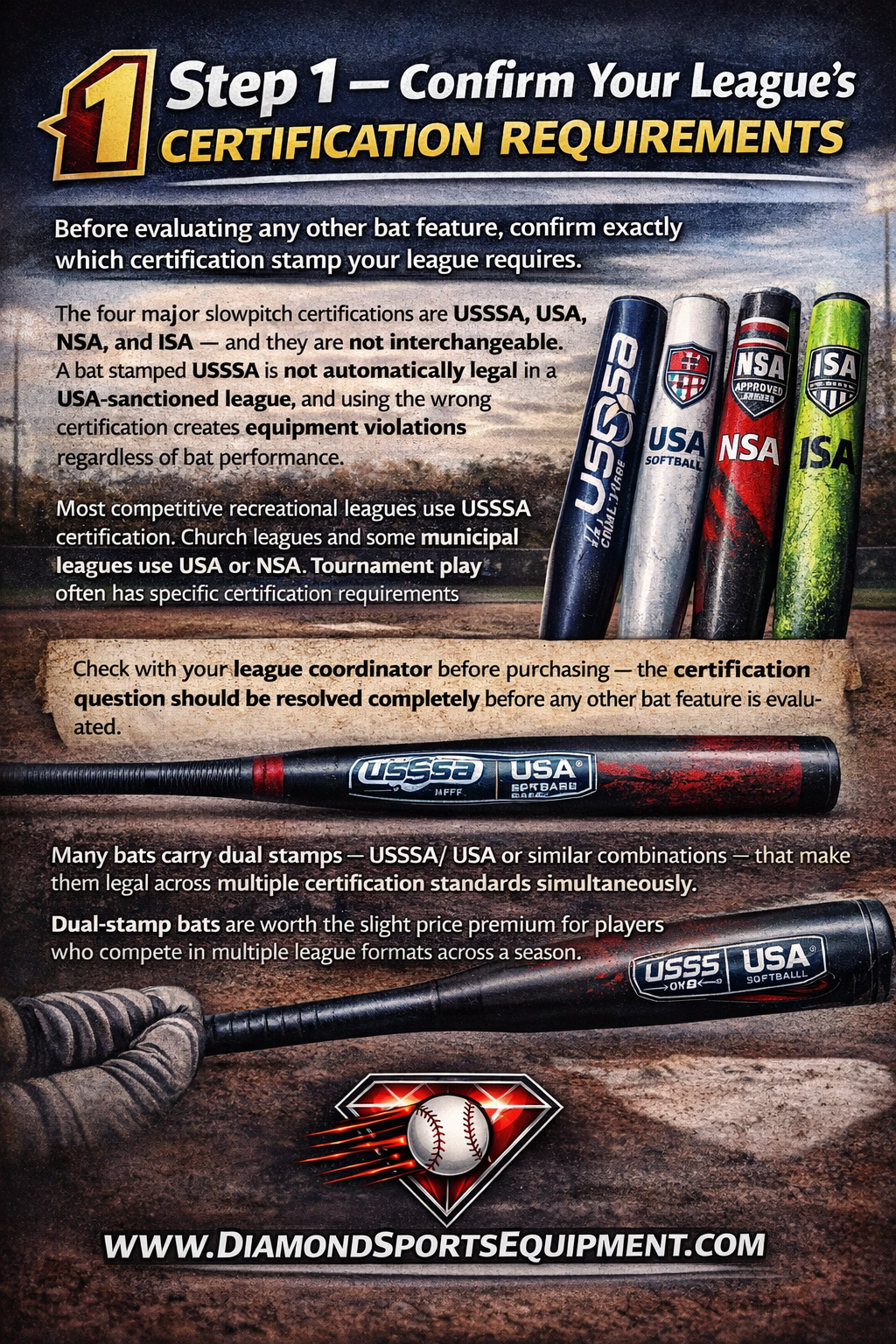
Before evaluating any other bat feature, confirm exactly which certification stamp your league requires. The four major slowpitch certifications are USSSA, USA, NSA, and ISA — and they are not interchangeable. A bat stamped USSSA is not automatically legal in a USA-sanctioned league, and using the wrong certification creates equipment violations regardless of bat performance.
Most competitive recreational leagues use USSSA certification. Church leagues and some municipal leagues use USA or NSA. Tournament play often has specific certification requirements that differ from regular season rules. Check with your league coordinator before purchasing — the certification question should be resolved completely before any other bat feature is evaluated.
Many bats carry dual stamps — USSSA/USA or similar combinations — that make them legal across multiple certification standards simultaneously. Dual-stamp bats are worth the slight price premium for players who compete in multiple league formats across a season.
Step 2 — Choose Between One-Piece and Two-Piece Construction
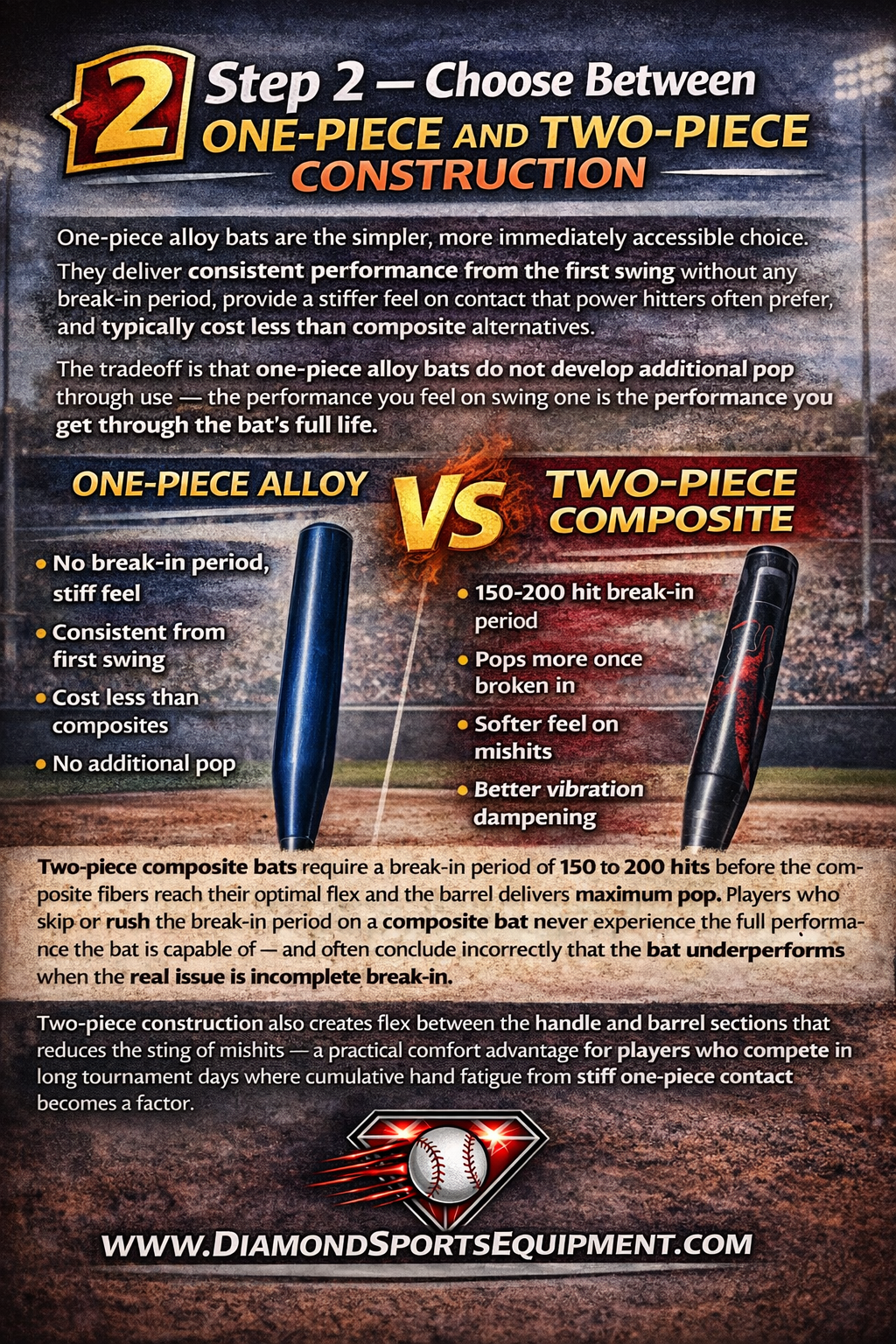
One-piece alloy bats are the simpler, more immediately accessible choice. They deliver consistent performance from the first swing without any break-in period, provide a stiffer feel on contact that power hitters often prefer, and typically cost less than composite alternatives. The tradeoff is that one-piece alloy bats do not develop additional pop through use — the performance you feel on swing one is the performance you get through the bat's full life.
Two-piece composite bats require a break-in period of 150 to 200 hits before the composite fibers reach their optimal flex and the barrel delivers maximum pop. Players who skip or rush the break-in period on a composite bat never experience the full performance the bat is capable of — and often conclude incorrectly that the bat underperforms when the real issue is incomplete break-in. The reward for completing the break-in process correctly is a bat that generates noticeably more pop and better vibration dampening than one-piece alternatives at comparable price points.
Two-piece construction also creates flex between the handle and barrel sections that reduces the sting of mishits — a practical comfort advantage for players who compete in long tournament days where cumulative hand fatigue from stiff one-piece contact becomes a factor.
Step 3 — Decide Between End Load and Balanced
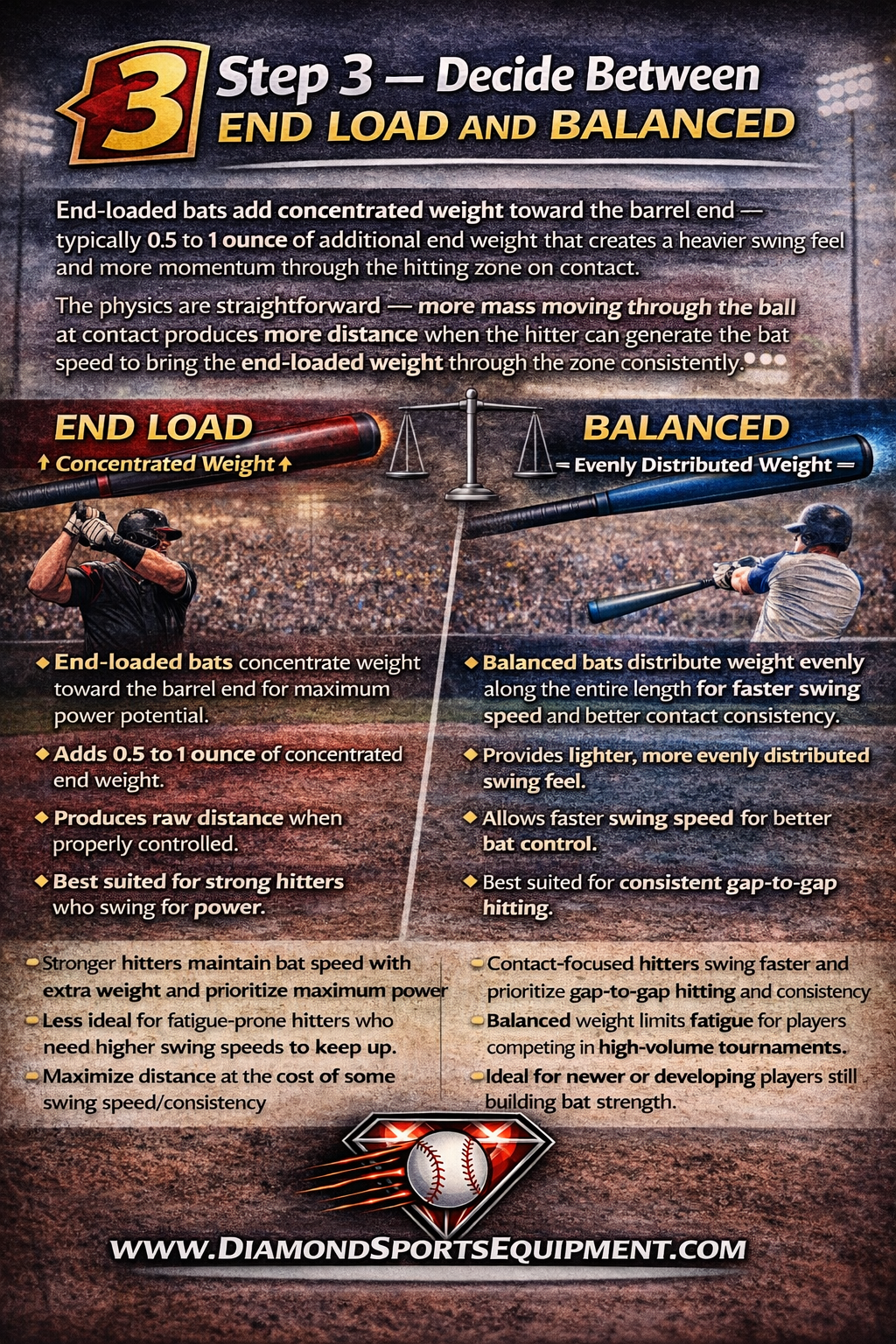
End-loaded bats add concentrated weight toward the barrel end — typically 0.5 to 1 ounce of additional end weight that creates a heavier swing feel and more momentum through the hitting zone on contact. The physics are straightforward — more mass moving through the ball at contact produces more distance when the hitter can generate the bat speed to bring the end-loaded weight through the zone consistently.
End load is most beneficial for strong hitters who can maintain bat speed with the extra barrel weight and who swing primarily for maximum distance rather than contact consistency. Players who are not strong enough to maintain bat speed with an end-loaded design will see their exit velocity decrease rather than increase because the extra weight slows the swing more than it adds momentum on contact.
Balanced bats distribute weight evenly across the entire bat length for a lighter, more controllable swing feel. The lower swing weight allows faster bat speed that benefits contact hitters who prioritize gap-to-gap hitting, players who compete in high-volume tournament formats where swing fatigue accumulates, and hitters who are still developing the strength to control an end-loaded design consistently.
🎯 Putting It Into Practice
Most slowpitch players benefit from starting with a balanced two-piece composite bat in their league's required certification — the balanced weight makes it easier to evaluate the bat's natural pop without fighting swing fatigue, and the composite construction provides the best overall performance ceiling once the break-in is complete. Players who have already established a strong, consistent swing and want to maximize distance should consider an end-loaded design in their next purchase after confirming they can maintain bat speed with the extra barrel weight. For players who are also selecting their complete slowpitch equipment setup alongside this guide, 🎒 Best Slowpitch Softball Bat Bags (2026 Guide) covers the bag options that protect and organize a slowpitch player's full equipment investment. And for players evaluating their glove alongside their bat selection, 🧤 Best Softball Gloves for Every Position (2026) covers the positional glove options appropriate for slowpitch defensive play.
✅ Common Slowpitch Bat Buying Mistakes
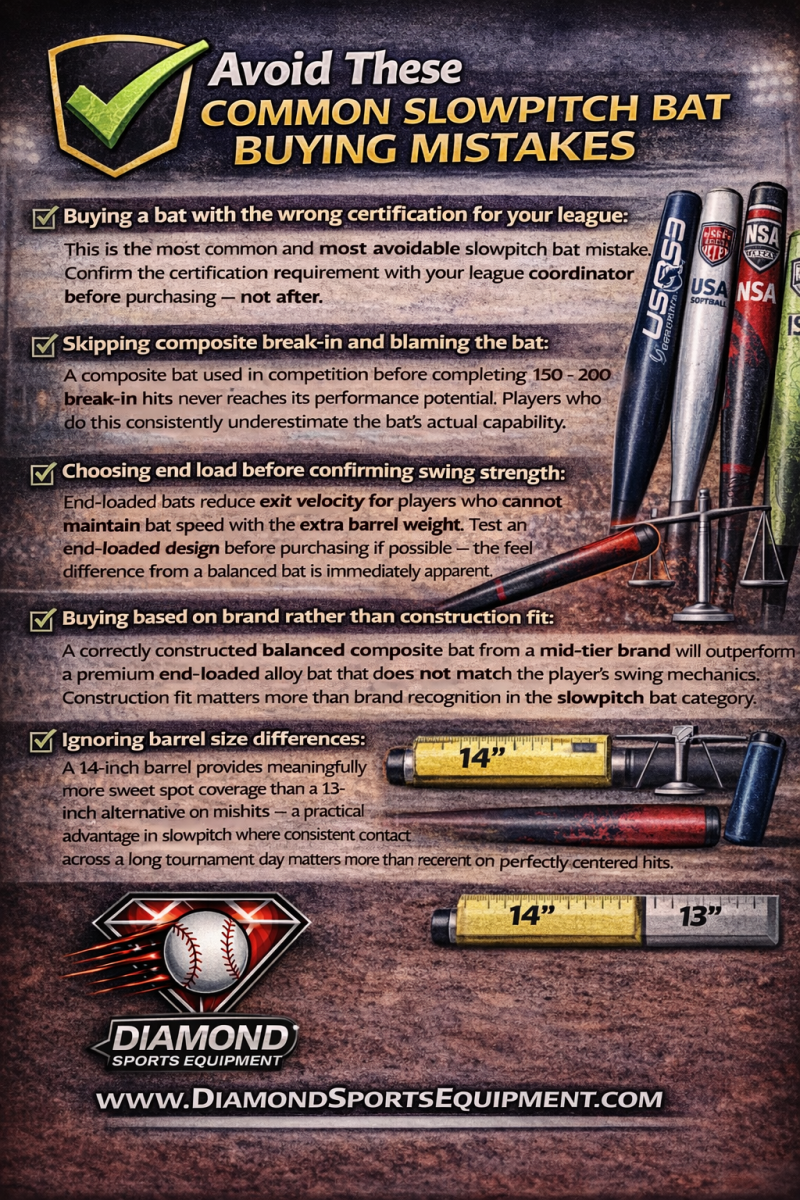
Buying a bat with the wrong certification for your league:
This is the most common and most avoidable slowpitch bat mistake. Confirm the certification requirement with your league coordinator before purchasing — not after.
Skipping composite break-in and blaming the bat:
A composite bat used in competition before completing 150 to 200 break-in hits never reaches its performance potential. Players who do this consistently underestimate the bat's actual capability.
Choosing end load before confirming swing strength:
End-loaded bats reduce exit velocity for players who cannot maintain bat speed with the extra barrel weight. Test an end-loaded design before purchasing if possible — the feel difference from a balanced bat is immediately apparent.
Buying based on brand rather than construction fit:
A correctly constructed balanced composite bat from a mid-tier brand will outperform a premium end-loaded alloy bat that does not match the player's swing mechanics. Construction fit matters more than brand recognition in the slowpitch bat category.
Ignoring barrel size differences:
A 14-inch barrel provides meaningfully more sweet spot coverage than a 13-inch alternative on mishits — a practical advantage in slowpitch where consistent contact across a long tournament day matters more than peak performance on perfectly centered hits.
Avoiding these mistakes at the buying stage prevents the frustration of discovering mid-season that the bat is working against the player's swing rather than amplifying it. For players ready to shop specific recommendations after working through these decisions, 🦇 Best Slowpitch Softball Bats (2026 Guide) covers the strongest options across every construction tier and certification standard available in 2026.
❓ FAQ
What is the difference between USSSA and USA slowpitch certification?
- USSSA bats are approved for USSSA-sanctioned competitive leagues while USA bats meet a different performance standard used in recreational and some tournament formats.
- Many bats carry dual stamps making them legal in both — worth the slight premium for players who compete across multiple league formats.
How do I break in a composite slowpitch bat?
- Hit 150 to 200 balls off a tee or soft toss rotating the bat a quarter turn between swings to evenly compress the composite fibers around the full barrel.
- Never use a composite bat in cold weather below 60°F during break-in — cold temperatures make composite fibers brittle and can crack the barrel permanently.
What bat weight should I use for slowpitch?
- Most adult slowpitch bats run 26 to 30 ounces — start with a weight you can swing comfortably for 20 consecutive swings without losing bat speed.
- Players who feel fatigue before 20 swings should drop one ounce — players who feel no resistance at all should go up one ounce for more contact momentum.
Can I use a fastpitch bat for slowpitch?
- No — fastpitch bats are not certified for slowpitch play and the barrel geometry is designed for a different pitch speed and arc than slowpitch delivers.
- Using a fastpitch bat in slowpitch also risks damaging the bat since it is not engineered for the higher compression balls used in slowpitch leagues.
How long do composite slowpitch bats last?
- A quality composite slowpitch bat used in regular competitive play typically lasts two to three seasons before performance noticeably degrades.
- Store composite bats at room temperature and avoid leaving them in hot car trunks or cold garages — extreme temperatures degrade composite fibers faster than regular use.
🧢 Final Thoughts
Choosing the right slowpitch softball bat comes down to four decisions made in the right order — certification first, then construction type, then weight distribution, then barrel size. Get those four decisions right for the specific player's swing mechanics, strength level, and league requirements and the bat becomes the offensive weapon that slowpitch is designed to reward. The right bat does not just hit the ball harder — it builds the hitting confidence that makes every at-bat feel like an opportunity rather than a challenge.
For players who want to explore the full range of specific bat recommendations after working through this guide, check out 🧤 How to Choose a Baseball Glove for the same decision-by-decision selection framework applied to defensive equipment. And for everything else across our baseball and softball coverage, visit 📝 Diamond Sports Equipment Blog & Gear Reviews for our full library of buying guides, product comparisons, and equipment reviews updated all season long.