A pitching machine is one of the most significant training investments a player, parent, or program can make — and one of the most frequently purchased based on price or brand recognition rather than the specific performance criteria that determine whether the machine actually serves the training goals it was purchased to advance. A machine that throws only fastballs when the player needs to develop timing against off-speed pitches. A machine that requires 120-volt power on a field with no electrical access. A machine that throws at speeds appropriate for adult competitive players when the user is a 9-year-old recreational player whose timing development requires much slower velocity. Every one of those mismatches creates a training limitation that reduces the return on what is typically one of the larger equipment investments in a player's development program.
Choosing a pitching machine correctly in 2026 means working through five decisions in the right order — pitch type capability first, then speed range, then power source, then portability, then ball compatibility — before brand or price enter the evaluation. Get those five decisions right and the machine becomes the training partner that accelerates timing development, builds plate confidence, and creates the high-volume repetition environment that game-speed performance requires. Get them wrong and the machine sits unused because it does not serve the actual training scenario it was purchased for. For programs and players who want to see specific machine options after working through this selection guide, 💨 Best Pitching Machines for Practice (2026 Guide) covers the strongest options across every construction tier. And for players who have been evaluating their pitching machine investment alongside broader training equipment decisions, 💨 Pitching Machines Complete Guide (2026) covers additional options that complement the selections in this guide.
💨 What You Should Know Before Choosing a Pitching Machine

🎯 Pitch Type Capability Is the Most Important Decision
A machine that throws only straight fastballs serves a fundamentally different training purpose than one that throws curveballs, sliders, and changeups alongside fastballs. Determine the pitch variety required for your specific training goals before evaluating any other machine feature — pitch type capability cannot be added after purchase.
⚡ Power Source Determines Where the Machine Can Be Used
Electric machines that require 120-volt outlet access cannot be used on fields without electrical infrastructure. Battery-powered alternatives provide location flexibility at the cost of run time between charges. Determine your primary training location's power availability before selecting any specific machine model.
⚾ Ball Compatibility Affects Total Investment Cost
Some machines require proprietary dimpled training balls rather than standard game balls — adding ongoing consumable cost beyond the initial machine investment. Others use standard game balls that programs already own. Confirm ball compatibility before purchasing and factor the ongoing ball cost into the total investment evaluation.
🚗 Portability Requirements Differ by Training Setup
Machines used at fixed training facility locations have different portability requirements than those transported to different fields for practice and game-day use. Wheeled designs, compact footprints, and lightweight construction all affect how practical regular transport is for programs that move their machine between locations regularly.
💨 How to Choose the Right Pitching Machine
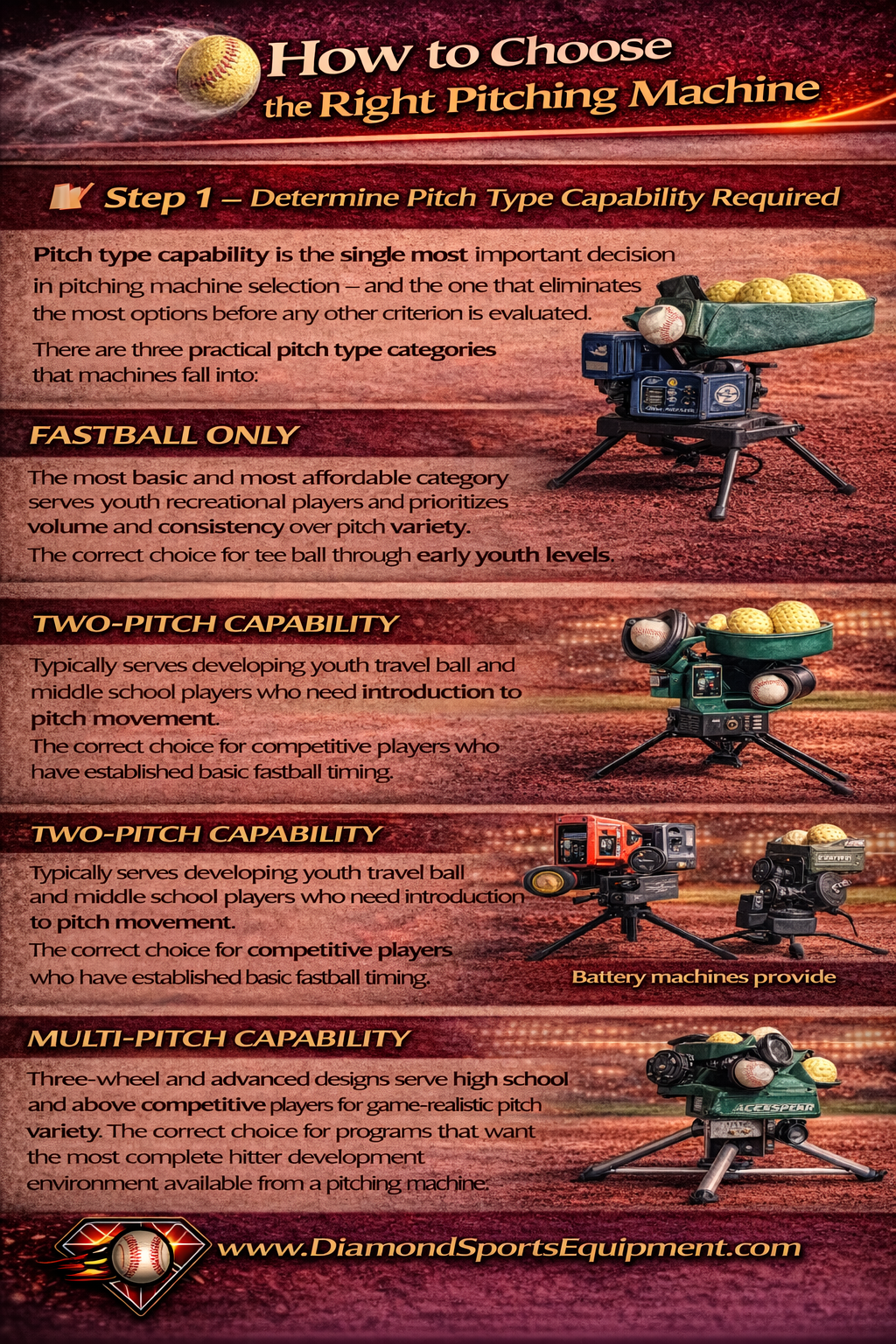
Step 1 — Determine Pitch Type Capability Required
Pitch type capability is the single most important decision in pitching machine selection — and the one that eliminates the most options before any other criterion is evaluated. There are three practical pitch type categories that machines fall into:
Fastball only — the most basic and most affordable category. Single-wheel machines that throw consistent straight pitches at selected speeds. Serves youth recreational players who need timing repetition at controlled velocities and programs that prioritize volume and consistency over pitch variety. The correct choice for tee ball through early youth levels where fastball timing is the primary development goal.
Two-pitch capability — machines that throw fastballs alongside one or two additional pitch types — typically curveball or changeup. Serves developing competitive players at the youth travel ball and middle school level who need exposure to pitch movement alongside fastball timing. The correct choice for players who have established basic fastball timing and are ready to develop off-speed recognition.
Multi-pitch capability — three-wheel and advanced designs that replicate the full range of pitches from fastball through curveball, slider, changeup, and sinker at competitive game speeds. Serves high school and above competitive players who need game-realistic pitch variety for genuine timing development. The correct choice for programs that want the most complete hitting development environment available from a pitching machine.
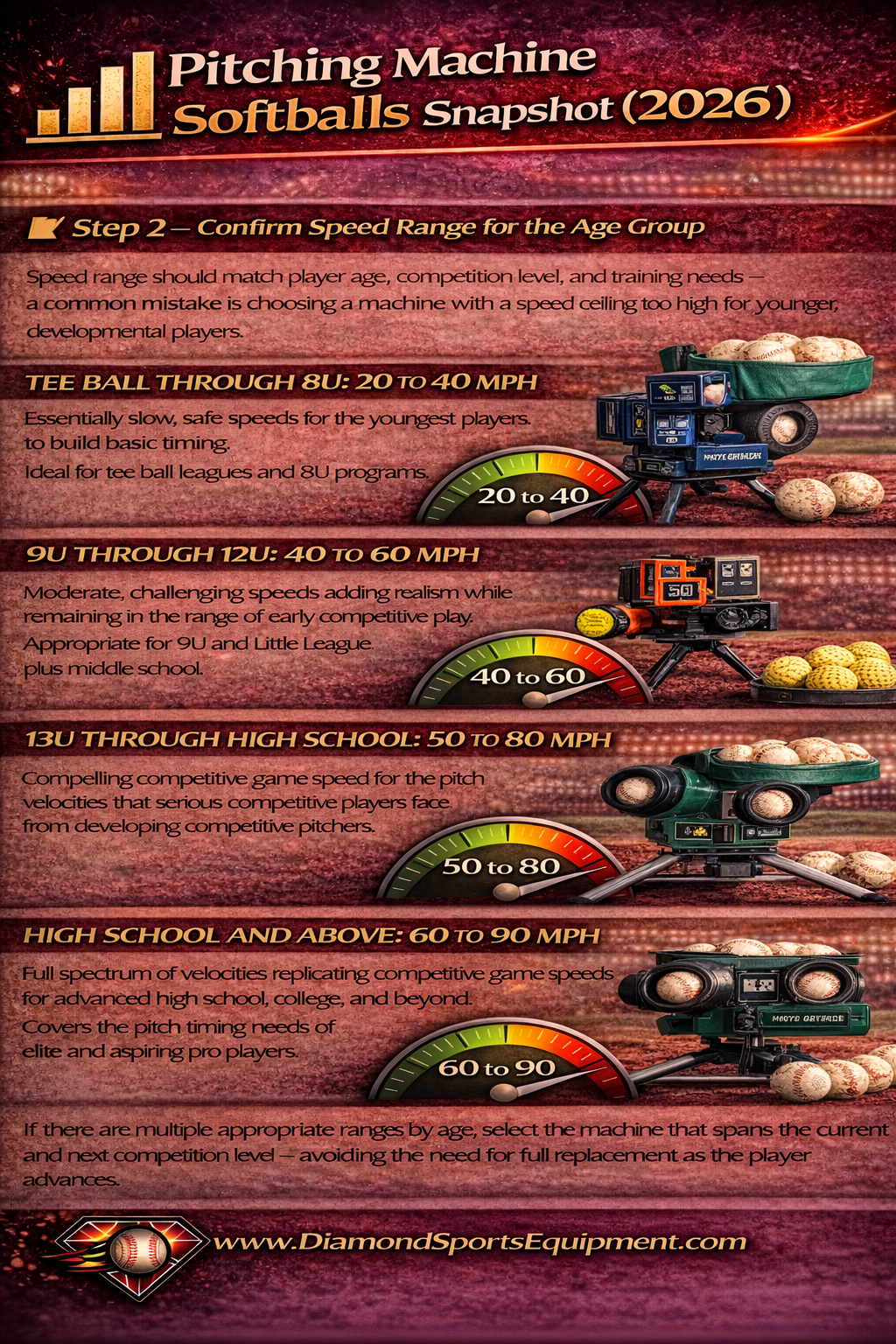
Step 2 — Confirm Speed Range for the Age Group
Speed range selection follows directly from the player's age and competition level — and the most common mistake is selecting a machine with a speed ceiling appropriate for adult competitive players when the user is a youth recreational player whose timing development requires much slower velocity.
Tee ball through 8U: 20 to 40 mph — consistent slow velocity that develops basic timing and contact mechanics without overwhelming young players' reaction time.
9U through 12U: 40 to 60 mph — appropriate for youth competitive play where fastball timing development requires realistic but manageable velocity.
13U through high school: 50 to 80 mph — approaching competitive game speed for the pitch velocities that serious competitive players face from developing competitive pitchers.
High school and above: 60 to 90 mph — full game-speed range for elite competitive players who need realistic timing against the velocities that advanced competitive pitching produces.
The practical guidance is to select a machine whose speed range covers both the current training need and the next developmental stage — a machine that only covers the current age group's needs requires replacement sooner as the player develops, reducing the long-term value of the investment.
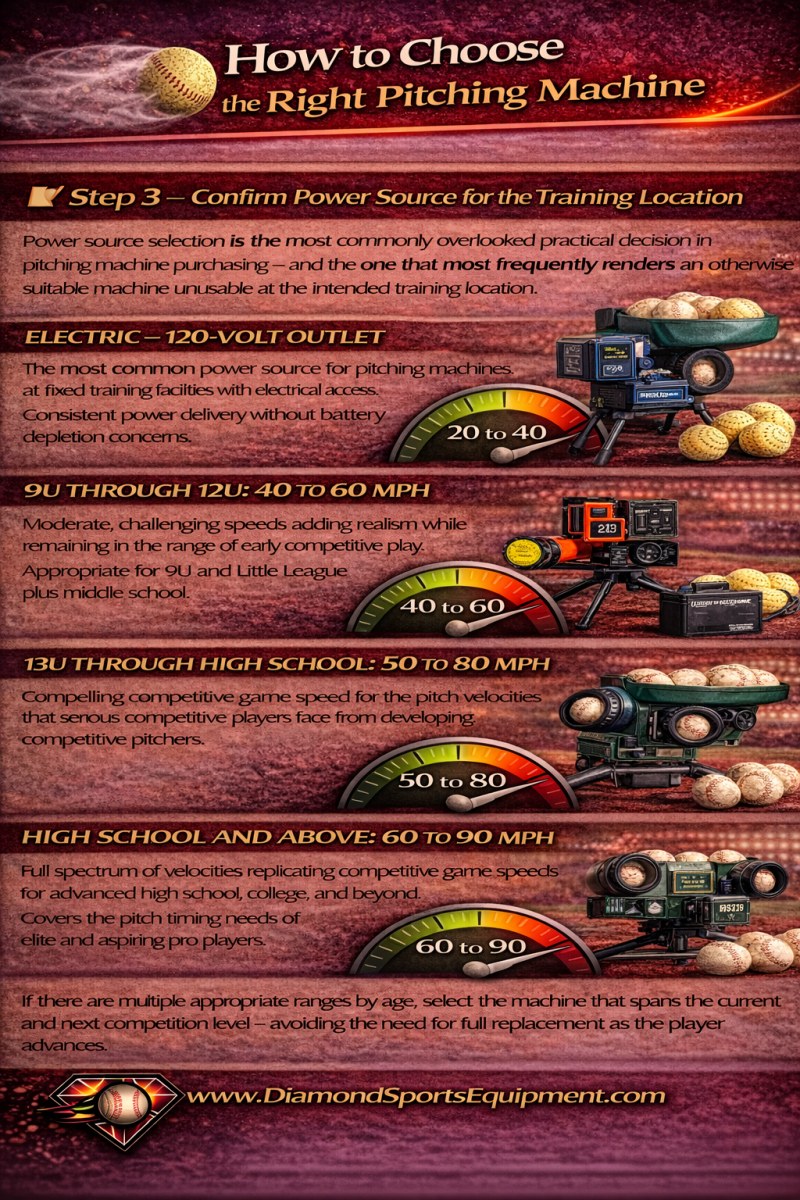
Step 3 — Confirm Power Source for the Training Location
Power source selection is the most commonly overlooked practical decision in pitching machine purchasing — and the one that most frequently renders an otherwise suitable machine unusable at the intended training location.
Electric — 120-volt outlet: The most common power source for pitching machines at fixed training facilities with electrical access. Consistent power delivery without battery depletion concerns. Not usable at fields without electrical infrastructure.
Battery-powered: Provides location flexibility for programs that train on fields without electrical access. Run time varies by machine — confirm hours of operation per charge before purchasing for programs that conduct extended practice sessions.
Combination: Some machines accept both power sources — providing outlet power at facilities and battery power for field locations. The most flexible option for programs that train in both settings regularly.
🎯 Putting It Into Practice
The four foundational decisions — pitch type, speed range, power source, and portability — narrow the appropriate machine field dramatically before ball compatibility, brand, or price enter the evaluation. A youth travel ball program that needs two-pitch capability at 40 to 70 mph, operates at a field with 120-volt electrical access, and wants a wheeled portable design for repositioning during practice has a clearly defined specification that eliminates most available machines before any product comparison begins. For programs who want to complement their pitching machine investment with batting tee options for additional hitting station setup, 🏏 Best Batting Tees for Baseball & Softball (2026 Guide) covers the tee options that complete a multi-station hitting practice environment. And for programs building their complete training equipment package alongside their pitching machine, ⚾ Best Baseball Training Tools & Equipment (2026) covers the full range of training accessories that maximize the hitting development environment a pitching machine creates.
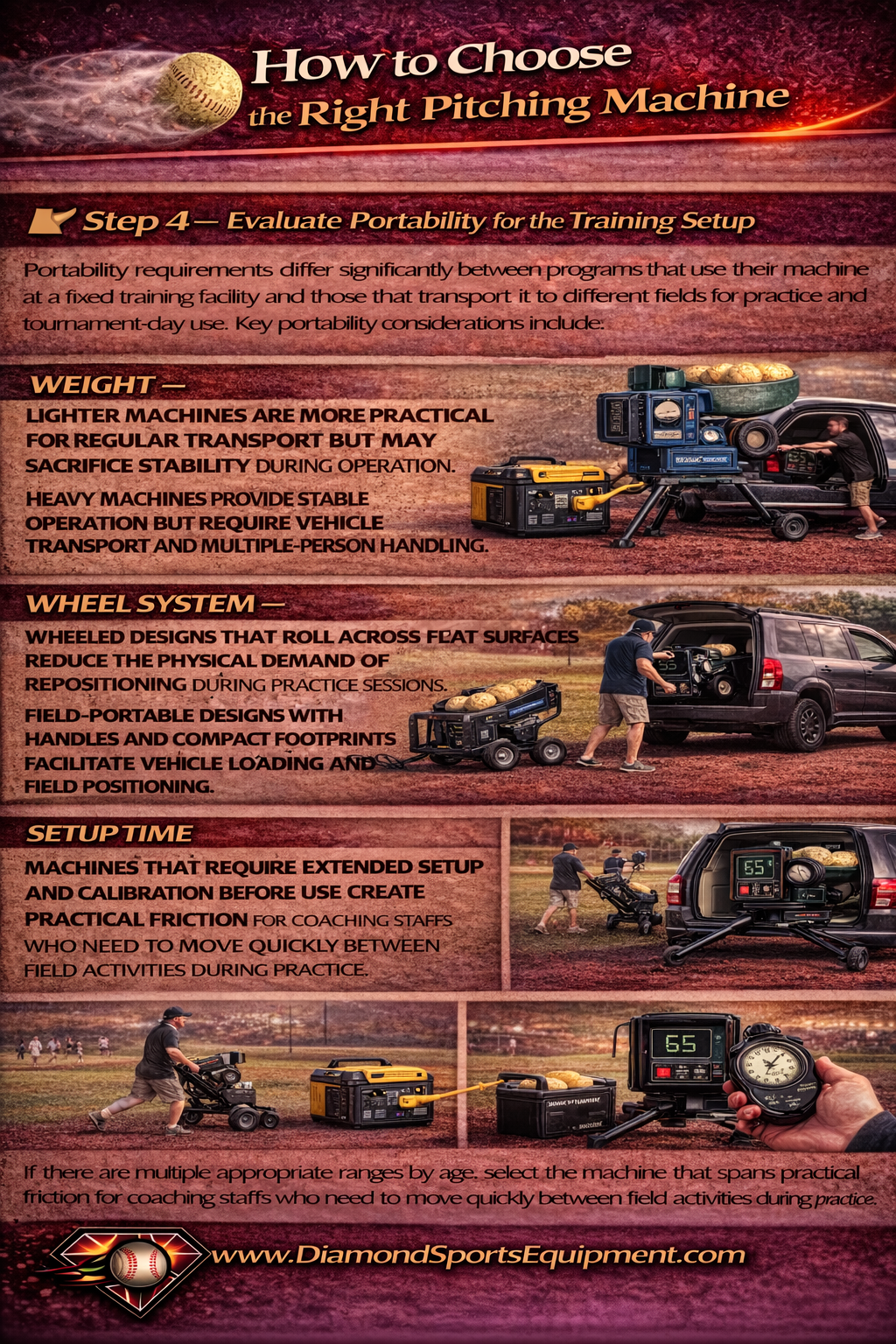
Step 4 — Evaluate Portability for the Training Setup
Portability requirements differ significantly between programs that use their machine at a fixed training facility and those that transport it to different fields for practice and tournament-day use. Key portability considerations include:
Weight — lighter machines are more practical for regular transport but may sacrifice stability during operation. Heavy machines provide stable operation but require vehicle transport and multiple-person handling.
Wheel system — wheeled designs that roll across flat surfaces reduce the physical demand of repositioning during practice sessions. Field-portable designs with handles and compact footprints facilitate vehicle loading and field positioning.
Setup time — machines that require extended setup and calibration before use create practical friction for coaching staffs who need to move quickly between field activities during practice.
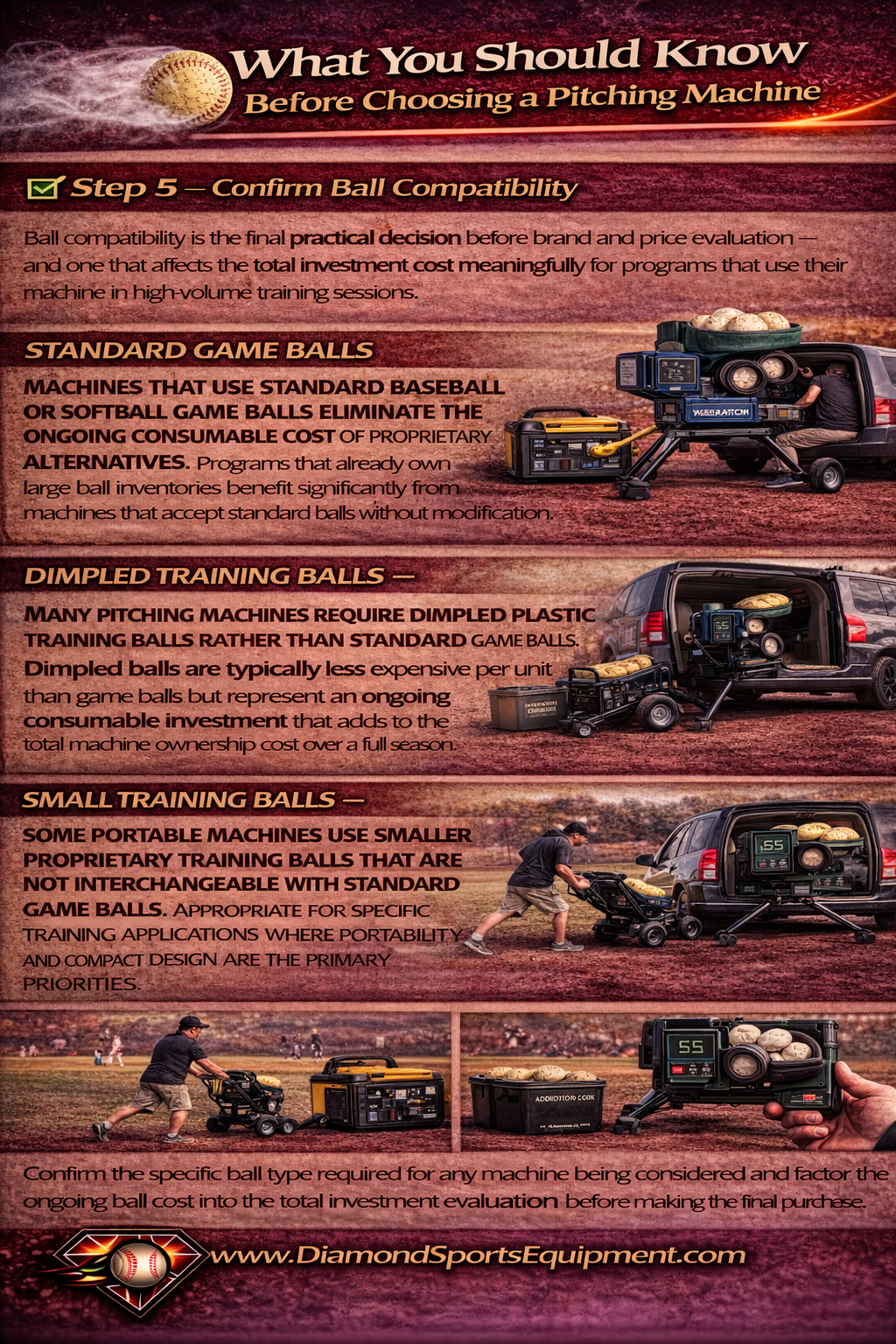
✅ Step 5 — Confirm Ball Compatibility
Ball compatibility is the final practical decision before brand and price evaluation — and one that affects the total investment cost meaningfully for programs that use their machine in high-volume training sessions.
Standard game balls — machines that use standard baseball or softball game balls eliminate the ongoing consumable cost of proprietary alternatives. Programs that already own large ball inventories benefit significantly from machines that accept standard balls without modification.
Dimpled training balls — many pitching machines require dimpled plastic training balls rather than standard game balls. Dimpled balls are typically less expensive per unit than game balls but represent an ongoing consumable investment that adds to the total machine ownership cost over a full season.
Small training balls — some portable machines use smaller proprietary training balls that are not interchangeable with standard game balls. Appropriate for specific training applications where portability and compact design are the primary priorities.
Confirm the specific ball type required for any machine being considered and factor the ongoing ball cost into the total investment evaluation before making the final purchase decision.
❌ Common Pitching Machine Buying Mistakes
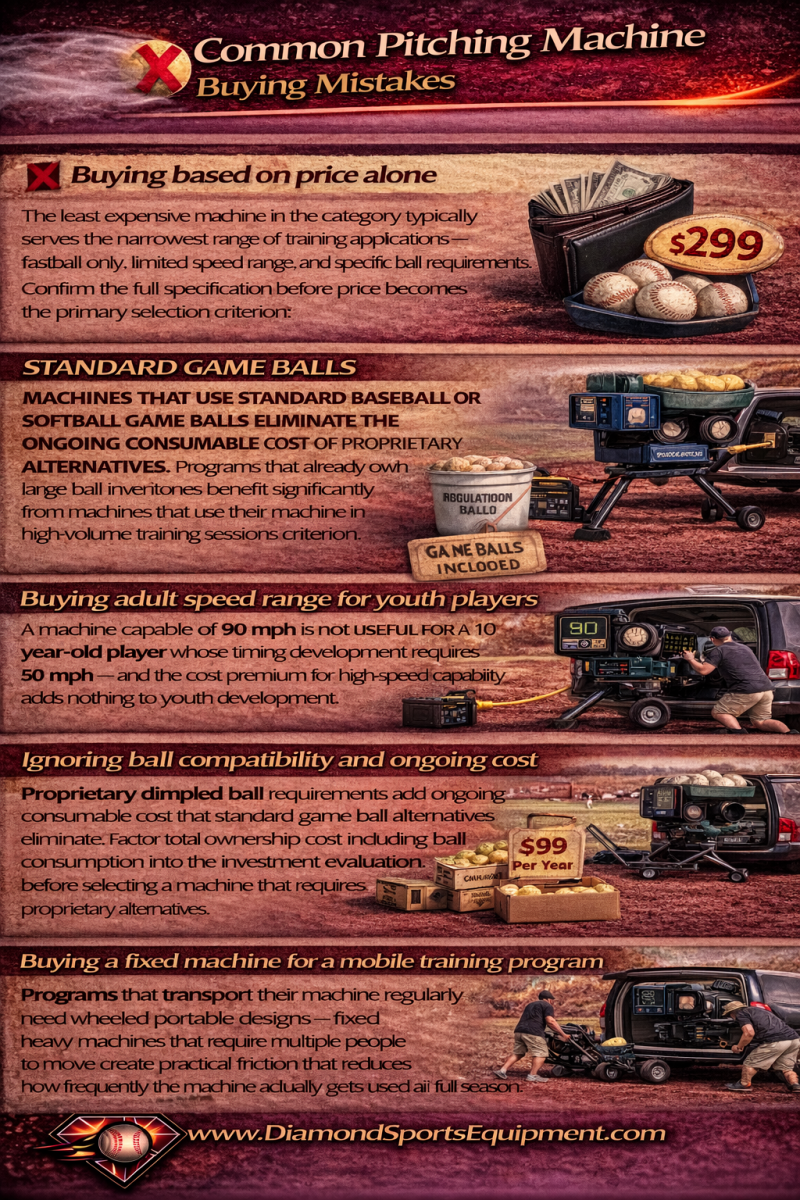
Buying based on price alone
The least expensive machine in the category typically serves the narrowest range of training applications — fastball only, limited speed range, and specific ball requirements. Confirm the full specification before price becomes the primary selection criterion.
Not confirming power source for the field location
The most avoidable practical mistake — an electric machine purchased for a field without electrical access is unusable at that location regardless of its training capability. Confirm power availability at the intended training location before any machine is purchased.
Buying adult speed range for youth players
A machine capable of 90 mph is not useful for a 10-year-old player whose timing development requires 50 mph — and the cost premium for high-speed capability adds nothing to youth development. Match speed range to the actual age and competition level of the primary user.
Ignoring ball compatibility and ongoing cost
Proprietary dimpled ball requirements add ongoing consumable cost that standard game ball alternatives eliminate. Factor total ownership cost including ball consumption into the investment evaluation before selecting a machine that requires proprietary alternatives.
Buying a fixed machine for a mobile training program
Programs that transport their machine regularly need wheeled portable designs — fixed heavy machines that require multiple people to move create practical friction that reduces how frequently the machine actually gets used during a full season.
❓ FAQ
What is the best pitching machine for youth baseball?
- A two-wheel electric machine with a 20 to 60 mph speed range using standard or dimpled balls — providing the consistent velocity and basic pitch variety that youth development requires.
- Single-wheel fastball-only machines serve tee ball through 8U adequately — two-pitch capability becomes more valuable from 9U through 12U as pitch recognition development becomes a training priority.
Can pitching machines throw curveballs?
- Yes — two-wheel and three-wheel machines can throw breaking balls by adjusting the relative speed of the two or three wheels that contact the ball during delivery.
- Single-wheel machines can only throw straight pitches — breaking ball capability requires at least a two-wheel design.
How much does a quality pitching machine cost?
- Entry-level youth machines: $200 to $500 for basic fastball capability at youth speeds.
- Mid-range two-pitch machines: $500 to $1500 for two-pitch capability at competitive youth and high school speeds.
- Premium multi-pitch machines: $2000 to $5000 and above for full game-speed multi-pitch capability appropriate for serious competitive programs.
Do I need a pitching machine if I have a batting tee?
- Both serve different development purposes — tees develop swing mechanics and contact quality while pitching machines develop timing and pitch recognition.
- Programs that want complete hitting development environments benefit from both tools serving their complementary purposes rather than treating them as alternatives.
How do I maintain a pitching machine?
- Clean the wheel surfaces regularly to maintain consistent ball delivery — worn or dirty wheel surfaces create velocity inconsistency that undermines timing training reliability.
- Store indoors when not in use to protect electronic components and wheel materials from weather exposure that accelerates wear beyond normal training use.
🧢 Final Thoughts
Choosing the right pitching machine comes down to five decisions made in the right order — pitch type capability first, speed range second, power source third, portability fourth, and ball compatibility fifth. Get those five decisions right and the machine becomes the most valuable training investment in a player's or program's full equipment budget — creating the high-volume game-speed repetition environment that no other training tool can replicate as completely. Get them wrong and the machine sits unused because it does not serve the actual training scenario it was purchased for.
For programs and players ready to shop specific machine options after working through this guide, check out ⚾ Best Pitching Machine Baseballs (2026) for the ball options that complete a pitching machine training investment. And for everything else across our baseball and softball coverage, visit 📝 Diamond Sports Equipment Blog & Gear Reviews for our full library of buying guides, product comparisons, and equipment reviews updated all season long.
Add comment
Comments