A pitching machine can create the repeatable hitting reps that are difficult to reproduce consistently with live batting practice, but the right machine depends on much more than maximum speed. Wheel configuration, pitch variety, ball compatibility, power source, portability, and the player's current competition level all determine whether a machine actually fits the training environment it is purchased for.
The six machines in this guide cover very different use cases, from manual youth machine-pitch practice and portable battery-powered training to high-volume electric machines and advanced three-wheel systems built for competitive programs. The goal is not simply to identify the machine with the most features, but to match each design to the type of repetition and pitch work the hitter actually needs.
Players still deciding which machine configuration fits their setup should start with 💨 How to Choose a Pitching Machine. Softball programs should also compare the ball options in 🥎 Best Pitching Machine Softballs (2026).
⚾ What You Should Know About Pitching Machines
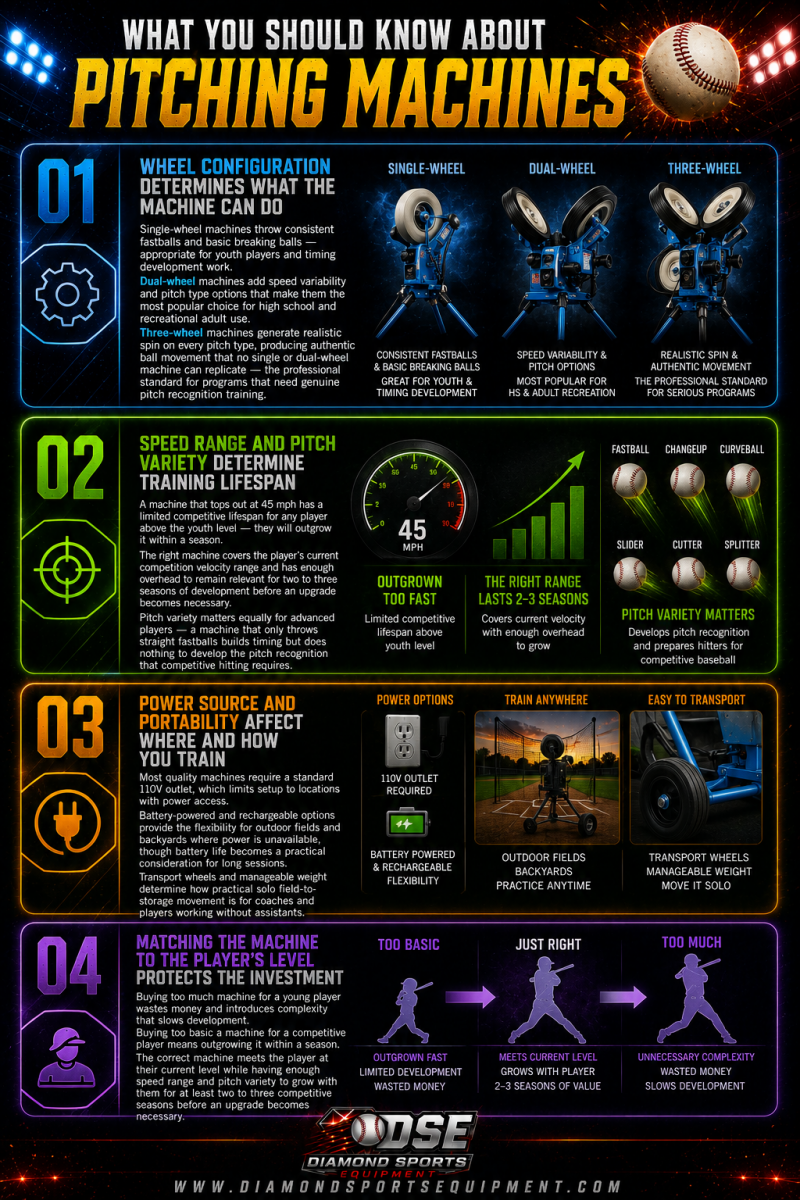
⚙️ Wheel Configuration Changes Training Capability
Single-wheel machines are strongest for repeatable fastballs, timing work, and high-volume contact reps, while two-wheel systems add greater control over spin and pitch movement. Three-wheel machines expand that control further by independently adjusting multiple wheels, making it easier to create a wider variety of realistic pitch shapes and locations for advanced recognition work.
🎯 Speed Range and Pitch Variety Determine Training Lifespan
Speed range should cover the velocities a player trains against now while leaving enough usable range for continued development. A machine with a lower maximum speed can work extremely well for younger hitters but may become less useful as game velocities increase, while purchasing significantly more speed than a developing player needs does not automatically improve training quality.
Pitch variety becomes more important as hitters progress. Consistent straight pitches are valuable for timing and contact work, while two-wheel and three-wheel systems provide greater control over movement and pitch shape for players working on recognition against breaking and off-speed pitches.
🔌 Power Source and Portability Affect Where and How You Train
Most quality machines require a standard 110V outlet, which limits setup to locations with power access. Battery-powered and rechargeable options provide the flexibility for outdoor fields and backyards where power is unavailable, though battery life becomes a practical consideration for long sessions. Transport wheels and manageable weight determine how practical solo field-to-storage movement is for coaches and players working without assistants.
🧒 Matching the Machine to the Player's Level Protects the Investment
Buying more machine than a young hitter can realistically use adds cost and complexity without necessarily improving development, while an overly limited machine can restrict the training options available to an advanced player. Match the speed range, pitch capability, controls, and portability to the player's current level first, then consider whether the machine leaves enough useful capacity for the way that player or program is likely to train in the future.
🏆 Best Pitching Machines for Practice (2026 Guide)
Six machines covering every wheel configuration, speed range, power source, and player level — from youth recreational through elite competitive program use.
⚡ Jugs BP1 Baseball Only Pitching Machine
Best For: Baseball programs and players who want repeatable baseball-only batting practice across a broad 15–70 mph speed range.
Construction: Single-wheel baseball pitching machine built around a 16-inch pneumatic tire, long straight legs for a realistic baseball release height, and a 360-degree swivel base that also allows the machine to be used for defensive ground-ball, fly-ball, and pop-up drills.
Material: Heavy-duty steel frame with weather-resistant components and a 16-inch pneumatic pitching tire.
Performance Feel: Consistent, repeatable baseball delivery with digital speed adjustment from 15–70 mph. The BP1 is designed around accurate straight-pitch repetition rather than the multi-wheel breaking-pitch control found on more advanced machines.
Ideal Player: Youth league through high school and college baseball players, pitching-machine leagues, teams, and programs that prioritize high-volume timing and contact work.
Performance Overview: The Jugs BP1 Baseball Only Pitching Machine is a straightforward baseball-only machine built around consistency, useful speed range, and full-field training versatility. Its digital readout allows coaches to set pitch speed precisely, while the long legs provide a baseball-appropriate release point. The 360-degree swivel also expands its usefulness beyond batting practice into defensive drills. It runs from standard 110V power and is compatible with JUGS-supported portable power options for locations where outlet access is limited.
Why It Stands Out:
- 15–70 mph adjustable speed range with digital readout.
- Baseball-specific release height.
- 360-degree swivel for grounders, fly balls, and pop-ups.
- Accepts real baseballs and multiple JUGS training-ball formats.
- 75-pound design can be broken down and moved by one person.
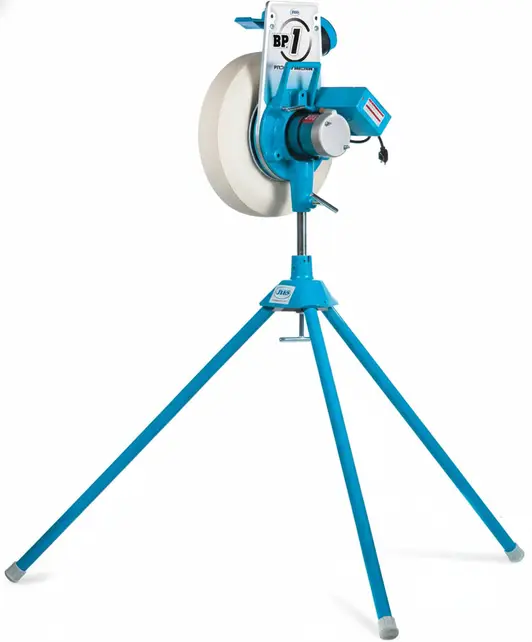
🔧 JUGS PS50 Baseball and Softball Pitching Machine
Best For: Youth baseball and softball players, families with athletes in both sports, and youth programs that want one powered machine capable of handling both ball sizes.
Construction: Single-wheel electric pitching machine with separate baseball and softball chutes, adjustable Quick-Snap legs, digital speed control, and sport-specific setup options for baseball and softball release angles.
Material: Heavy-duty steel construction with a 1/4-horsepower motor and pitching wheel system built for repeated youth practice use.
Performance Feel: Controlled and predictable, with speeds adjustable from 15–50 mph. The PS50 delivers repeatable fastballs for baseball and fastpitch training and can also be configured for slowpitch softball arcs.
Ideal Player: Backyard hitters, youth leagues, developing baseball and softball players, and families looking for dual-sport capability without moving into a higher-speed program machine.
Performance Overview: The JUGS PS50 Baseball and Softball Pitching Machine provides genuine baseball-and-softball versatility, but it is best viewed as a youth and development machine rather than a high-speed adult program machine. Separate ball chutes and adjustable leg configurations allow it to accommodate the different ball sizes and release requirements of the two sports, while the digital speed display makes it easy to match practice velocity to the hitter.
Why It Stands Out:
- 15–50 mph adjustable speed range.
- Separate 9-inch baseball and 12-inch softball chutes.
- Handles baseball, fastpitch softball, and slowpitch practice.
- 50-pound steel construction with Quick-Snap legs.
- Runs from standard 110V AC power.
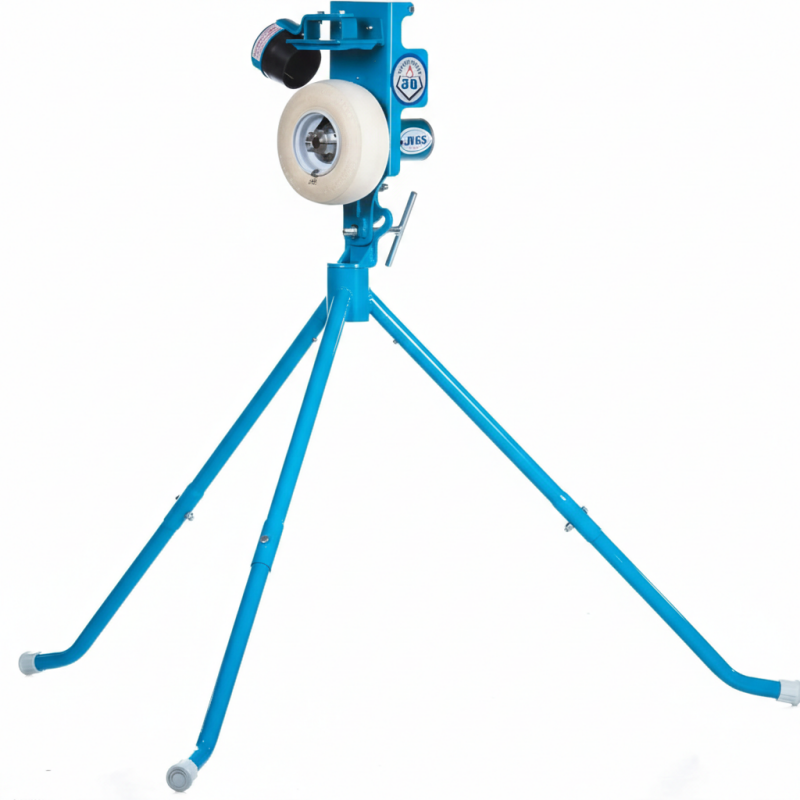
🏟️ Junior Hack Attack Baseball Pitching Machine by Sports Attack
Best For: Competitive travel ball programs, high school organizations, and serious training families who want three-wheel pitching machine performance — realistic ball movement, authentic pitch spin, and genuine pitch variety — at a more accessible investment level than the full-size Hack Attack
Construction: Three-wheel pitching machine platform scaled for baseball use — three independently adjustable wheels mounted on a heavy-duty steel frame that allow operators to dial in virtually any pitch type with realistic spin and velocity by adjusting each wheel's speed independently relative to the other two, the same fundamental engineering principle that makes the full-size Hack Attack the professional standard applied to a more accessible package
Material: Sports Attack's proprietary rubber wheel compound on all three wheels, with heavy-duty steel frame construction throughout — the wheel material maintains consistent grip across thousands of pitches without the significant wear degradation that lower-quality rubber compounds develop under the daily use loads that competitive programs produce across a full training season
Performance Feel: A pitch quality that no single or dual-wheel machine can match — the three-wheel configuration generates genuine ball movement with realistic spin on every pitch type, forcing hitters to read the rotation and trajectory rather than simply timing a consistent mechanical feed, which is the specific training stimulus that develops real pitch recognition rather than machine timing
Ideal Player Type: Travel ball coaches, high school programs, and competitive families who have reached the ceiling of what single and dual-wheel machines can deliver for their players' development and need the training quality that realistic three-wheel pitch movement provides — but whose budget or program scale makes the full Hack Attack a larger investment than the current situation requires
Performance Overview: The Junior Hack Attack Baseball Pitching Machine by Sports Attack earns its third-place position by bringing genuine three-wheel pitching machine performance into the range of competitive programs that cannot justify the full Hack Attack investment — delivering the pitch variety, realistic ball movement, and authentic spin that are qualitatively different from anything a single or dual-wheel machine produces. The ability to throw realistic breaking balls, off-speed pitches, and fastballs with true rotation gives hitters the pitch recognition training that competitive performance at the plate requires and that single-wheel machine repetition alone never develops — because recognizing a breaking ball from a fastball out of the hand is a skill built through exposure to realistic ball movement, not through timing a consistent flat-spin mechanical feed at increasingly higher speeds. Sports Attack's construction quality ensures the machine holds its three-wheel calibration and delivers consistent pitch types through the heavy program use that competitive training schedules produce, making this the strongest mid-tier investment in this guide for programs that prioritize pitch variety and training realism over raw batting practice volume.
Why It Stands Out:
- Three-wheel configuration delivers realistic ball movement and authentic spin unavailable from any single or dual-wheel machine.
- Can throw virtually any pitch type — fastballs, curveballs, sliders, changeups, and two-seamers — with true rotation.
- Forces hitters to read and react to pitch type rather than timing a consistent mechanical feed.
- Sports Attack construction quality maintains three-wheel calibration through heavy competitive program use.
- Brings three-wheel performance into a more accessible range than the full-size Hack Attack requires.
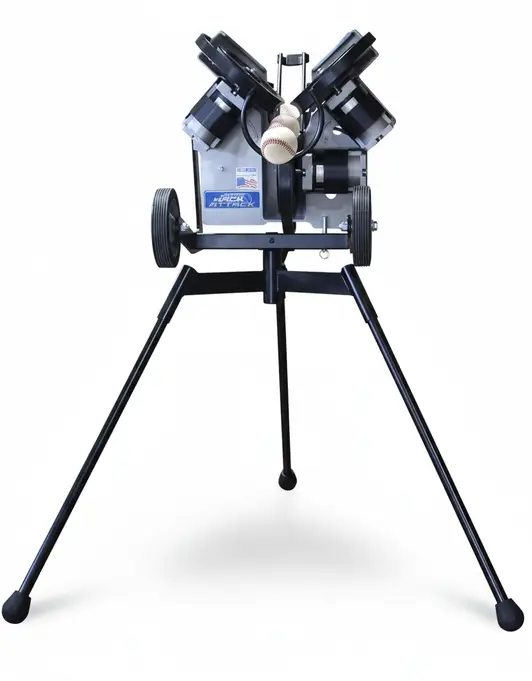
⚡ Performance Differences Between Pitching Machines
The biggest performance differences between pitching machines come from wheel configuration, pitch variety, velocity range, feed consistency, and how easily the machine fits the player’s actual training environment. Single-wheel machines work well for repeatable timing and contact reps, while multi-wheel systems give advanced hitters more control over pitch movement and location for recognition work. Power source matters just as much as pitch capability — a professional electric machine may deliver excellent repetition but still be the wrong choice for a player who trains at fields without reliable outlets, while battery-powered designs trade some top-end capability for much greater flexibility. Programs building a permanent high-volume machine station can compare containment options in 🥅 Best Batting Cage Nets (2026 Guide), while hitters who want to pair machine timing work with mechanics-focused training can add 🏏 Swing Trainers for Hitters (2026 Guide).
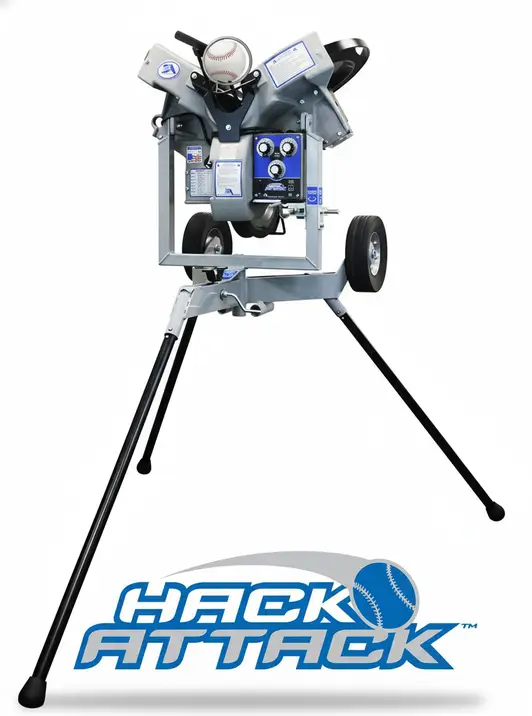
🔴 Hack Attack Baseball Pitching Machine by Sports Attack
Best For: Advanced high school, college, professional, and commercial training programs that need three-wheel control over velocity, spin, location, and breaking-pitch shape.
Construction: Three-wheel pitching machine using three independently controlled variable-speed motors and 14-inch concave throwing wheels, with an adjustable pitching head and a standard baseball release point of approximately 53 inches.
Material: Heat-treated alloy and weather-resistant aluminum components in the throwing head with a rugged powder-coated steel frame built for high-volume program use.
Performance Feel: Highly adjustable and game-oriented. The three-wheel design can deliver fastballs and right- or left-handed breaking pitches including curves, sliders, and split-finger pitches while allowing coaches to change movement through wheel-speed adjustments rather than repositioning the entire throwing head.
Ideal Player: Advanced competitive hitters and programs that need realistic pitch variety rather than only repeatable straight-pitch batting practice.
Performance Overview: The Hack Attack Baseball Pitching Machine by Sports Attack is Sports Attack's full-size three-wheel baseball machine. It reaches 100+ mph, gives hitters full visual tracking of the ball through the feeding and release process, and lets coaches adjust pitch elevation within the strike zone. Its biggest advantage over simpler machines is the amount of control available over speed, spin, movement, and pitch selection.
Why It Stands Out:
- Three independently controlled throwing wheels.
- 100+ mph maximum speed.
- Throws fastballs, curves, sliders, split fingers, and other breaking pitches.
- Approximately 53-inch standard baseball release point.
- Designed for high school, college, professional, and commercial use.
🔵 Louisville Slugger Blue Flame Pitching Machine
Best For: Youth baseball and softball players, machine-pitch leagues, recreational practice, and coaches who need a simple machine that works anywhere without electricity.
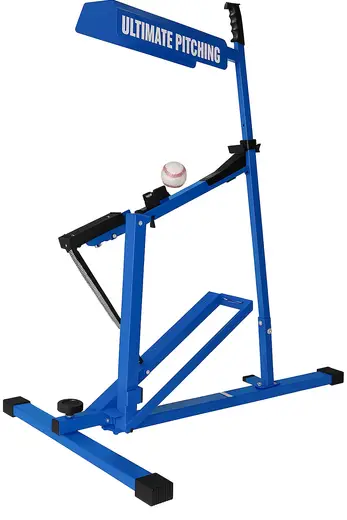
Construction: Fully manual spring-loaded pitching machine using an adjustable throwing arm, power spring, release mechanism, and foot-operated loading system. It does not use an electric motor or pitching wheel.
Material: Durable metal frame and throwing-arm assembly with replaceable mechanical spring and adjustment components.
Performance Feel: Simple and repeatable once properly adjusted. With regulation baseballs and softballs, the Blue Flame operates roughly in the 18–45 mph range and can also be adjusted for fielding drills, including fly balls and grounders.
Ideal Player: Young developing hitters, coach-pitch and machine-pitch players, recreational teams, and families practicing at parks or fields where electricity is unavailable.
Performance Overview: The Louisville Slugger Blue Flame Pitching Machine is fundamentally different from the powered wheel machines in this guide. Its spring-loaded mechanical design requires no electricity, battery, motor, or extension cord, making it inexpensive to operate and easy to use almost anywhere. It is particularly useful for youth hitting development where repeatable strikes at manageable speeds matter more than advanced pitch movement.
Why It Stands Out:
- Fully manual operation with no electricity or battery required.
- Roughly 18–45 mph with regulation baseballs and softballs.
- Spring-loaded adjustable throwing system.
- Can also be configured for fly-ball and ground-ball drills.
- Widely used in youth machine-pitch environments.
🌀 Zooka ZS740 Baseball Pitching Machine
Best For: Players and teams that need a portable baseball pitching machine for parks, fields, and other locations where electrical outlets are inconvenient or unavailable.
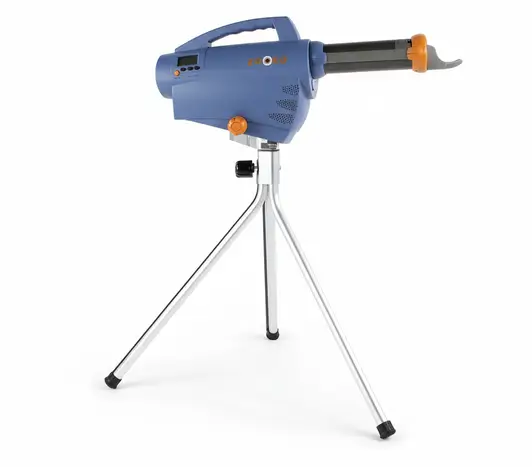
Construction: Enclosed compressed-air pitching system powered by an internal rechargeable battery. Unlike conventional pitching machines, the ZS740 uses no exposed spinning pitching wheels.
Material: High-impact polycarbonate outer housing with a high-strength aluminum-alloy barrel and tripod.
Performance Feel: Digitally controlled and repeatable, with adjustable speeds from 10–70 mph. The ZS740 can deliver topspin fastballs and computer-controlled changeups while maintaining speed consistency within approximately ±1 mph.
Ideal Player: Youth through adult baseball players, families, teams, and coaches who value portability and cordless field use more than the broad breaking-pitch selection of a three-wheel machine.
Performance Overview: The Zooka ZS740 Baseball Pitching Machine combines compressed-air delivery with an internal 12-volt rechargeable battery, creating a self-contained machine that weighs less than 30 pounds with the tripod. Zooka rates the machine for roughly 700–900 pitches per charge depending on throwing speed, giving it enough capacity for extended practices without cords or a generator.
Why It Stands Out:
- 10–70 mph adjustable speed range.
- Compressed-air delivery with no exposed spinning wheels.
- Internal rechargeable battery.
- Approximately 700–900 pitches per charge depending on speed.
- Less than 30 pounds with tripod.
- Throws fastballs and computer-controlled changeups.

📊 Pitching Machines Snapshot (2026)
- ⚡ Jugs BP1 Baseball Only Pitching Machine — 15–70 mph baseball-only single-wheel machine built for consistent batting practice and defensive drills.
- 🔧 JUGS PS50 Baseball and Softball Pitching Machine — 15–50 mph dual-sport machine with separate baseball and softball chutes for youth and developmental training.
- 🏟️ Junior Hack Attack Baseball Pitching Machine by Sports Attack — Three-wheel machine delivering approximately 35–70+ mph with advanced control over pitch movement for developing competitive hitters.
- 🔴 Hack Attack Baseball Pitching Machine by Sports Attack — Full-size three-wheel machine reaching 100+ mph with advanced fastball and breaking-pitch control for high-level programs.
- 🔵 Louisville Slugger Blue Flame Pitching Machine — Manual spring-loaded machine requiring no power and delivering manageable youth baseball and softball practice speeds.
- 🌀 Zooka ZS740 Baseball Pitching Machine — Battery-powered compressed-air machine with a 10–70 mph range, fastballs, changeups, and cord-free portability.
❓ FAQ
What type of pitching machine is best for a youth player?
- Youth players generally benefit most from repeatable pitches at manageable speeds rather than maximum velocity or advanced breaking-pitch capability.
- A manual machine such as the Louisville Slugger Blue Flame works well for simple machine-pitch and backyard practice, while an electric option such as the JUGS PS50 adds digital speed control and powered repetition for developing hitters.
- Match the machine's minimum and maximum speeds to the player's current training needs before comparing more advanced features.
Can one machine work for both baseball and softball?
- Yes, but the machine must be specifically designed or configured for both ball sizes.
- The JUGS PS50 uses separate baseball and softball chutes and sport-specific setup adjustments, while other machines may require different components or conversion kits.
- Always follow the manufacturer's ball-size and setup requirements rather than assuming a baseball-only machine can safely feed softballs.
Do I need a three-wheel machine or will single-wheel work?
- Single-wheel machines are adequate for timing development and high-volume fastball work at the youth and recreational level.
- Three-wheel machines are worth the investment for competitive players whose primary development need is pitch recognition and realistic ball movement — the Junior Hack Attack or Hack Attack are the correct choices at that stage.
What balls should I use with a pitching machine?
- Follow the ball-compatibility guidance for the specific machine. Some machines are designed to throw both regulation leather balls and dedicated pitching-machine balls, while others have more restrictive requirements.
- Using one consistent ball type during a session generally produces more repeatable pitch speed and location than mixing balls with different weights, seams, or surface materials.
- Do not assume regulation game balls are prohibited — machines such as the JUGS BP1, Sports Attack Hack Attack, and Zooka ZS740 are designed to accept specified regulation baseballs as well as certain training balls.
🧢 Final Thoughts
The best pitching machine for practice depends on what the hitter actually needs to train. A youth player learning basic timing may get more useful work from a simple manual or lower-speed machine than from an advanced three-wheel system, while competitive programs developing pitch recognition can benefit from greater control over velocity, spin, movement, and location.
Power access and portability matter just as much as pitch capability. The Jugs BP1 Baseball Only Pitching Machine and JUGS PS50 Baseball and Softball Pitching Machine fit powered practice environments, the Junior Hack Attack Baseball Pitching Machine by Sports Attack and Hack Attack Baseball Pitching Machine by Sports Attack provide advanced three-wheel control, the Louisville Slugger Blue Flame Pitching Machine eliminates power requirements entirely, and the Zooka ZS740 Baseball Pitching Machine combines battery operation with compressed-air portability. Matching those differences to the player's level and training location is more important than simply buying the machine with the longest feature list.
For additional hitting-development equipment, continue with ⚾ Best Baseball Training Tools & Equipment (2026). For the complete collection of baseball and softball equipment reviews and buying guides, visit 📝 Diamond Sports Equipment Blog & Gear Reviews.