The base runner who slides headfirst into second without a mitt on is making the same bet every time — that the fielder's tag is going to miss, that the cleat isn't going to find the back of the hand on the swipe, that the base edge won't be at exactly the wrong angle when the extension hits. Most of the time that bet pays off. The one time it doesn't is a broken finger, a fractured knuckle, or a hand that is out of the lineup for six to eight weeks because the $20 decision to skip protection turned into a $2,000 medical bill and a missed postseason run. Sliding mitts have become standard equipment at every competitive level above recreational youth ball for exactly that reason — the play is too fast, the contact is too unpredictable, and the hands are too important to leave unprotected when a piece of padded neoprene, spandex, or reinforced nylon locks onto the wrist in ten seconds and changes nothing about how the runner moves or reads pitchers while eliminating the entire category of hand injury that headfirst base running produces. The 2026 sliding mitt market covers every base running profile — low-profile everyday designs for the runner who goes on every count, dual-layer hardshell construction for the player who takes the most aggressive slides on the most demanding field surfaces, durable neoprene and EVA foam padding with a precise hand-specific fit, bold universal-fit designs that pair palm-and-wrist coverage with on-field personality, and breathable lightweight construction for warm-weather high-frequency use. Every mitt in this guide is confirmed in inventory and matched to a specific runner profile, field condition, and protection need. Players building out a complete base running protective setup should also check out 🧤 Sliding Mitts & Hand Guards (2026) for the full hand and wrist protection breakdown across every design and protection tier. For the full ranked lineup, see the 🧤 Sliding Mitts for Aggressive Base Running (2026).
⚾ What You Should Know About Sliding Mitts
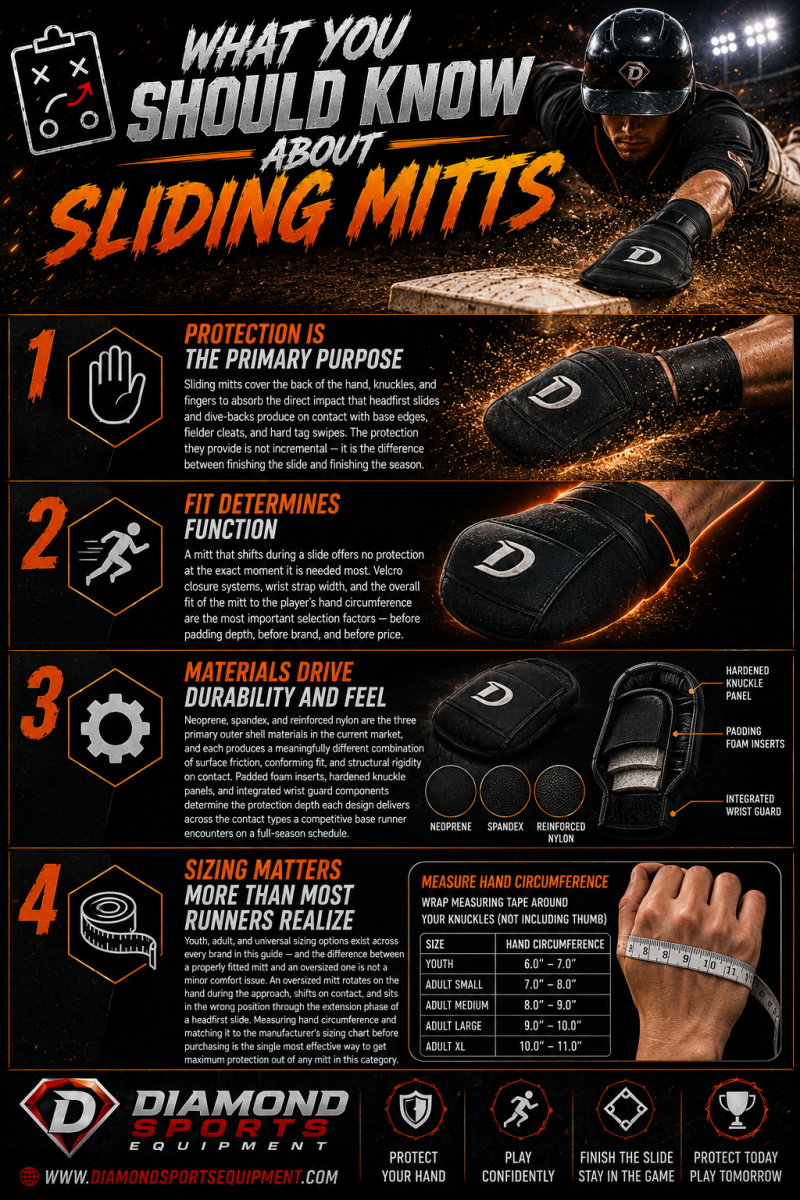
🤚 Protection Is the Primary Purpose
Sliding mitts cover the back of the hand, knuckles, and fingers to absorb the direct impact that headfirst slides and dive-backs produce on contact with base edges, fielder cleats, and hard tag swipes. The protection they provide is not incremental — it is the difference between finishing the slide and finishing the season.
🏃 Fit Determines Function
A mitt that shifts during a slide offers no protection at the exact moment it is needed most. Velcro closure systems, wrist strap width, and the overall fit of the mitt to the player's hand circumference are the most important selection factors — before padding depth, before brand, and before price.
🔧 Materials Drive Durability and Feel
Neoprene, spandex, and reinforced nylon are the three primary outer shell materials in the current market, and each produces a meaningfully different combination of surface friction, conforming fit, and structural rigidity on contact. Padded foam inserts, hardened knuckle panels, and integrated wrist guard components determine the protection depth each design delivers across the contact types a competitive base runner encounters on a full-season schedule.
📏 Sizing Matters More Than Most Runners Realize
Youth, adult, and universal sizing options exist across every brand in this guide — and the difference between a properly fitted mitt and an oversized one is not a minor comfort issue. An oversized mitt rotates on the hand during the approach, shifts on contact, and sits in the wrong position through the extension phase of a headfirst slide. Measuring hand circumference and matching it to the manufacturer's sizing chart before purchasing is the single most effective way to get maximum protection out of any mitt in this category.
🏆 Best Sliding Mitts for Base Stealers (2026)
Six sliding mitts built for aggressive base runners at every competitive level — from youth travel ball through high school and adult league play — each matched to a specific runner profile, closure system, and protection depth.
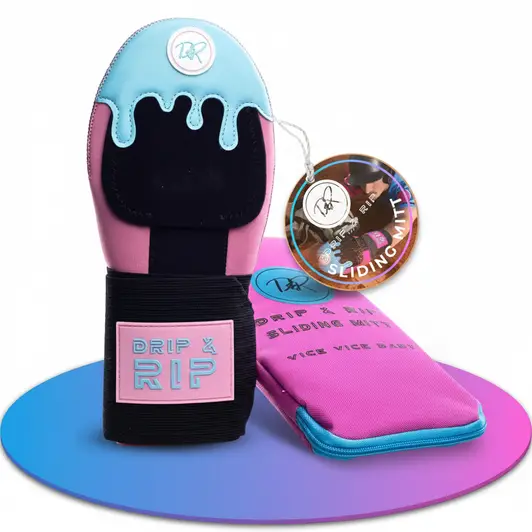
🖐️ Drip & Rip Sliding Mitt
Best For: Aggressive travel ball and high school base runners who want a low-profile neoprene design that combines visual identity with protective performance without adding bulk to the hand
Construction: Single-piece padded shell with reinforced knuckle zone, elasticized wrist sleeve, and velcro closure strap — designed to sit flush against the hand through every phase of the base running sequence from read to extension
Material: Neoprene outer shell with foam padding inserts and durable velcro closure — neoprene provides the conforming, low-friction surface profile that allows the mitt to stay positioned during approach without catching air or dragging during the slide
Performance Feel: Lightweight and low-profile from the moment it goes on — the Drip & Rip sits flush against the hand with minimal bulk and allows full natural finger movement through the approach phase, delivering a firm padded surface the moment contact occurs without the stiff, restrictive feel that over-built entry-level designs produce on a hand that needs to move freely before the slide starts
Ideal Player Type: The travel ball and high school base runner who goes on every count, runs on a short lead, and needs a mitt that keeps up with a pace of play that doesn't allow for adjustment time once the read is made — the runner who wants protection that is essentially invisible until it is needed
Performance Overview: The Drip & Rip Sliding Mitt brings a combination of visual identity and functional protection that stands out in a market where most neoprene mitt designs are indistinguishable from each other in construction and appearance. The padded knuckle zone absorbs direct impact from fielder tags and base edge contact on the hardest headfirst slides without compressing flat on repeated impact — the failure mode that under-built foam inserts produce after a few weeks of regular competitive use. The elasticized wrist sleeve keeps the mitt positioned through the full transition from approach to extension without the velcro-only reliance that standard single-strap designs depend on, and the velcro closure strap locks the fit in place for players who size correctly before putting it on. The low-profile neoprene construction means there is no extra bulk catching air on the approach, no trailing material dragging on the dirt surface during the slide, and no repositioning required between plays. For the base runner who wants a mitt that functions the way protective equipment should — consistently present, structurally reliable, and completely out of the way until it absorbs the contact it was built to handle — the Drip & Rip delivers that performance on every play.
Why It Stands Out:
- Padded knuckle zone absorbs direct tag and base contact repeatedly without compressing flat on impact.
- Elasticized wrist sleeve supplements velcro closure to keep mitt positioned through full extension.
- Low-profile neoprene construction eliminates bulk that catches air or drags during headfirst slides.
- Velcro closure strap provides a secure, adjustable fit across hand sizes when properly sized.
- Distinctive design gives competitive runners team identity without any trade-off in protective function.
⚔️ Dirty Mids Savage Series Sliding Mitt
Best For: High school and adult league base runners who take the hardest, most aggressive headfirst slides on competitive field surfaces and need dual-layer protection depth that single-shell designs cannot provide
Construction: Dual-layer padded shell with extended finger coverage, reinforced impact zone positioned directly over the knuckle ridge, and a hardened knuckle panel that intercepts direct impacts at the highest-force contact point a headfirst slide produces
Material: Spandex blend outer with dense foam padding and hardened knuckle panel — the spandex blend allows the outer shell to move with natural hand articulation during the approach phase while the dense foam and hardened panel combination behind it handles the impact load that the approach motion never produces but the slide always does
Performance Feel: Noticeably more substantial than any single-layer design in the market — the Savage Series delivers a planted, secure feel on contact that gives competitive base runners the confidence to extend fully on a close play without pulling up instinctively to protect the hand, and it achieves that feel without the wrist-locking stiffness that over-built protection designs add to a hand that needs full range of motion through the full sequence
Ideal Player Type: The competitive high school and adult league base runner who takes hard slides on rough, poorly maintained, or hard-packed field surfaces — the runner who has experienced single-layer foam compressing flat on a hard tag and wants a mitt that handles that contact profile without giving ground on impact
Performance Overview: The Dirty Mids Savage Series Sliding Mitt is built for the base runner who runs through close plays at full commitment rather than pulling up or going in feet-first to manage the hand exposure that a headfirst dive creates on a contested play. The dual-layer padded shell extends protective coverage from the knuckles through the full back of the hand, and the hardened knuckle panel sits directly over the knuckle ridge — the area that takes the highest-force direct impact on a fielder tag swipe and the base edge contact that occurs when a slide arrives at slightly the wrong angle relative to the bag. The spandex blend outer material allows the natural hand movement that a runner needs through the approach phase without creating pressure points that build into distraction before the slide begins, and the reinforced impact zone holds its structure through the repeated compression cycles that a full season of competitive base running produces on every layer of padding behind the outer shell. The extended finger coverage addresses the fingertip exposure that standard mitt designs leave partially unguarded at the edges of the contact zone — the area where glancing tag contact produces the finger injuries that single-size protection footprints miss.
Why It Stands Out:
- Dual-layer padded shell provides protection depth that no single-layer design in the market matches.
- Hardened knuckle panel intercepts direct impacts at the highest-force contact point on a headfirst slide.
- Extended finger coverage addresses the fingertip exposure that standard protection footprints leave unguarded.
- Spandex blend outer allows natural hand movement through approach without pressure point buildup.
- Reinforced impact zone holds structure through the repeated compression of a full competitive season.
🦌 Holy Elks Sliding Mitt
Best For: Youth travel ball players and recreational adult league base runners who want a dependable, well-fitted mitt that delivers consistent protective performance through a full season of regular use without the price premium that premium brand designs carry
Construction: Single-padded shell with molded wrist strap, reinforced palm guard, and EVA foam padding — a straightforward protection architecture that prioritizes durability and fit consistency over the layered complexity that higher-price designs add for competitive use scenarios
Material: Synthetic leather outer with EVA foam padding and adjustable hook-and-loop closure — the synthetic leather outer provides meaningful abrasion resistance on dirt and gravel field surfaces while the EVA foam maintains its shape through repeated compression cycles better than the low-density foam that budget mitt designs use to hit a price point at the expense of longevity
Performance Feel: Comfortable straight out of the package without any break-in period — the Holy Elks fits correctly from the first slide and the EVA foam delivers consistent cushion on every subsequent play without the gradual flattening that makes underbuild budget mitts ineffective before the season is halfway through
Ideal Player Type: The youth travel ball player whose parents want a protective mitt that will hold up through the season without needing replacement, and the recreational adult league base runner who slides infrequently but wants reliable protection when the play demands a headfirst attempt — both player types who benefit from durable construction at a price point that doesn't require premium budget allocation
Performance Overview: The Holy Elks Sliding Mitt earns its position in this guide by solving the most common problem in the accessible price tier of the sliding mitt market — the EVA foam that flattens within four to six weeks of regular competitive use and leaves the runner with a mitt that occupies the hand without providing meaningful protection. The EVA foam in the Holy Elks holds its shape through the full compression cycle of a regular-use season because it is the right density for a single-layer design — not the soft, compressible foam that entry-level designs use to produce a comfortable initial feel at the cost of structural longevity. The synthetic leather outer resists the surface abrasion that dirt, gravel, and poorly maintained field surfaces produce on a headfirst slide without cracking, peeling, or separating from the underlying foam structure the way vinyl and budget synthetic materials do under repeated abrasion. The adjustable hook-and-loop closure accommodates a range of hand sizes without requiring a perfect size match — a practical advantage for youth programs purchasing a consistent mitt across a squad of players whose hand sizes vary enough to make size-specific ordering a logistics problem.
Why It Stands Out:
- EVA foam density is calibrated for structural longevity — retains shape through a full season of regular use.
- Synthetic leather outer resists abrasion on dirt, gravel, and rough field surfaces without cracking or peeling.
- Adjustable hook-and-loop closure accommodates a range of hand sizes without size-specific ordering requirements.
- Comfortable from the first use with no break-in period required before the first competitive slide.
- Accessible price point makes it practical for youth programs outfitting multiple players simultaneously.
⚡ Performance Differences Between Sliding Mitts
The most important performance separation between the mitts in this guide is padding architecture — and it is a separation that most base runners don't think about until a mitt fails on a play that mattered. A single-layer EVA foam design like the Holy Elks delivers reliable everyday protection for youth and recreational players whose slides are lower-velocity, whose fields are reasonably maintained, and whose contact scenarios are less severe than what a competitive high school or adult league base runner encounters on a full-season schedule. A dual-layer shell with a hardened knuckle panel like the Dirty Mids Savage Series is a completely different protection profile built for a different contact scenario — high-velocity headfirst dives on hard-packed or rough field surfaces where impact forces are significantly greater and a single-layer foam design compresses flat on the first hard contact rather than distributing that force across two layers of material with different compression characteristics. The material difference between neoprene and spandex blend outer shells is the second performance variable worth understanding before selecting — neoprene conforms more naturally to the hand's contour and holds position more consistently during a slide, while spandex blend allows more hand articulation during the approach phase but requires denser foam inserts to compensate for the reduced structural rigidity the softer outer shell provides on contact. The fit profile is the third variable that separates the three mitts below from the first three — each addresses a different runner priority, from the precise hand-specific sizing of a dedicated left or right build, through the ambidextrous universal versatility that fits either hand, to the breathable construction that keeps the hand cool through a full warm-weather game. Players building a complete protective kit around their sliding mitt should also explore 🦵 Best Batter's Leg Guards (2026 Guide) for the lower-body protection that pairs with every mitt design in this guide, and 🧤 Sliding Mitts for Aggressive Base Running (2026) for the full base running protection breakdown across every design tier.
⛑️ MediCaptain Baseball Sliding Mitt
Best For: Competitive baseball and softball base runners who want dependable padded protection with a true left- or right-hand-specific fit rather than the compromise fit of a one-size universal design.
Construction: Padded sliding mitt with a neoprene shell and EVA foam padding across the back of the hand and knuckle zone, built in hand-specific left and right versions and a secure wrist strap closure that holds position through the full headfirst slide.
Material: Neoprene outer shell with EVA foam padding inserts — the neoprene conforms to the hand for a low-friction surface that stays put during the approach, and the EVA foam holds its shape through repeated compression rather than flattening out after a few weeks of regular competitive use.
Performance Feel: The MediCaptain Baseball Sliding Mitt sits cleanly on the hand with a hand-specific fit that a universal one-size mitt cannot match — because it is built for a left or a right hand specifically, the padding lands exactly where the contact comes on a headfirst dive instead of sitting slightly off-center the way a reversible design does on one of the two hands it is forced to fit.
Ideal Player Type: The competitive travel ball, high school, and adult league base runner who wants dependable everyday hand protection from a mitt that fits their lead hand precisely, available in both youth and adult sizing for a fit that matches hand size rather than approximating it.
Performance Overview: The MediCaptain Baseball Sliding Mitt delivers the core protection a base runner needs from an everyday mitt — neoprene-and-EVA padded coverage across the back of the hand and knuckles — with the hand-specific fit advantage that separates it from the universal designs that dominate the accessible price tier. The EVA foam is the right density for a single-layer mitt, holding its protective shape through a full season of regular use rather than compressing flat early, and the dedicated left and right builds put the padding exactly where the contact lands on the lead hand. Available in youth and adult sizing, the MediCaptain Baseball Sliding Mitt covers the everyday protection need for players at every competitive level who want a precise fit without a premium price.
Why It Stands Out:
- Hand-specific left and right builds place padding exactly where contact lands on the lead hand.
- EVA foam padding holds its protective shape through a full season without flattening early.
- Neoprene shell conforms to the hand for a low-friction fit that stays positioned through the slide.
- Youth and adult sizing matches the mitt to actual hand size rather than approximating it.
- Dependable everyday protection at an accessible price for competitive players at every level.

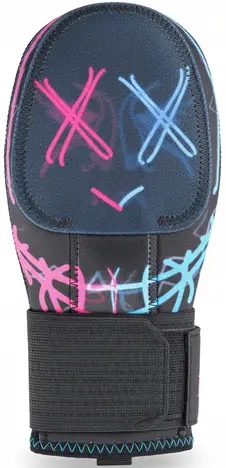
🎨 Big Crazy Sliding Mitt
Best For: Base runners who want bold on-field personality alongside genuine palm-and-wrist protection in a universal ambidextrous design that fits either hand for players who switch their lead or share gear across a squad.
Construction: Padded sliding mitt with an ambidextrous universal-fit build, protective coverage across the palm and wrist, and a secure wrist strap closure — designed to fit either the left or right hand and to deliver protection on the palm-side and wrist contact points as well as the back of the hand.
Material: Padded protective shell with foam cushioning and a universal-fit closure system — the ambidextrous construction lets the same mitt fit either hand, and the bold graphic-forward designs give the Big Crazy Sliding Mitt the on-field visual identity that style-conscious base runners want without giving up protective coverage.
Performance Feel: The Big Crazy Sliding Mitt brings personality to the base paths while covering the palm and wrist as well as the back of the hand — the universal ambidextrous fit means it works on either hand, which makes it the practical pick for a switch runner or a program sharing mitts across players, and the bold designs stand out in a category where most mitts look identical.
Ideal Player Type: The travel ball and youth-through-adult base runner who wants their gear to reflect their personality, the switch-lead runner who needs a mitt that fits either hand, and the program or family that wants one versatile ambidextrous design that fits across multiple players rather than ordering hand-specific.
Performance Overview: The Big Crazy Sliding Mitt earns its spot by pairing genuine palm-and-wrist protection with the bold, fun design identity and universal ambidextrous fit that set it apart from the standard look-alike mitts in the category. The protective coverage extends across the palm and wrist as well as the back of the hand, covering the contact points that a headfirst slide and a dive-back both produce, and the ambidextrous build means the same mitt fits either hand — a practical versatility advantage for switch runners, shared-gear programs, and families outfitting players whose lead hand varies. For the base runner who wants protection that performs and a design that stands out in the dugout and on the bases, the Big Crazy Sliding Mitt delivers both.
Why It Stands Out:
- Ambidextrous universal fit works on either hand for switch runners and shared-gear programs.
- Protective coverage extends across the palm and wrist, not just the back of the hand.
- Bold graphic-forward designs give base runners standout on-field identity in a look-alike category.
- Versatile fit makes it practical for families and programs outfitting players with varied lead hands.
- Genuine slide protection paired with personality for players who want both at an accessible price.

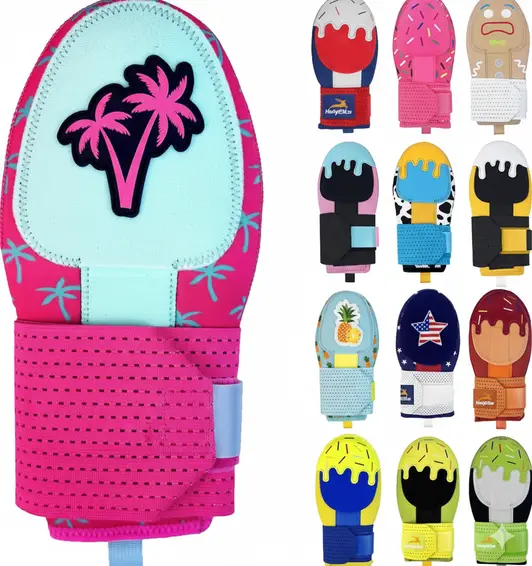
🌬️ Heyear Baseball Sliding Mitt
Best For: Youth and recreational base runners who play through warm-weather conditions and need a breathable, lightweight mitt that stays comfortable across a full game without the heat buildup a solid-shell design produces in summer play.
Construction: Lightweight sliding mitt with breathable, durable outer material, an adjustable elastic wrist strap, and padded back-of-hand coverage — built to deliver airflow and a secure snug fit while remaining portable enough to tuck into the back pocket of baseball pants between baserunning situations.
Material: Breathable, sturdy outer material with foam padding and an adjustable elastic wrist strap — the breathable construction allows airflow that a solid neoprene or hard shell never can, keeping the hand cooler through a full warm-weather game, while the elastic strap delivers a snug fit that prevents the mitt from slipping during the run.
Performance Feel: The Heyear Baseball Sliding Mitt is one of the lightest, most breathable designs a youth or recreational runner can wear — the breathable material keeps the hand cooler than a sealed-shell mitt through a hot summer game, and the adjustable elastic wrist strap locks the fit in so the mitt stays positioned through the approach and the slide without shifting or requiring readjustment between plays.
Ideal Player Type: Youth and recreational base runners in warm-weather climates, players who keep a mitt on across extended stretches of a game, and any developing runner who wants breathable comfort and a secure, easy-to-adjust fit that holds position from leadoff through the slide.
Performance Overview: The Heyear Baseball Sliding Mitt addresses the warm-weather comfort problem that solid-shell mitts create during a full summer game — the breathable outer material allows continuous airflow across the back of the hand rather than sealing it inside a heat-retaining shell, keeping the hand cooler and the runner more comfortable through the innings that matter most. The adjustable elastic wrist strap delivers a snug, secure fit that prevents the mitt from slipping during the run, the padded back-of-hand coverage protects the primary contact zone on a headfirst slide, and the lightweight build tucks easily into a back pocket between baserunning situations. For the youth and recreational base runner who plays in summer heat and wants breathable comfort without giving up protection, the Heyear Baseball Sliding Mitt is the lightweight choice.
Why It Stands Out:
- Breathable outer material allows airflow that keeps the hand cooler through warm-weather games.
- Adjustable elastic wrist strap locks in a snug fit that prevents slipping during the run.
- Lightweight build registers minimally on the hand through the approach and slide.
- Padded back-of-hand coverage protects the primary contact zone on every headfirst slide.
- Tucks easily into a back pocket between baserunning situations for quick access.


📊 Sliding Mitts Snapshot (2026)
- 🖐️ Drip & Rip Sliding Mitt — Low-profile neoprene design with reinforced knuckle zone and elasticized wrist sleeve for aggressive travel ball and high school base runners who want protection without bulk.
- ⚔️ Dirty Mids Savage Series Sliding Mitt — Dual-layer padded shell with hardened knuckle panel and extended finger coverage for competitive base runners taking high-velocity headfirst slides on demanding field surfaces.
- 🦌 Holy Elks Sliding Mitt — EVA foam with synthetic leather outer and adjustable hook-and-loop closure delivers durable, consistent protection for youth and recreational base runners at an accessible price point.
- ⛑️ MediCaptain Baseball Sliding Mitt — neoprene and EVA foam padding in a hand-specific left or right build delivering precise everyday protection for competitive base runners at every level.
- 🎨 Big Crazy Sliding Mitt — bold graphic design with ambidextrous universal fit and palm-and-wrist coverage for style-conscious runners who want protection on either hand.
- 🌬️ Heyear Baseball Sliding Mitt — breathable lightweight construction with an adjustable elastic wrist strap delivering cool, secure protection for warm-weather youth and recreational base runners.
❓ FAQ
What is a sliding mitt and do I really need one?
- A sliding mitt is a padded hand guard worn on the lead hand during base running to protect the fingers, knuckles, and back of the hand from direct contact with base edges, fielder cleats, and tag swipes on headfirst slides and dive-backs.
- Competitive players at every level from youth travel ball through high school and adult league use them — the protection they provide takes ten seconds to put on and eliminates the entire category of hand injury that unprotected headfirst base running produces.
What size sliding mitt should I buy?
- Measure your hand circumference around the knuckles and match it to the manufacturer's sizing chart — most brands offer distinct youth and adult options with some universal designs that accommodate a range through an adjustable closure system.
- A properly fitted mitt sits snug across the back of the hand without restricting finger movement, does not rotate during the approach phase, and does not shift position when the velcro closure is properly secured before the slide.
Can I wear a sliding mitt while batting?
- Sliding mitts are designed exclusively for base running and are not worn during at-bats — they are slipped on in the on-deck circle, at the plate after a walk, or at first base after reaching on a hit, and removed during defensive innings.
- Some players keep the mitt in their back pocket during the at-bat and slide it on while taking their lead at first base — a workflow that keeps the mitt accessible without requiring a trip back to the dugout between an at-bat and a base running situation.
How do I care for a sliding mitt to get a full season out of it?
- Rinse dirt, clay, and field debris off the mitt after each use with cool water and allow it to air dry completely before storing — machine washing accelerates foam padding breakdown and causes velcro closure degradation significantly faster than hand rinsing.
- Store the mitt flat or loosely rolled rather than folded under weight — foam inserts that are stored compressed under other equipment develop permanent creases that alter the protection profile the padding delivers on contact.
🧢 Final Thoughts
The sliding mitt a base runner chooses is not a complicated decision when the right framework is in place — match the protection depth to the slide velocity and field conditions the player actually encounters, match the closure system to the runner's history with mitt slippage or stability on close plays, and match the construction material to the climate and use frequency that the player's schedule produces across a full competitive season. The Drip & Rip and Holy Elks handle everyday protection across the widest range of players. The Dirty Mids Savage Series handles the high-velocity contact profile that everyday designs are underbuilt for. The MediCaptain delivers dependable padded protection with a precise hand-specific fit. The Big Crazy brings bold personality and ambidextrous versatility with full palm-and-wrist coverage. The Heyear solves the warm-weather comfort problem with breathable, lightweight construction. Every base runner in this guide can find a mitt that disappears on the hand during the approach, stays locked in position through the extension, and absorbs the contact that unprotected hands cannot. Players who want to complete their full protective kit from hand to arm should explore 🧤 Batting Gloves Built for Grip & Performance for the glove options that pair with every mitt design in this guide on every play from the on-deck circle to the base. For the complete library of baseball and softball gear guides across every category and player level, visit 📝 Diamond Sports Equipment Blog & Gear Reviews.
Add comment
Comments