The player who puts in the physical work without understanding the principles behind it is building strength and swing mechanics on a foundation that has gaps in it — and those gaps show up at the worst possible time, in the at-bat that matters most or the arm session that pushes past what the body was actually prepared to handle. Baseball development books written by coaches, hitting instructors, strength specialists, and professional players who have spent careers studying the exact skills every competitive baseball player needs to improve are the resources that fill those gaps — not with generic athletic advice, but with baseball-specific programs, hitting philosophies, strength training frameworks, and mental approach systems built for the demands of the sport at every competitive level from youth travel ball through high school and collegiate play. The six books in this guide cover the two categories that drive the most measurable improvement for position players and hitters specifically — strength training programs designed around the physical demands baseball places on the body, and hitting development resources that address swing mechanics, mental approach, bat path, and the line drive contact philosophy that translates directly into production at the plate. Every title is confirmed in inventory and matched to a specific development need, player level, and skill focus. Players who want the complete training book overview across every category should also check out 📚 Best Baseball Training Books (2026) for the full library breakdown. Players building out a complete development setup alongside their reading should explore 💪 Speed, Strength & Velocity Training Tools (2026) for the physical training tools that pair with every program in this guide.
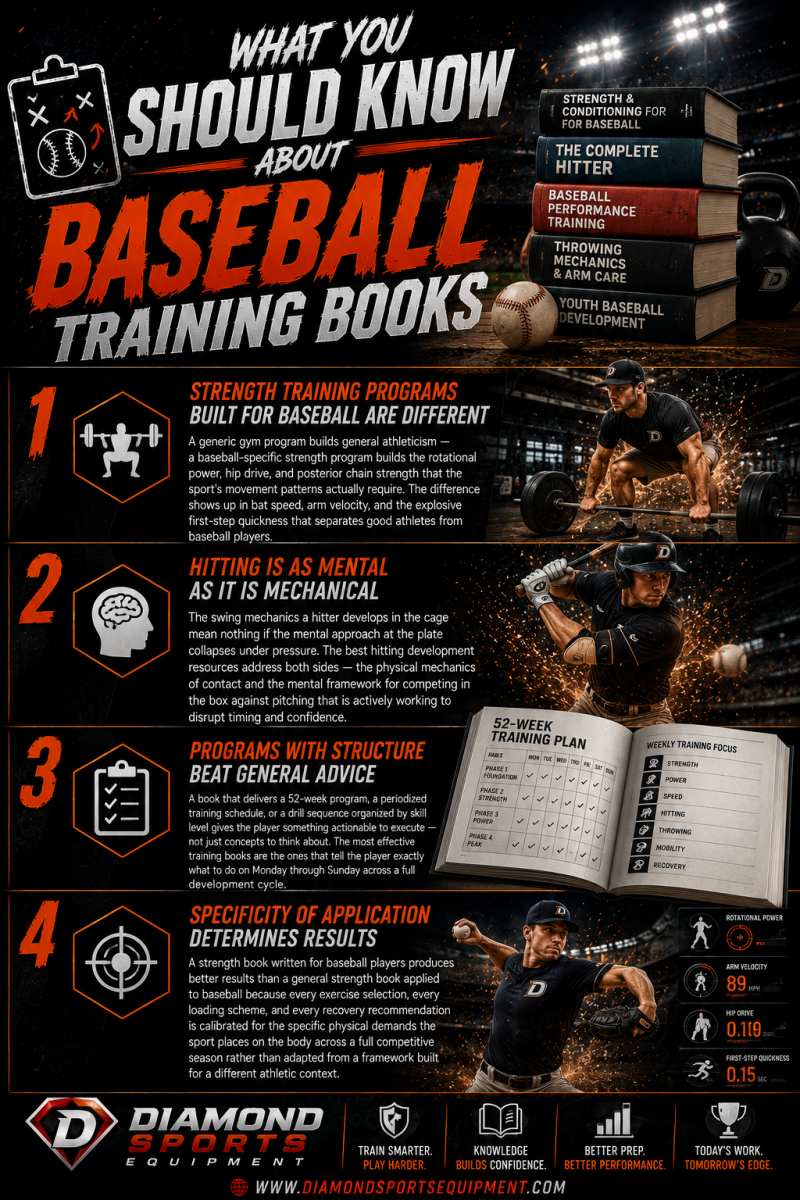
⚾ What You Should Know About Baseball Training Books
🏋️ Strength Training Programs Built for Baseball Are Different
A generic gym program builds general athleticism — a baseball-specific strength program builds the rotational power, hip drive, and posterior chain strength that the sport's movement patterns actually require. The difference shows up in bat speed, arm velocity, and the explosive first-step quickness that separates good athletes from baseball players.
🧠 Hitting Is as Mental as It Is Mechanical
The swing mechanics a hitter develops in the cage mean nothing if the mental approach at the plate collapses under pressure. The best hitting development resources address both sides — the physical mechanics of contact and the mental framework for competing in the box against pitching that is actively working to disrupt timing and confidence.
📋 Programs With Structure Beat General Advice
A book that delivers a 52-week program, a periodized training schedule, or a drill sequence organized by skill level gives the player something actionable to execute — not just concepts to think about. The most effective training books are the ones that tell the player exactly what to do on Monday through Sunday across a full development cycle.
🎯 Specificity of Application Determines Results
A strength book written for baseball players produces better results than a general strength book applied to baseball because every exercise selection, every loading scheme, and every recovery recommendation is calibrated for the specific physical demands the sport places on the body across a full competitive season rather than adapted from a framework built for a different athletic context.
🏆 Best Baseball Books for Strength & Hitting (2026)
Six titles covering baseball-specific strength development and hitting mastery — each matched to a specific player level, skill focus, and development need.
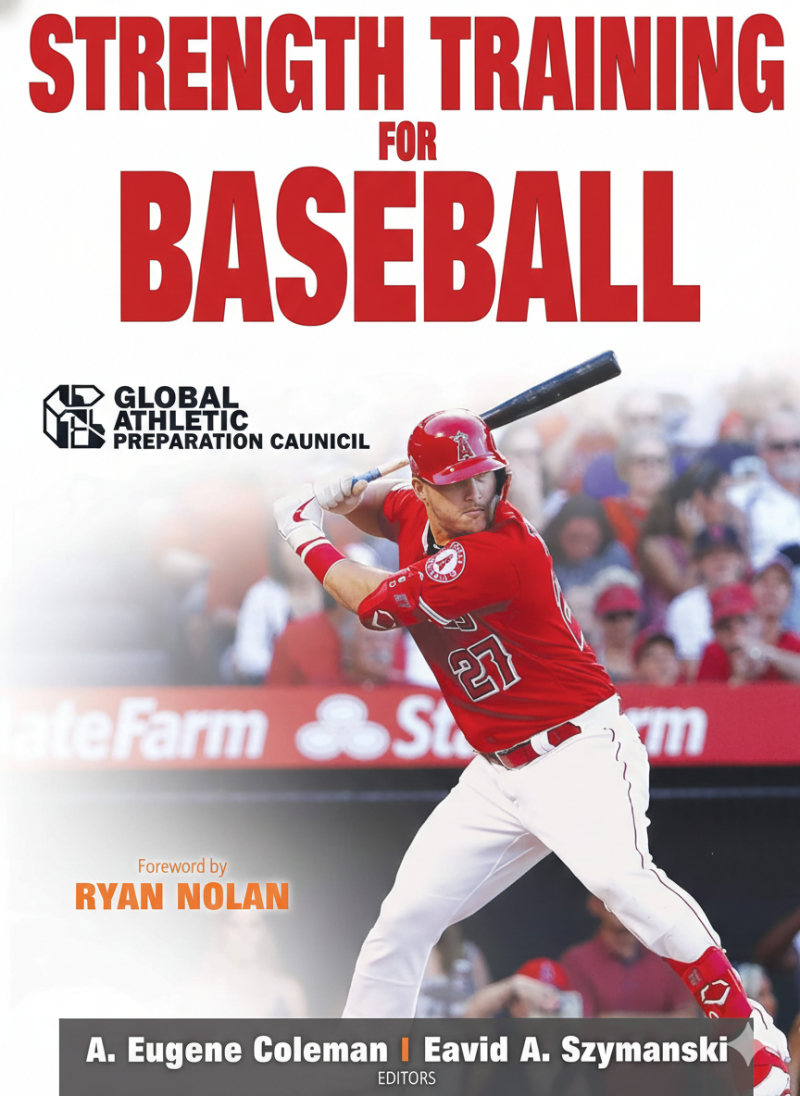
💪 Strength Training for Baseball
Best For: Position players and pitchers at the high school and collegiate level who want a baseball-specific strength program built around the rotational power, posterior chain development, and explosive athleticism that the sport's movement demands require
Construction: A baseball-specific strength training resource organized around the physical movement patterns the sport demands — rotational power development, hip hinge mechanics, lower body explosiveness, and the arm care principles that serious competitive players need to train around a baseball schedule without breaking down during the season
Material: Written content delivering baseball-specific strength programming — exercise selection, loading schemes, periodization frameworks, and recovery principles calibrated for athletes who are also playing and practicing baseball rather than generic gym programming adapted for a sport it was never designed to serve
Performance Feel: The kind of resource that makes a player realize how much of their previous gym work was general athletic training that happened near a baseball field rather than a program specifically designed to build the physical qualities that create better baseball performance — rotational explosiveness, hip drive depth, and the posterior chain strength that generates bat speed from the ground up
Ideal Player Type: The high school and collegiate position player or pitcher who is serious enough about development to train in the off-season and wants to know that every rep they put in is building the specific physical qualities that translate directly to on-field performance rather than general fitness that may or may not carry over to what baseball actually demands from the body
Performance Overview: Strength Training for Baseball delivers the baseball-specific physical development framework that serious competitive players at the high school and collegiate level need — not a general strength program that can be loosely applied to any sport, but a resource built around the exact movement patterns, energy systems, and physical demands that baseball places on the body across a full development cycle and competitive season. The rotational power development work addresses the hip-to-shoulder sequencing that generates bat speed and throwing velocity at the mechanical level, building the physical foundation that swing and pitching instruction sits on top of rather than assuming that foundation already exists. The posterior chain emphasis covers the glutes, hamstrings, and lower back strength that the sport's explosive movement patterns require but that most players neglect in favor of anterior-dominant gym work that builds appearance without building the specific strength profile baseball performance demands. The arm care principles and in-season training guidance allow players to maintain strength gains through a competitive schedule rather than losing the off-season development work by the second month of the season because the training load wasn't adjusted for what playing baseball four to five days a week actually does to the body's recovery capacity.
Why It Stands Out:
- Baseball-specific exercise selection builds the rotational power and posterior chain strength the sport demands.
- Hip-to-shoulder sequencing work develops the physical foundation that bat speed and arm velocity are built on.
- In-season training guidance allows players to maintain off-season strength gains through a competitive schedule.
- Arm care principles are integrated throughout rather than treated as a separate consideration after the main program.
- Written for baseball athletes specifically — not general athletic programming adapted for a sport it wasn't built for.
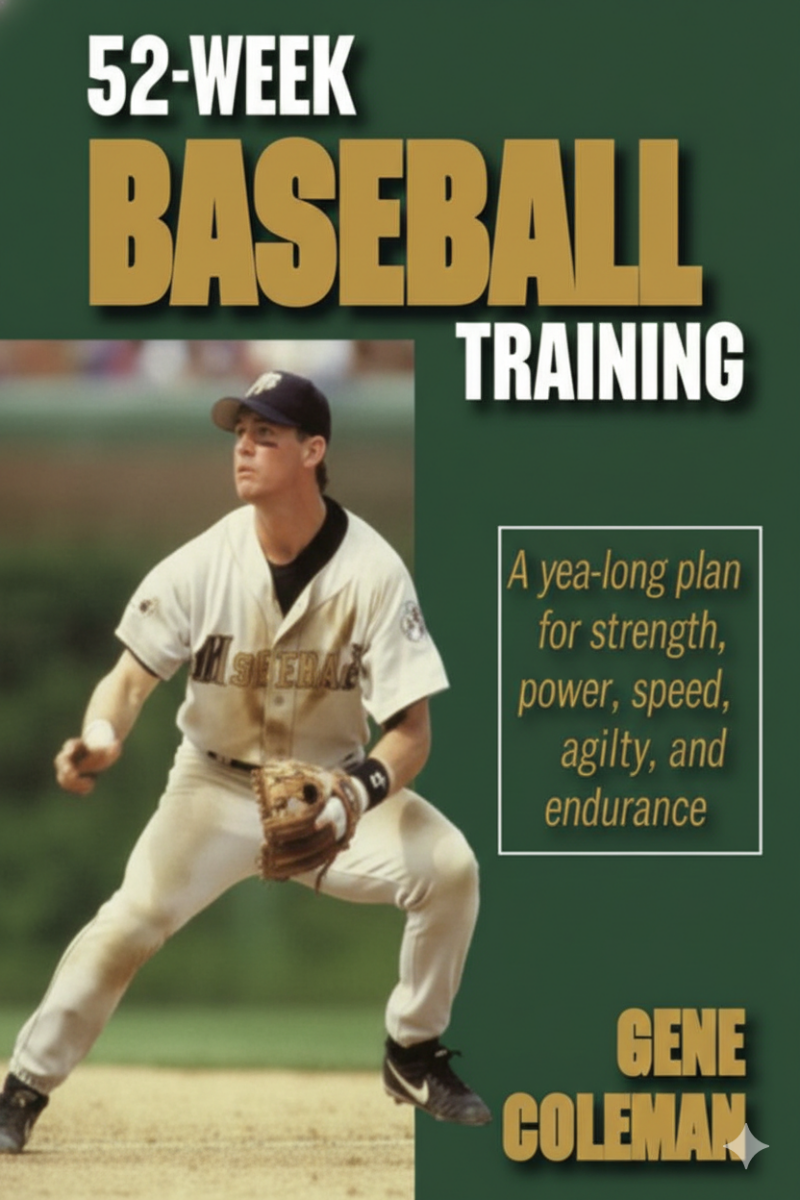
📅 52-Week Baseball Training
Best For: Dedicated players at the high school level and above who want a full annual periodized training program that covers every phase of a baseball player's development cycle — off-season, pre-season, in-season, and recovery — in a single structured resource
Construction: A 52-week periodized baseball training program organized around the annual development cycle — off-season strength and power building, pre-season baseball-specific preparation, in-season maintenance and performance optimization, and the recovery phase principles that allow the body to absorb the accumulated training and competitive stress of a full calendar year without breaking down before the next cycle begins
Material: Written content delivering a complete year-round baseball training program — week-by-week structure, phase-specific training priorities, exercise progressions, and the periodization principles that make a full annual program more effective than a collection of individual workout sessions assembled without regard for where they fall in the development calendar
Performance Feel: The resource that eliminates the question every serious player faces in October — what am I supposed to be doing right now to be better by March — by providing a specific answer for every week of the year rather than leaving the player to reverse-engineer a training schedule from general strength and conditioning principles that were never organized around a baseball calendar
Ideal Player Type: The high school player who wants to develop year-round with a structured program rather than training intensely in January and February and then letting fitness drift through the spring and summer competitive season — the player who is committed enough to follow a week-by-week program and wants every phase of their annual development cycle to be as intentional and structured as their in-season preparation
Performance Overview: 52-Week Baseball Training addresses the single biggest gap in most competitive baseball players' development programs — the absence of structure outside the competitive season. Most high school players train inconsistently in the off-season, ramp up intensity too quickly in the weeks before tryouts, manage in-season training by feel rather than by a planned maintenance program, and enter the next off-season without a coherent framework for what the previous year's training produced or what the next year's development cycle should prioritize. A 52-week periodized program eliminates every one of those problems by providing a specific, intentional training plan for every week of the year — off-season phases that build the physical foundation the competitive season sits on top of, pre-season phases that transition training toward baseball-specific movement preparation, in-season phases that maintain the strength and conditioning gains the off-season produced rather than letting them erode through the physical demands of a full competitive schedule, and recovery phases that allow the body to absorb a full year of training and competition stress before the next development cycle begins.
Why It Stands Out:
- Complete 52-week periodized structure covers every phase of the annual baseball development cycle.
- Eliminates the off-season training inconsistency that leaves most competitive players underprepared by tryouts.
- In-season maintenance programming prevents the strength and conditioning loss that a full competitive schedule produces.
- Week-by-week structure gives players a specific actionable plan rather than general development principles.
- Recovery phase guidance allows the body to absorb a full year of training stress before the next cycle.
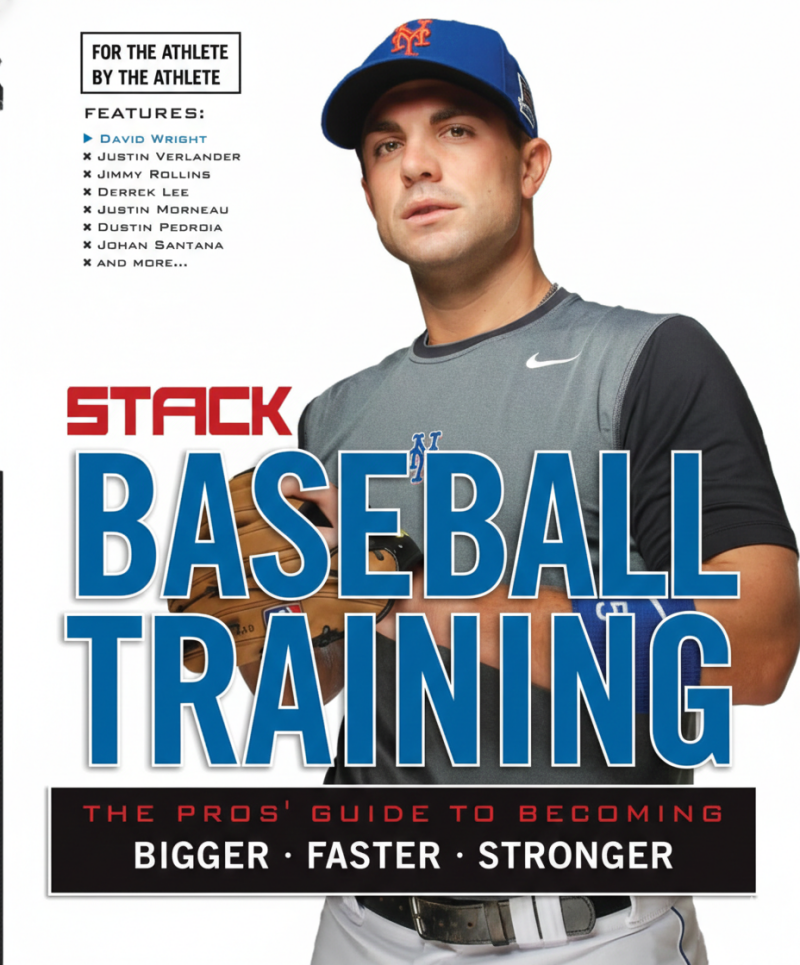
🔬 Baseball Training: The Pros' Guide to Becoming Bigger, Faster, Stronger
Best For: Competitive players at every level who want access to the professional-level training principles, strength development frameworks, and athletic development philosophies that major league players and elite coaches use — applied to the development needs of players who are building toward the highest competitive levels the game offers
Construction: A professional-level baseball training resource built around the strength, speed, and athletic development principles that elite players and their coaches have developed through careers spent studying what actually makes baseball players bigger, faster, and stronger — not what looks impressive in a gym or what general sports science says about athletic development in the abstract
Material: Written content delivering professional-level baseball training principles — the strength development frameworks, speed and agility training approaches, and athletic development philosophies that serious coaches at the highest levels of the game apply to the players they develop, translated into a resource that competitive players outside the professional system can access and apply to their own development programs
Performance Feel: The resource that gives a serious competitive player access to the level of training thinking that most players only encounter if they happen to work with an elite travel ball program, a well-resourced high school program, or a college coaching staff that prioritizes player development as seriously as game strategy — the professional standard applied to the development context of the competitive player who is working toward something
Ideal Player Type: The serious high school and collegiate player who wants to develop with the same quality of training information that elite players work with — the player who is not satisfied with generic gym programming or watered-down athletic development advice and wants to understand how professional-level training principles apply to their specific development stage and physical profile
Performance Overview: Baseball Training: The Pros' Guide to Becoming Bigger, Faster, Stronger delivers the professional training standard to competitive players who are developing outside the professional system — providing access to the strength development frameworks, speed and agility training principles, and athletic development philosophies that serious coaches at the elite level of the game have built through careers spent studying what actually produces better baseball performance at the physical level. The bigger, faster, stronger framework addresses all three athletic dimensions simultaneously rather than prioritizing one at the expense of the others — building the strength base that generates power while maintaining or improving the speed and agility that the sport's defensive demands require and the explosive first-step quickness that offensive base running and reaction time produce in the most complete baseball athletes. The professional application of these principles means every training recommendation is calibrated for the specific physical demands the sport places on athletes who are actually playing baseball — not adapted from frameworks designed for contact sports, endurance athletes, or general gym population training that has no specific relationship to what baseball performance requires.
Why It Stands Out:
- Professional-level training principles applied to competitive players developing outside the professional system.
- Addresses strength, speed, and agility simultaneously rather than prioritizing one athletic dimension.
- Training recommendations calibrated for athletes who are playing baseball — not adapted from other sports.
- Gives serious competitive players access to the training thinking that elite programs work with.
- Builds the complete athletic profile that the sport demands rather than general fitness that may not transfer.
⚡ Performance Differences Between Baseball Training Books
The most meaningful performance difference between the strength training titles and the hitting development titles in this guide is the phase of performance they address — and serious competitive players need both rather than choosing between them. A player who builds elite rotational power through a baseball-specific strength program but has mechanical inefficiencies in the swing path is generating force that the mechanics are wasting rather than transferring into ball exit velocity. A player who has a mechanically sound swing and a mature mental approach at the plate but is physically underprepared — lacking the hip drive depth, the posterior chain strength, and the rotational explosiveness that the swing's power ceiling is built on — is operating well below the physical capacity that better strength development would unlock. The three titles above build the physical foundation. The three titles below build the swing mechanics, mental approach, and hitting philosophy that sit on top of that foundation and determine how much of the physical development translates into plate production. Players who want to put physical training tools alongside the books in this guide should explore ⚾ Best Baseball Training Tools & Equipment (2026) for the equipment that turns program principles into daily training reps. Players building a complete development setup across every skill area should also check out ⚒️ Training Tools for Ball Players for the full training equipment picture.
🎯 Mind of a Superior Hitter: The Art, Science and Philosophy
Best For: High school and collegiate hitters who are mechanically competent but mentally inconsistent at the plate — the hitter whose swing works in the cage and breaks down in the game because the mental approach under competition pressure is the underdeveloped side of their hitting game
Construction: A hitting development resource organized around the mental approach, competitive mindset, and plate discipline philosophy that separates hitters who perform in practice from hitters who perform when the game is on the line — addressing the psychological side of hitting that mechanics instruction alone never reaches
Material: Written content delivering hitting philosophy, mental approach frameworks, and the competitive mindset development that experienced hitting coaches and players who have studied the craft at the highest levels have identified as the primary differentiator between hitters who are physically talented and hitters who are consistently productive under pressure
Performance Feel: The resource that makes a hitter realize that the at-bat they lost last Tuesday had nothing to do with their swing and everything to do with the sequence of mental choices they made from the moment they walked to the plate to the moment they swung at a pitch they had no business offering at — and gives them a framework for making better choices the next time the same situation presents itself
Ideal Player Type: The mechanically developed hitter at the high school and collegiate level whose performance gap between cage work and game situations is wider than mechanics can explain — the hitter who needs to understand that hitting is a mental discipline as much as a physical skill and that the mental side requires as much intentional development as the swing itself
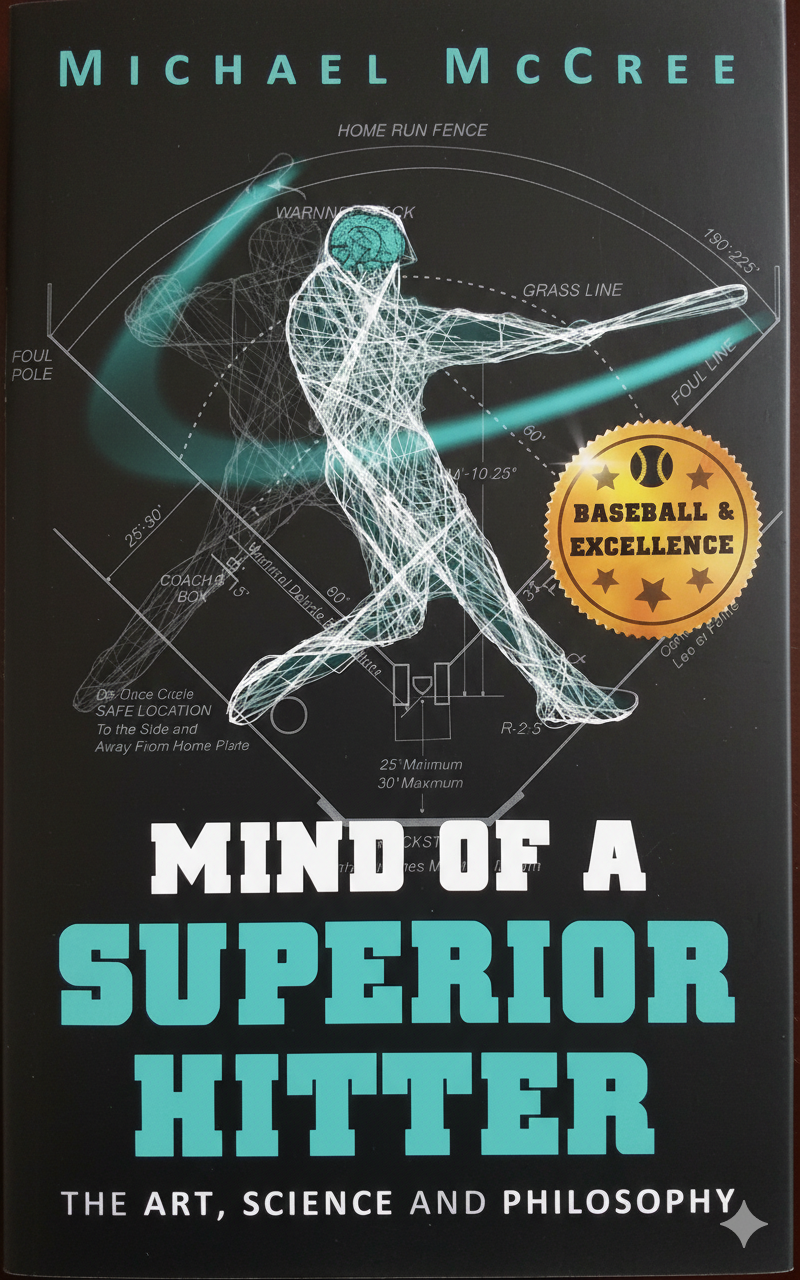
Performance Overview: Mind of a Superior Hitter: The Art, Science and Philosophy addresses the development gap that most hitting instruction ignores because it is harder to teach than swing mechanics and harder to measure than exit velocity — the mental approach, competitive mindset, and plate discipline philosophy that determine whether a hitter's physical tools produce results under the specific pressure conditions that game at-bats create. The art component addresses the feel-based, instinctive side of hitting — the pitch recognition, the timing adjustments, and the competitive intuition that experienced hitters develop through years of at-bats and that less experienced hitters can accelerate by understanding the principles behind what elite hitters do instinctively at the plate. The science component grounds the mental approach in the physical and psychological research that explains why certain mental strategies produce better hitting performance — why pre-pitch routines matter, why zone management is a learnable skill rather than a natural gift, and why the hitters who compete most effectively under pressure approach the mental side of each at-bat with as much structure and intentionality as they bring to their swing mechanics in the cage.
Why It Stands Out:
- Addresses the mental approach gap that separates cage performance from game performance.
- Art, science, and philosophy framework develops intuition, research-backed strategy, and competitive mindset simultaneously.
- Pre-pitch routine and zone management principles give hitters actionable mental tools for every at-bat.
- Written for hitters who are mechanically competent and need the mental side developed to match.
- Covers the competitive pressure response that no amount of cage work or mechanics instruction reaches.
📐 Baseball Hitting Mastery: The Art of a Line Drive Swing
Best For: Players at every competitive level who want to develop a mechanically sound, repeatable swing built around consistent hard contact and line drive production — the hitter who wants to understand the specific mechanical principles that produce the line drive swing path and build them into muscle memory through structured drill work
Construction: A hitting development resource organized around the mechanics of a line drive swing — the specific mechanical principles, swing path concepts, and contact zone fundamentals that produce consistent hard contact to all fields rather than the pull-heavy, uppercut-influenced swing that power-first hitting instruction has pushed into youth and high school development programs at the expense of contact quality and on-base reliability
Material: Written content delivering line drive swing mechanics — bat path concepts, contact point positioning, hip-to-shoulder sequencing through the hitting zone, and the hand path principles that keep the barrel in the hitting zone longer and produce harder, more consistent contact than the long swing approaches that sacrifice contact rate for raw power potential
Performance Feel: The resource that reframes what a hitter thinks they are trying to do in the box — shifting the focus from hitting the ball as hard as possible on the pull side to squaring the ball up consistently to all fields with a swing that is mechanically efficient enough to repeat under pressure at every pitch type and every velocity the hitter encounters in a competitive game
Ideal Player Type: The contact-oriented hitter at every competitive level who wants a mechanically principled approach to line drive production — the hitter who has been told their swing is long, their bat path creates too much below-the-ball contact, or their pull-side power production is coming at the cost of the on-base reliability that their team needs from their lineup spot
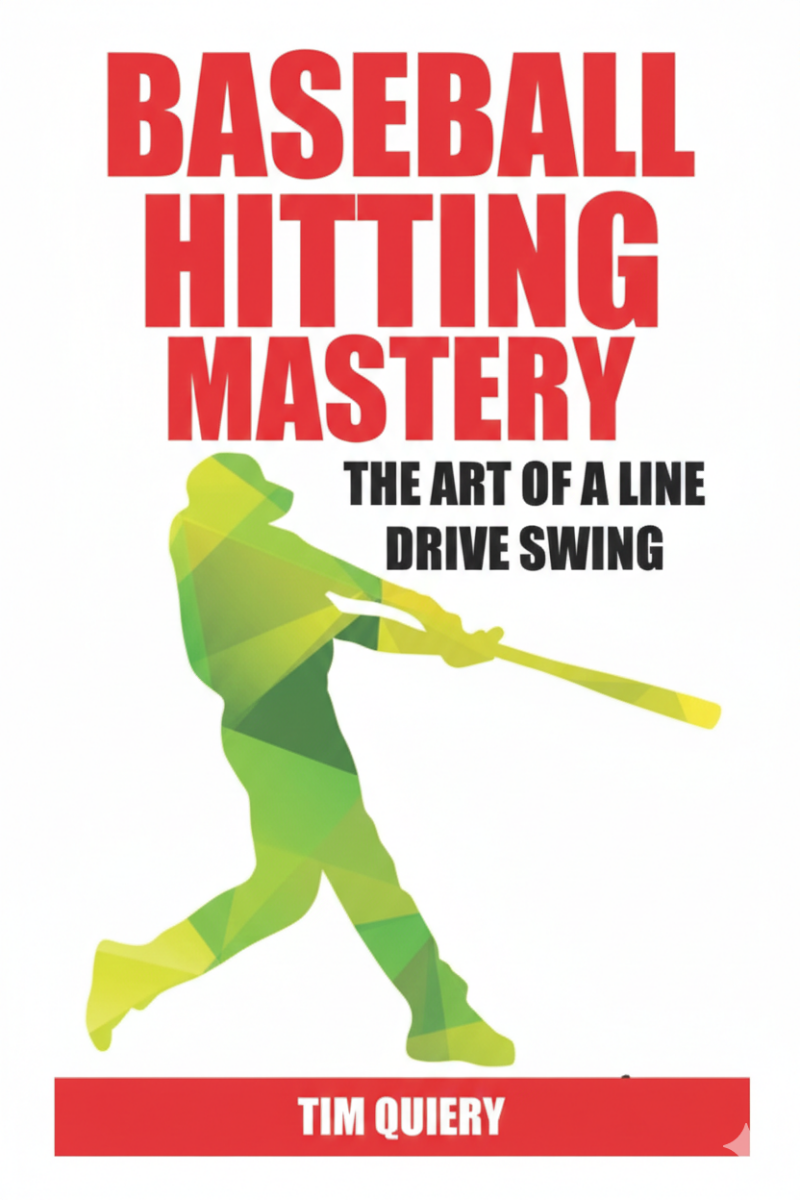
Performance Overview: Baseball Hitting Mastery: The Art of a Line Drive Swing delivers the mechanically principled hitting instruction that contact-oriented players at every competitive level need — a resource built around the specific swing path concepts, contact zone fundamentals, and mechanical sequencing principles that produce hard, consistent line drive contact rather than the pull-heavy, high-launch-angle swing philosophy that has dominated youth and high school hitting instruction at the expense of the contact quality and on-base reliability that most competitive lineups actually need more than they need another hitter swinging for the fences and striking out at a 30% rate. The line drive swing path keeps the barrel in the hitting zone longer than an uppercut-influenced approach — creating more margin for error on pitch timing, more contact surface against off-speed pitches that expose long swings, and more consistent hard contact to all fields that produces the batting average and on-base production that contact-first lineup construction is built on. The mechanical sequencing work addresses the hip-to-shoulder separation, hand path efficiency, and contact point positioning that allow a mechanically sound swing to repeat reliably under the pressure conditions that game at-bats create — because a swing that requires perfect timing to produce good contact is a swing that breaks down against quality pitching at the competitive levels where perfect timing is exactly what the pitcher is working to take away.
Why It Stands Out:
- Line drive swing path philosophy prioritizes contact quality and on-base reliability over pull-side power.
- Barrel-in-zone-longer mechanics create more timing margin against off-speed pitches that expose long swings.
- Contact point positioning and hand path principles produce consistent hard contact to all fields.
- Mechanical sequencing work builds a swing repeatable under competitive pressure — not just in the cage.
- Addresses the long swing correction that contact-oriented hitters at every level need instruction on.
🧬 The Science of Hitting — Ted Williams
Best For: Serious students of hitting at every competitive level who want to learn from the most analytically rigorous hitting philosophy ever committed to print — the foundational text that every serious hitting instructor, coach, and player at the elite level has read and that remains the most referenced hitting resource in the history of the game
Construction: The definitive hitting instruction resource — Ted Williams' complete hitting philosophy organized around the strike zone analysis, pitch selection principles, swing mechanics, and competitive approach that produced the last .400 batting average in major league history and that serious hitting coaches and players have studied as the intellectual foundation of elite hitting development for more than five decades
Material: Written content delivering Ted Williams' complete hitting philosophy — the strike zone mapping, pitch selection discipline, swing mechanics principles, and competitive approach that the greatest pure hitter in baseball history developed through a career of obsessive study and refined into the most analytically complete hitting instruction resource ever written for the game
Performance Feel: The resource that puts a serious hitter in direct contact with the thinking of the greatest pure hitter who ever played the game — a mind that approached hitting with the same level of analytical rigor and competitive obsession that the best hitters in every generation since have cited as the intellectual framework behind their own development as plate-discipline, hard-contact, strike-zone-disciplined hitters
Ideal Player Type: Every serious hitter at every competitive level — from the high school player who is developing their first coherent hitting philosophy through the collegiate player who wants to ground their existing approach in the most analytically complete hitting framework the game has ever produced
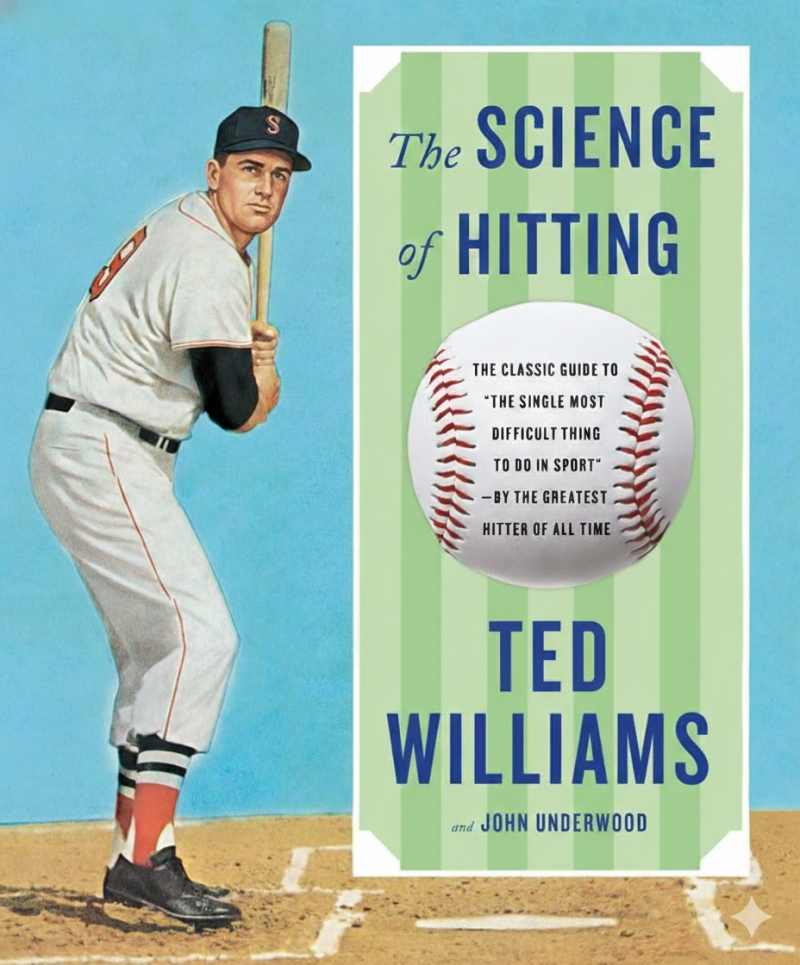
Performance Overview: The Science of Hitting by Ted Williams is not a contemporary hitting instruction resource with updated launch angle data, exit velocity metrics, and modern swing analysis — it is the foundational text that every serious conversation about elite hitting philosophy eventually traces back to, and the reason it has remained in print and in use for more than fifty years is that the principles Williams articulated have proven to be correct at every level of analysis the game has subsequently applied to them. The strike zone mapping that Williams developed — dividing the zone into specific regions and understanding the batting average and power production each region produces — was the first systematic, analytically rigorous framework for pitch selection that any hitter committed to paper, and it remains the most clearly reasoned argument for discipline, zone management, and the patient, selective approach that the game's best contact hitters have built their careers on. The swing mechanics principles Williams articulates are not complicated — the hip rotation, the level swing path, the back-foot drive, and the hands-through-contact emphasis that Williams built his swing around are the mechanical fundamentals that serious hitting instruction has refined and built on for generations without fundamentally departing from the framework Williams established. For a serious hitter who wants to understand where elite hitting philosophy comes from and why the most analytically rigorous approach to the discipline has looked the same across every era of the game, this is the book.
Why It Stands Out:
- The foundational hitting text that every serious coach, instructor, and elite hitter has studied and referenced.
- Strike zone mapping provides the first systematic analytical framework for pitch selection and zone management.
- Swing mechanics principles established the foundational framework that serious hitting instruction has built on for fifty years.
- Written by the last hitter to bat .400 in major league history — the credibility behind every principle is unmatched.
- Relevant at every competitive level from high school through collegiate play as the intellectual foundation of elite hitting philosophy.
📊 Baseball Books for Strength & Hitting Snapshot (2026)
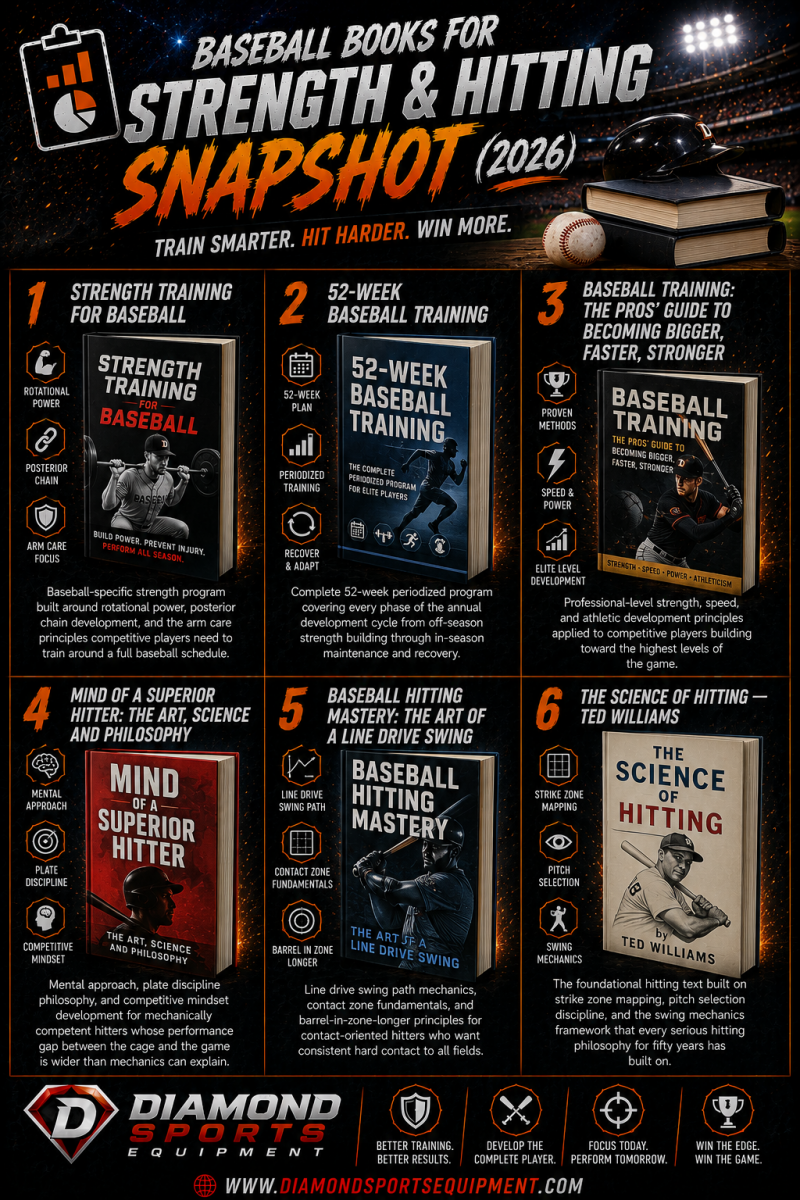
- 💪 Strength Training for Baseball — Baseball-specific strength program built around rotational power, posterior chain development, and the arm care principles competitive players need to train around a full baseball schedule.
- 📅 52-Week Baseball Training — Complete 52-week periodized program covering every phase of the annual development cycle from off-season strength building through in-season maintenance and recovery.
- 🔬 Baseball Training: The Pros' Guide to Becoming Bigger, Faster, Stronger — Professional-level strength, speed, and athletic development principles applied to competitive players building toward the highest levels of the game.
- 🎯 Mind of a Superior Hitter: The Art, Science and Philosophy — Mental approach, plate discipline philosophy, and competitive mindset development for mechanically competent hitters whose performance gap between the cage and the game is wider than mechanics can explain.
- 📐 Baseball Hitting Mastery: The Art of a Line Drive Swing — Line drive swing path mechanics, contact zone fundamentals, and barrel-in-zone-longer principles for contact-oriented hitters who want consistent hard contact to all fields.
- 🧬 The Science of Hitting — Ted Williams — The foundational hitting text built on strike zone mapping, pitch selection discipline, and the swing mechanics framework that every serious hitting philosophy for fifty years has built on.
❓ FAQ
What is the difference between a baseball strength training book and a general sports training book?
- A baseball-specific strength training resource selects exercises, loading schemes, and periodization frameworks built around the rotational power, hip drive, and posterior chain demands that baseball movement patterns specifically require — not general athletic development principles adapted from a different sport.
- The practical difference shows up in the training outcomes — baseball-specific programming builds bat speed, arm velocity, and explosive first-step quickness directly rather than building general fitness that may or may not transfer to on-field performance.
At what age should a player start using a structured baseball training program?
- High school is the appropriate entry point for a structured periodized strength program — the physical maturity needed to train productively with a structured loading scheme is generally present by the freshman or sophomore year for most competitive players.
- Youth players benefit more from movement quality work, coordination development, and skill-based training than from structured strength periodization — the strength program phase comes after the athletic foundation is established.
Is The Science of Hitting still relevant to modern baseball development?
- The strike zone management principles, pitch selection philosophy, and swing mechanics fundamentals Williams articulated have been validated by every era of analytical hitting research since the book was published — the core framework has not been superseded, only refined.
- Modern exit velocity and launch angle data supports rather than contradicts the Williams framework — the hitters who produce the best hard contact outcomes in the contemporary game are the ones whose approach most closely reflects the strike zone discipline and contact-first philosophy Williams built his career on.
Should a hitter focus on mechanics or mental approach first?
- Mechanics need to reach a functional baseline before mental approach work produces its full benefit — a hitter who cannot consistently make contact with a mechanically repeatable swing cannot apply mental approach frameworks effectively because the swing inconsistency creates too many variables.
- Once mechanics are functionally sound, mental approach becomes the primary performance differentiator — the hitter whose mental game matches their mechanical development is the hitter who performs in games the way they perform in the cage.
🧢 Final Thoughts
The six books in this guide cover the two sides of hitting development that serious competitive players need to address simultaneously — the physical foundation that strength training builds and the swing mechanics, mental approach, and hitting philosophy that sit on top of that foundation and determine how much of the physical development translates into plate production when the game is on the line. Strength Training for Baseball, 52-Week Baseball Training, and The Pros' Guide give players the physical development framework. Mind of a Superior Hitter, Baseball Hitting Mastery, and The Science of Hitting give them the hitting philosophy and mechanical principles that complete the development picture. A player who works through all six has covered more of their development comprehensively than most competitive players encounter in an entire high school career of coaching and instruction. Players who want the full training book library across every category — pitching, fielding, mental game, and coaching resources — should explore 🧤 Batting Gloves Built for Grip & Performance for the complete gear picture that pairs with every training program in this guide. For the full library of baseball and softball gear guides and buying breakdowns across every category, visit 📝 Diamond Sports Equipment Blog & Gear Reviews.
Add comment
Comments