The end-loaded vs balanced decision is the most consequential equipment choice a competitive slowpitch player makes — and the one that gets made most carelessly across the amateur game. Most recreational and competitive slowpitch players choose their bat based on what their teammates are swinging, what the most respected player on their team uses, or what the store associate recommended when they walked in without a clear sense of their own swing profile. The result is a significant percentage of slowpitch players swinging end-loaded bats they cannot fully drive — sacrificing bat speed, timing, and all-fields coverage for a momentum advantage they cannot access with their current rotational force — or swinging balanced bats that leave real power on the table for players who generate the bat speed to drive a load. The end-loaded vs balanced decision is not a question of which bat is better. It is a question of which bat matches the player's actual swing profile — and answering that question correctly is what separates a productive equipment investment from an expensive mistake that follows the player through an entire competitive season. The 2026 slowpitch market is delivering options that illustrate the end-loaded vs balanced distinction clearly — Worth's Bedlam XL End Load, Easton's Salvo, Miken's KP23 12.5", Axe's Dabacle Axe Handle, and both configurations of the Axe Fury Bravo platform — giving players and coaches the most direct side-by-side comparison of end-load and balanced design available in a single product group. Players who want the full power hitter picture that end-loaded designs serve will find the complete breakdown in 💥 Slowpitch Bats for Power Hitters (2026). For senior players who need to understand how the end-load vs balanced decision changes with age, 🎖️ Slowpitch Bats for Senior League covers the senior-specific considerations in detail.
⚾ What You Should Know About End-Loaded vs Balanced Slowpitch Bats
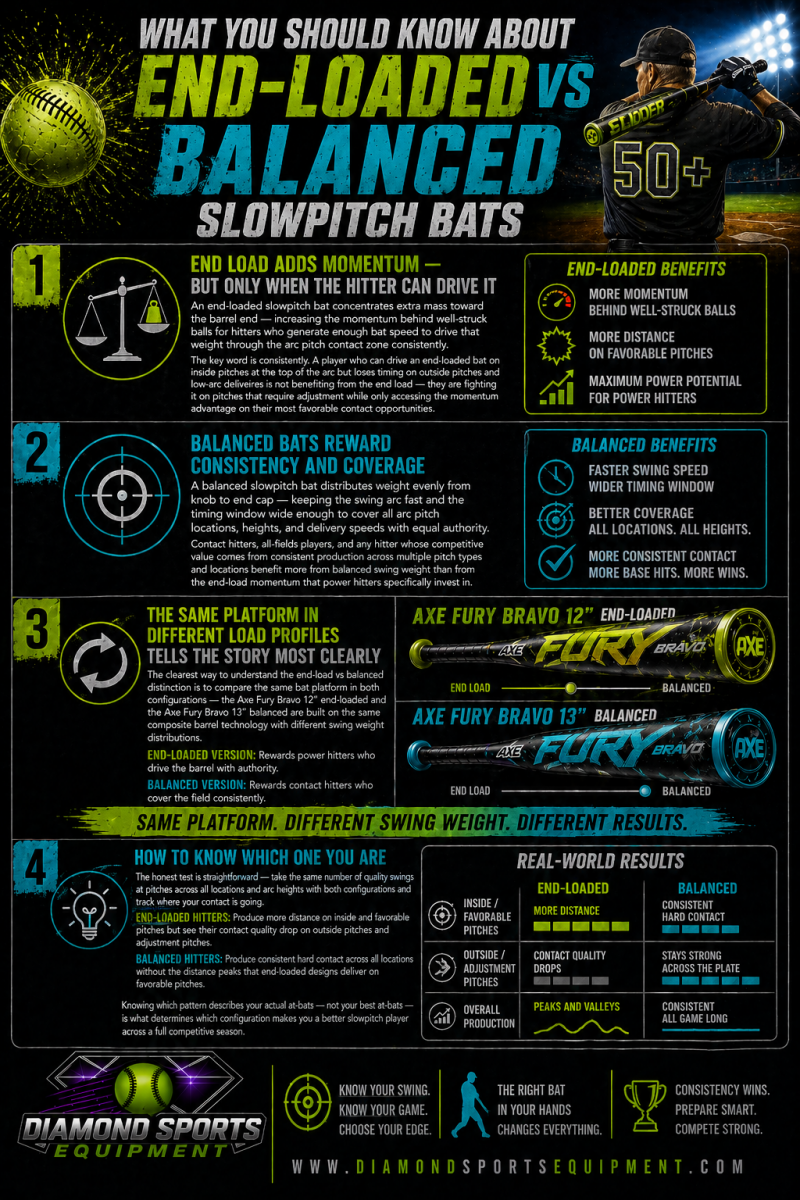
⚖️ End Load Adds Momentum — But Only When the Hitter Can Drive It
An end-loaded slowpitch bat concentrates extra mass toward the barrel end — increasing the momentum behind well-struck balls for hitters who generate enough bat speed to drive that weight through the arc pitch contact zone consistently. The key word is consistently. A player who can drive an end-loaded bat on inside pitches at the top of the arc but loses timing on outside pitches and low-arc deliveries is not benefiting from the end load — they are fighting it on pitches that require adjustment while only accessing the momentum advantage on their most favorable contact opportunities.
🎯 Balanced Bats Reward Consistency and Coverage
A balanced slowpitch bat distributes weight evenly from knob to end cap — keeping the swing arc fast and the timing window wide enough to cover all arc pitch locations, heights, and delivery speeds with equal authority. Contact hitters, all-fields players, and any hitter whose competitive value comes from consistent production across multiple pitch types and locations benefit more from balanced swing weight than from the end-load momentum that power hitters specifically invest in.
🔄 The Same Platform in Different Load Profiles Tells the Story Most Clearly
The clearest way to understand the end-load vs balanced distinction is to compare the same bat platform in both configurations — the Axe Fury Bravo 12" end-loaded and the Axe Fury Bravo 13" balanced are built on the same composite barrel technology with different swing weight distributions. The end-loaded version rewards power hitters who drive the barrel with authority. The balanced version rewards contact hitters who cover the field consistently. Same platform, fundamentally different performance philosophy.
💡 How to Know Which One You Are
The honest test is straightforward — take the same number of quality swings at pitches across all locations and arc heights with both configurations and track where your contact is going. End-loaded hitters produce more distance on inside and favorable pitches but see their contact quality drop on outside pitches and adjustment pitches. Balanced hitters produce consistent hard contact across all locations without the distance peaks that end-loaded designs deliver on favorable pitches. Knowing which pattern describes your actual at-bats — not your best at-bats — is what determines which configuration makes you a better slowpitch player across a full competitive season.
🏆 End-Loaded vs Balanced Slowpitch Bats (2026)
The 2026 slowpitch lineup illustrates the end-load vs balanced distinction across multiple brand platforms and construction types — here are six of the best options for understanding and choosing between the two approaches.
💣 Worth | 2025 | Bedlam Slowpitch Softball Bat | USSSA | 12.75" Barrel | XL End Load | 1-Piece
Best For: Competitive USSSA slowpitch power hitters who want the most aggressive end-loaded expression available in a one-piece composite design — delivering XL end load momentum through a 12.75" barrel that concentrates mass at the barrel end for players who generate the rotational force to drive maximum swing weight through the arc pitch contact zone consistently.
Construction: One-piece composite construction with Worth's Bedlam barrel technology, USSSA certification, 12.75" barrel size, and XL end load profile — the most aggressively end-loaded design in this group, built for competitive slowpitch power hitters who want the stiff, direct feel of one-piece construction behind the maximum barrel momentum that XL end load produces on well-struck contact.
Material: Full composite one-piece barrel and handle construction with Worth's Bedlam barrel geometry and XL end-loaded weight distribution — the one-piece design eliminates the flex point that two-piece construction creates at the connection, transferring energy directly from the swing through the barrel at contact while the XL end load concentrates that energy at the point of impact for maximum exit velocity on well-centered hits.
Performance Feel: The Worth | 2025 | Bedlam Slowpitch Softball Bat | USSSA | 12.75" Barrel | XL End Load | 1-Piece has the stiff, barrel-heavy feel that one-piece XL end-loaded composite designs deliver at their most aggressive — the bat loads noticeably toward the barrel through the swing arc, well-struck contact produces the explosive exit velocity that XL end load is designed to create, and the one-piece construction provides the direct, unfiltered feedback that tells the hitter exactly where on the barrel every contact landed. Off-center contact on this design is immediately apparent — and that honest feedback is part of what makes it the clearest end-loaded reference point in the group.
Ideal Player Type: Competitive USSSA slowpitch power hitters who have confirmed through honest self-assessment that they generate the bat speed to drive XL end load through all pitch locations consistently — particularly players who prefer the stiff, direct feel of one-piece composite construction over the vibration-dampened flex of two-piece designs and want the most aggressive end-load momentum available in a premium composite platform.
Performance Overview: The Worth 2025 Bedlam XL End Load 12.75" USSSA Slowpitch Softball Bat is the most aggressively end-loaded design in this group — a one-piece composite platform that demonstrates what XL end load actually does to swing weight, timing window, and contact quality across different pitch locations. For power hitters who drive the barrel consistently, the XL end load produces the distance output that no balanced design can match on well-struck contact. For players who cannot maintain bat speed with that much barrel weight, it produces the timing compromise and coverage reduction that makes the end-load vs balanced decision the most consequential equipment choice in competitive slowpitch. The Bedlam XL is the most honest test of whether a player's swing profile matches the end-loaded philosophy — if this bat produces consistent power across all pitch locations, the player is an end-loaded hitter. If it narrows their game to pull-side power on favorable pitches only, they are better served by the balanced options in this group.
Why It Stands Out:
- XL end load is the most aggressive swing weight profile in this group — the clearest expression of end-loaded philosophy available.
- One-piece composite construction delivers stiff, direct barrel feedback without the flex dampening of two-piece designs.
- 12.75" barrel concentrates the XL end-load mass at the contact point for maximum exit velocity on well-centered hits.
- Worth Bedlam composite platform delivers premium USSSA certified power performance for competitive slowpitch distance hitters.

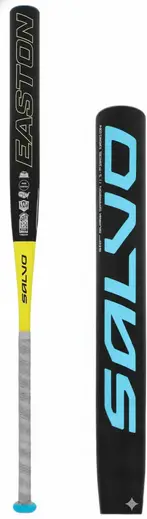
🚀 Easton | Salvo Slowpitch Softball Bat
Best For: Competitive slowpitch players who want Easton's composite barrel engineering in a design that clearly illustrates the end-load performance philosophy — delivering the momentum advantage that end-loaded composite construction provides for players who generate the bat speed to drive the barrel weight through the arc pitch contact zone.
Construction: Two-piece composite construction with Easton's Salvo barrel technology and an end-loaded swing weight profile — built for competitive slowpitch players who want Easton's composite barrel performance behind a power-forward approach that rewards well-struck contact with the momentum that end-loaded designs produce over balanced alternatives.
Material: Full composite barrel and handle construction with Easton's connection technology, Salvo barrel geometry, and an end-loaded weight distribution that concentrates mass toward the barrel end — delivering the momentum advantage that competitive slowpitch power hitters access when they square up pitches within their optimal contact zone.
Performance Feel: The Salvo has the end-loaded composite feel that Easton's power-forward slowpitch designs deliver — the barrel adds momentum on well-struck contact, the composite construction provides the trampoline response that amplifies that momentum into real distance output, and the end-load profile makes the timing demands of covering outside pitches and adjustment pitches immediately apparent for players who test the design honestly across all pitch locations.
Ideal Player Type: Competitive slowpitch power hitters who want Easton's composite barrel engineering in an end-loaded design — particularly players who have honestly assessed their swing profile and confirmed they generate the bat speed to drive the end load consistently across all pitch types and locations rather than only on their most favorable contact opportunities.
Performance Overview: The Easton Salvo Slowpitch Softball Bat gives competitive slowpitch players a clear expression of Easton's end-loaded composite philosophy — delivering the momentum and distance advantage that end-loaded designs produce for players who drive them correctly while providing an honest demonstration of the timing demands that the end-load creates on adjustment pitches for players who are evaluating whether this approach matches their actual swing profile.
Why It Stands Out:
- Easton composite barrel engineering in a clear end-loaded design for competitive slowpitch power hitters.
- End-load momentum adds real distance advantage on well-struck contact for players who drive the barrel consistently.
- Two-piece composite construction delivers trampoline response that amplifies end-load momentum output.
- Strong reference point for players evaluating whether end-loaded composite performance matches their swing profile.
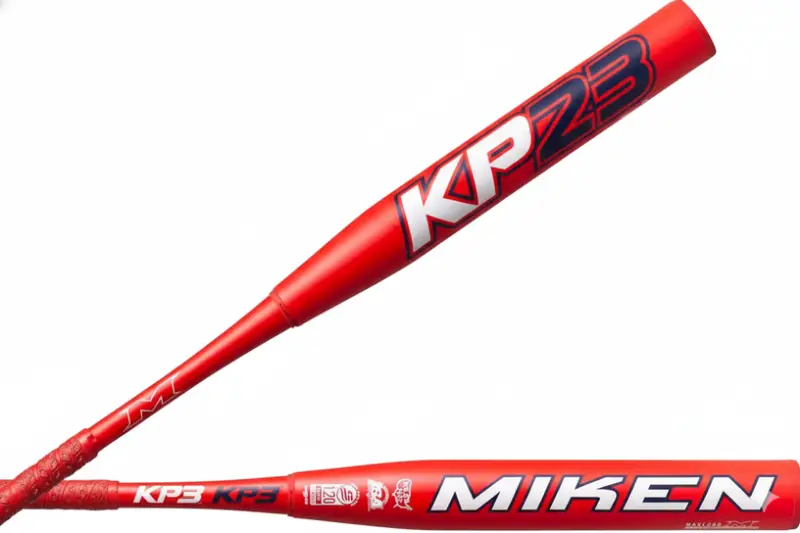
🎵 Miken | 2025 | KP23 Slowpitch Softball Bat (12.5" barrel)
Best For: Competitive slowpitch contact hitters who want the proven KP23 platform in the 12.5" barrel configuration — delivering Miken's benchmark balanced composite performance in a slightly smaller barrel than the 12.75" version for players who prefer a tighter, more precise contact feel alongside the balanced swing weight that all-fields coverage requires.
Construction: Two-piece composite construction with Miken's KP23 barrel technology in the 12.5" balanced configuration — the contact hitter's KP23 platform in a barrel size that delivers a more precise contact feel than the 12.75" version while maintaining the balanced swing weight and Miken composite barrel quality that the KP23 name represents in competitive slowpitch softball.
Material: Full composite barrel and handle construction with Miken's connection technology, 12.5" KP23 barrel geometry, and a balanced weight distribution — the proven KP23 composite quality in a barrel size that serves contact hitters who prefer the tighter feel of a 12.5" barrel over the wider forgiveness of the 12.75" version.
Performance Feel: The KP23 12.5" has the same refined, balanced composite feel as the 12.75" version but with a slightly tighter, more precise contact response — the smaller barrel rewards well-centered contact more precisely and provides a different feel through the contact zone that some competitive slowpitch contact hitters specifically prefer over the wider forgiveness of larger barrel designs.
Ideal Player Type: Competitive slowpitch contact hitters who want the proven KP23 balanced platform in the 12.5" barrel configuration — particularly players who have swung both barrel sizes and prefer the tighter, more precise contact feel of the 12.5" version over the wider forgiveness of the 12.75" design.
Performance Overview: The Miken 2025 KP23 12.5" Slowpitch Softball Bat gives competitive contact hitters the proven KP23 balanced platform in the barrel size that delivers a more precise contact feel than the larger version — serving players who want the KP23's benchmark balanced composite performance with a barrel geometry that rewards well-centered contact more specifically rather than the broader forgiveness that the 12.75" version provides across the full hitting zone.
Why It Stands Out:
- Proven KP23 balanced composite platform in 12.5" barrel for contact hitters who prefer precise contact feel.
- Balanced swing weight covers all arc pitch locations for competitive all-fields slowpitch players.
- Miken composite barrel quality in a barrel size that differentiates clearly from the 12.75" KP23 version.
- Strong choice for contact hitters who have researched both KP23 barrel sizes and prefer the tighter 12.5" feel.
⚡ Performance Differences Between End-Loaded and Balanced Slowpitch Bats
The six bats in this group illustrate the end-load vs balanced distinction more directly than any single-category slowpitch blog can — because they include both configurations of the same Axe Fury Bravo platform side by side, giving players the clearest possible comparison of how the same composite barrel technology performs differently when the swing weight distribution changes. The Worth Bedlam XL End Load establishes the end-loaded ceiling — the most aggressively end-loaded one-piece composite design in the group, delivering the stiff, direct barrel feedback and maximum barrel momentum that gives players the clearest possible test of whether their swing profile matches the end-loaded philosophy. The Easton Salvo represents the end-loaded composite philosophy clearly — the momentum advantage that drives real distance output for players who generate the bat speed to use it. The Miken KP23 12.5" represents the balanced precision philosophy — the all-fields coverage and consistent contact that balanced swing weight delivers for contact-first players. The Axe Dabacle Axe Handle covers the dual-stamp balanced tier for players who want format flexibility alongside balanced composite performance. The Fury Bravo 12" 1 oz end-loaded and Fury Bravo 13" balanced provide the most direct apples-to-apples comparison in the group — the same Axe composite platform in two fundamentally different swing weight philosophies that serve two fundamentally different player types. For players who want the complete slowpitch selection framework that puts this end-load vs balanced decision in its full context, 🥎 How to Choose a Slowpitch Bat covers every decision point comprehensively. Players who want the full competitive slowpitch bat picture beyond this specific comparison will find the most complete reference in 🦇 Best Slowpitch Softball Bats (2026).
🎸 Axe | Dabacle | 2-Piece Composite | Dual Stamp (USSSA/USA) Slowpitch Softball Bat | Axe Handle
Best For: Competitive slowpitch contact hitters who compete across multiple certifications and want Axe's dual-stamp balanced composite design in the standard Axe handle format — delivering all-fields coverage and maximum format flexibility with the Axe handle geometry that competitive slowpitch players have come to trust across the brand's lineup.
Construction: Two-piece composite construction with Axe's Dabacle barrel technology, dual USSSA/USA certification stamp, balanced swing weight, and the standard Axe handle design — combining all-fields contact performance with maximum certification flexibility in the Axe handle format that gives competitive slowpitch players the balanced composite approach alongside the brand's signature handle geometry.
Material: Full composite barrel with Axe's standard handle construction, Dabacle barrel geometry, and a balanced dual-stamp certified performance profile — delivering balanced composite sweet spot size and vibration dampening for contact hitters who compete across both USSSA and USA sanctioned formats from a single bat investment.
Performance Feel: The Dabacle Axe Handle has the smooth, balanced composite feel that Axe's contact-focused designs deliver — the barrel provides consistent sweet spot response across all arc pitch locations, the dual-stamp certification eliminates format compliance concerns, and the Axe handle gives competitive slowpitch contact hitters the distinctive grip experience that differentiates their bat from the standard round-handle options that dominate most competitive slowpitch lineups.
Ideal Player Type: Competitive slowpitch contact hitters who compete across USSSA and USA sanctioned formats and want Axe's dual-stamp balanced composite design in the standard Axe handle format — particularly players who want maximum format flexibility alongside the all-fields coverage that balanced swing weight provides.
Performance Overview: The Axe Dabacle Dual Stamp Axe Handle Slowpitch Softball Bat gives competitive contact hitters the most format-flexible balanced composite design in Axe's 2026 slowpitch lineup — combining USSSA and USA certification from a single bat with the balanced swing weight and Axe handle geometry that serve all-fields contact performance. The dual-stamp coverage eliminates equipment logistics for players who compete across multiple associations, and the balanced composite construction delivers the sweet spot size and vibration management that contact-first players need to produce consistent results across all arc pitch locations and heights.
Why It Stands Out:
- Dual USSSA/USA certification covers every format competitive contact hitters compete in from a single bat.
- Balanced swing weight serves all-fields coverage for contact-first competitive slowpitch players.
- Axe handle geometry delivers distinctive grip feel that differentiates from standard round-handle designs.
- Two-piece composite construction provides sweet spot size and vibration dampening for contact performance.
🔥 Axe | Fury Bravo | 2-Piece Composite | USSSA Slowpitch Softball Bat | 12" Barrel | 1 oz. Endloaded | Flared Handle
Best For: Competitive USSSA slowpitch power hitters who want the Fury Bravo platform in its end-loaded configuration — the 1 oz end load and 12" barrel delivering the momentum advantage that power hitters who drive the barrel consistently access within the USSSA performance window.
Construction: Two-piece composite construction with Axe's Fury Bravo barrel technology, USSSA certification, 12" barrel size, 1 oz end load profile, and Axe's flared handle design — the power configuration of the Fury Bravo platform that serves competitive USSSA slowpitch power hitters who generate the bat speed to drive 1 oz of end load through the arc pitch contact zone consistently.
Material: Full composite barrel with Axe's flared handle construction, 12" Fury Bravo barrel geometry, and USSSA certified 1 oz end-loaded performance profile — the end-load momentum that power hitters access when they square up pitches within their optimal contact zone, combined with the Axe flared handle grip comfort that the brand applies across their slowpitch lineup.
Performance Feel: The Fury Bravo 12" 1 oz end-loaded has the powerful, barrel-heavy feel that 1 oz of end load produces — the composite barrel loads and releases through the contact zone with the trampoline response that USSSA certification amplifies, and the end load adds the barrel momentum that makes well-struck contact noticeably more productive than the balanced version of the same platform for hitters who drive it consistently.
Ideal Player Type: Competitive USSSA slowpitch power hitters who want the Fury Bravo platform's end-loaded configuration — particularly players who have compared the end-loaded and balanced Fury Bravo side by side and confirmed that the 1 oz end load serves their swing profile better than the balanced 13" version.
Performance Overview: The Axe Fury Bravo 12" 1 oz End-Loaded USSSA Slowpitch Softball Bat is one half of the most direct end-load vs balanced comparison in the 2026 slowpitch market — the same Axe Fury Bravo composite barrel technology in the power configuration that rewards hitters who drive the barrel with authority. The 1 oz end load produces meaningful distance advantage on well-struck contact for players who generate the rotational force to drive it consistently, and the USSSA certification ensures the design is performing at the BPF ceiling that amplifies that momentum into real competitive power output.
Why It Stands Out:
- End-loaded configuration of the Fury Bravo platform delivering 1 oz momentum advantage for USSSA power hitters.
- Direct comparison reference against the balanced 13" Fury Bravo for players evaluating both configurations.
- USSSA certified composite performance amplifies end-load momentum within the BPF performance window.
- Axe flared handle delivers grip comfort advantage through the full power swing arc.
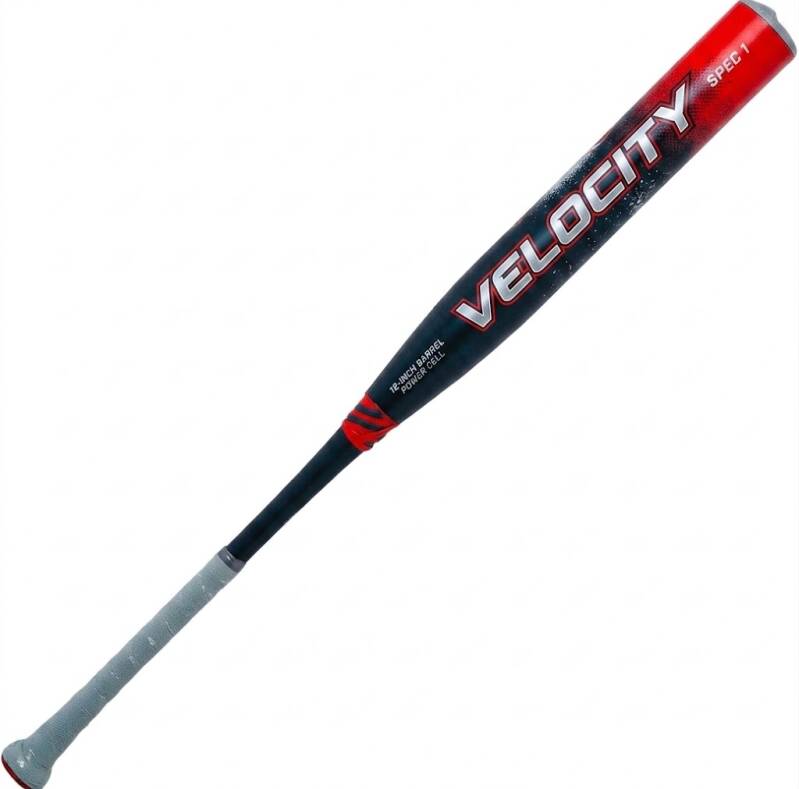
🌊 Axe | Fury Bravo | 2-Piece Composite | USSSA Slowpitch Softball Bat | 13" Barrel | Balanced | Flared Handle
Best For: Competitive USSSA slowpitch contact hitters who want the Fury Bravo platform in its balanced configuration — the 13" balanced barrel delivering all-fields coverage and a larger effective hitting zone for contact hitters who prioritize coverage consistency over the momentum advantage that the end-loaded version provides.
Construction: Two-piece composite construction with Axe's Fury Bravo barrel technology, USSSA certification, 13" barrel size, balanced swing weight, and Axe's flared handle design — the contact configuration of the Fury Bravo platform that serves competitive USSSA slowpitch contact hitters who need their bat to cover all arc pitch locations consistently rather than rewarding only pull-side power contact.
Material: Full composite barrel with Axe's flared handle construction, 13" Fury Bravo barrel geometry, and USSSA certified balanced performance profile — the larger barrel size and balanced swing weight combination that delivers maximum coverage and forgiveness for contact hitters who drive pitches to all fields across a full competitive day.
Performance Feel: The Fury Bravo 13" balanced has a noticeably different feel from the end-loaded version — the swing is faster, the timing window is wider, and the 13" barrel makes the effective hitting zone larger than the 12" end-loaded version. Contact hitters who compare both versions immediately feel which one matches their all-fields approach and which one asks them to narrow their game to access its performance advantage.
Ideal Player Type: Competitive USSSA slowpitch contact hitters who want the Fury Bravo platform's balanced configuration — particularly players who have compared the balanced and end-loaded Fury Bravo side by side and confirmed that the balanced 13" version serves their all-fields contact approach better than the 1 oz end-loaded 12" version.
Performance Overview: The Axe Fury Bravo 13" Balanced USSSA Slowpitch Softball Bat is the other half of the most direct end-load vs balanced comparison in the 2026 slowpitch market — the same Axe Fury Bravo composite barrel technology in the contact configuration that rewards hitters who cover all fields with consistent authority. The balanced swing weight keeps the timing window wide enough to handle all arc pitch locations, the 13" barrel maximizes the effective hitting zone for slightly off-center contact, and the USSSA certification ensures the design delivers the BPF performance ceiling that makes every well-struck contact across the full field as productive as the USSSA standard permits.
Why It Stands Out:
- Balanced configuration of the Fury Bravo platform delivering all-fields coverage for USSSA contact hitters.
- Direct comparison reference against the end-loaded 12" Fury Bravo for players evaluating both configurations.
- 13" barrel delivers larger effective hitting zone than the end-loaded version for contact forgiveness.
- Balanced swing weight keeps timing window wide enough to cover all arc pitch locations consistently.
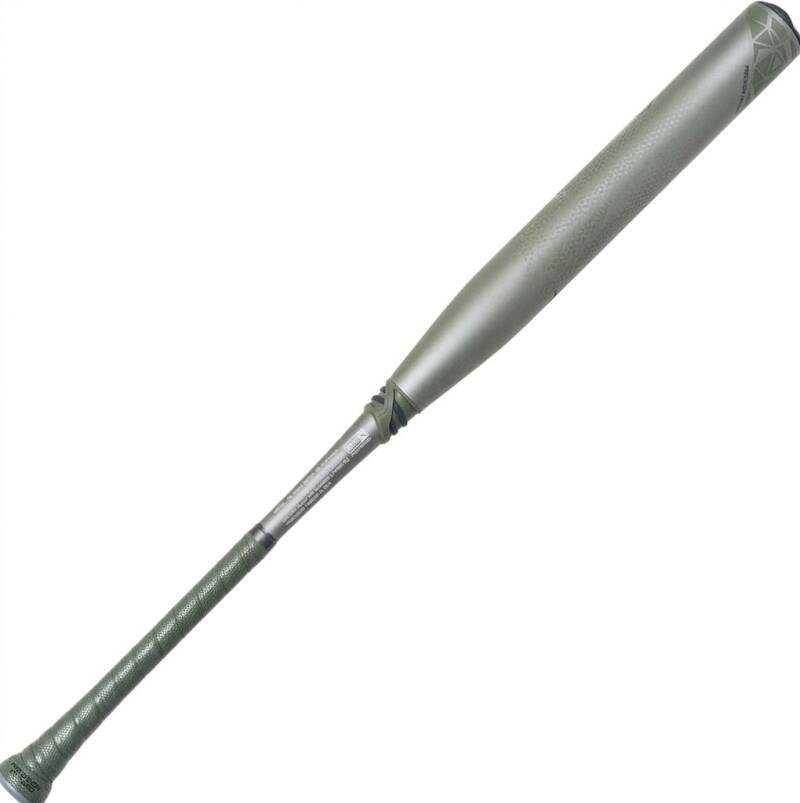

📊 End-Loaded vs Balanced Slowpitch Bats Snapshot (2026)
- 💣 Worth | 2025 | Bedlam Slowpitch Softball Bat | USSSA | 12.75" Barrel | XL End Load | 1-Piece — Most aggressive end-loaded one-piece composite in the group delivering XL barrel momentum and direct contact feedback for USSSA power hitters who drive the barrel consistently.
- 🚀 Easton | Salvo Slowpitch Softball Bat — End-loaded composite design delivering momentum advantage for competitive power hitters who generate the bat speed to drive the barrel consistently.
- 🎵 Miken | 2025 | KP23 Slowpitch Softball Bat (12.5" barrel) — Proven KP23 balanced composite platform in 12.5" configuration delivering precise contact feel for competitive all-fields slowpitch players.
- 🎸 Axe | Dabacle | 2-Piece Composite | Dual Stamp (USSSA/USA) Slowpitch Softball Bat | Axe Handle — Dual-stamp balanced composite with Axe handle delivering maximum format flexibility for competitive contact hitters across multiple associations.
- 🔥 Axe | Fury Bravo | 2-Piece Composite | USSSA Slowpitch Softball Bat | 12" Barrel | 1 oz. Endloaded | Flared Handle — End-loaded Fury Bravo configuration delivering 1 oz momentum advantage for USSSA power hitters who drive the barrel consistently.
- 🌊 Axe | Fury Bravo | 2-Piece Composite | USSSA Slowpitch Softball Bat | 13" Barrel | Balanced | Flared Handle — Balanced Fury Bravo configuration delivering all-fields coverage and larger 13" barrel for USSSA contact hitters.
❓ FAQ
How do I know if I am an end-loaded or balanced slowpitch hitter?
- Track your contact quality across all pitch locations over a full game — end-loaded hitters produce their best contact on inside pitches and favorable arc heights but struggle with coverage on outside pitches and adjustment pitches where the end load narrows their timing window.
- Balanced hitters produce consistent hard contact across all pitch locations without the distance peaks that end-loaded designs deliver — if your game value comes from consistent all-fields production rather than occasional deep shots, balanced is the right match.
Can a recreational slowpitch player benefit from an end-loaded bat?
- Most recreational slowpitch players do not generate enough bat speed to consistently drive an end-loaded design through all pitch locations — which means the end load is working against their coverage rather than adding momentum to their power contact.
- Recreational players who are honest about their bat speed and contact consistency typically perform better with balanced designs that maximize coverage and keep more contact on line across a full game.
Is the Axe Fury Bravo end-loaded or balanced version better?
- Neither version is objectively better — they serve fundamentally different player profiles and the right choice depends entirely on honest assessment of the player's swing profile rather than which version sounds more impressive.
- Power hitters who drive the barrel consistently across all pitch locations should try the 1 oz end-loaded 12" version. Contact hitters who cover the field consistently should try the balanced 13" version. The comparison is the most direct end-load vs balanced test available in a single platform in the 2026 slowpitch market.
Does end load affect bat control on off-speed and low-arc pitches?
- Yes — end-loaded designs narrow the timing window and reduce bat control on pitches that require adjustment, including off-speed deliveries and low-arc pitches that demand a different swing entry point than high-arc fastball pitches.
- Power hitters who can make that adjustment consistently still benefit from end load. Players who find their contact quality drops significantly on those pitches with an end-loaded design are better served by a balanced option that keeps the timing window wide enough to handle pitch variety.
🧢 Final Thoughts
The end-loaded vs balanced decision is not complicated once a player commits to honest self-assessment rather than aspirational equipment selection. End-loaded bats reward power hitters who drive the barrel with authority across all pitch locations — delivering the momentum that turns well-struck contact into the deep-field shots that define the power hitter's contribution to a competitive slowpitch lineup. Balanced bats reward contact hitters who cover the field consistently — delivering the timing window and barrel forgiveness that all-fields production requires across a full competitive season. The Worth Bedlam XL End Load gives players the most aggressive end-loaded test available in the group. The Easton Salvo illustrates the end-load philosophy clearly. The Miken KP23 12.5" demonstrates balanced precision. The Axe Dabacle provides format-flexible balanced coverage. And the Fury Bravo end-loaded and balanced versions provide the most direct side-by-side comparison of both approaches available in the 2026 slowpitch market. For players who want the complete slowpitch competitive bat picture beyond this comparison, 🥎 The Complete Slowpitch Bat Guide (2026) covers the full landscape. And for the complete library of gear reviews and buying guides across every category, visit 📝 Diamond Sports Equipment Blog & Gear Reviews.
Add comment
Comments