The composite vs alloy decision is the USA bat conversation that parents and players get wrong more consistently than any other selection variable in the youth baseball equipment market — and the cost of getting it wrong is a bat that works against the player's development rather than supporting it through the season the bat was purchased for. Composite and alloy are not quality tiers where one construction is inherently superior to the other — they are fundamentally different material philosophies that deliver specific performance characteristics matched to specific player development stages, practice environments, and competitive use cases that no single construction type serves equally well across every situation. Alloy bats are made from aluminum alloy in a single-piece or two-piece format that delivers immediate barrel readiness from the first swing, consistent performance in cold weather conditions where composite barrels become brittle and crack-prone, direct crisp feedback on every contact point, and a durability standard that holds up through the high-volume batting practice that youth development programs put on a bat across a full season. Composite bats are made from layered carbon fiber in a construction that requires 150 to 200 swings of break-in before the barrel reaches its peak performance window, performs better in warm weather conditions where the composite fibers are at their most responsive, delivers a softer more forgiving feel on mishits through the barrel's natural vibration dampening, and reaches a higher performance ceiling at full break-in than alloy alternatives at the same USA certification level. Neither construction is universally correct — the right answer depends on the player's age, their league's temperature environment, their practice volume, and the parent's willingness to manage the break-in timeline that composite construction demands before competitive use. Once you know which build you want, the 🦇 Best USA Baseball Bats (2026) covers the top picks in both. Players working through the full bat selection process from certification through construction will find the complete framework in 🦇 How to Choose a Baseball Bat.
⚾ What You Should Know About Composite vs Alloy USA Bats
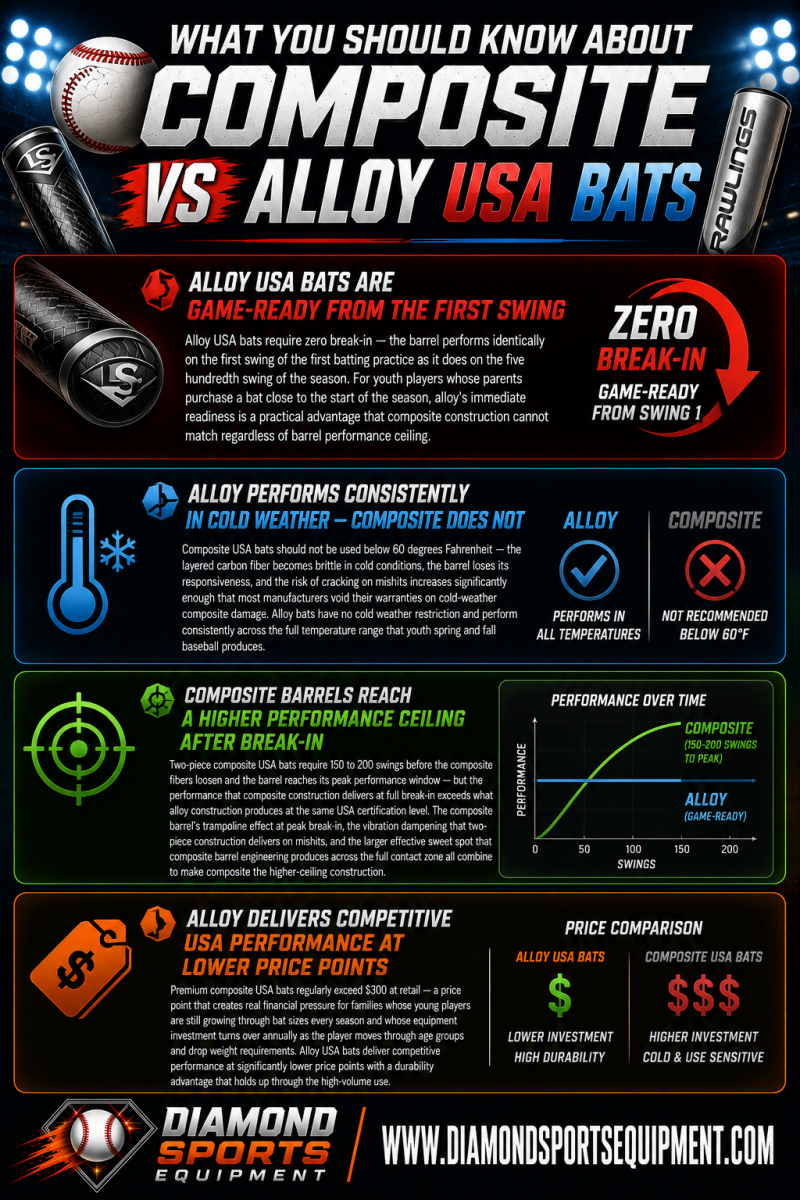
🔩 Alloy USA Bats Are Game-Ready From the First Swing
Alloy USA bats require zero break-in — the barrel performs identically on the first swing of the first batting practice as it does on the five hundredth swing of the season. For youth players whose parents purchase a bat close to the start of the season, alloy's immediate readiness is a practical advantage that composite construction cannot match regardless of barrel performance ceiling. The player who picks up a new alloy bat the week before opening day is swinging a fully performing bat from rep one — not a bat still working through its break-in cycle during live competition while the composite fibers loosen toward their peak performance window.
🌡️ Alloy Performs Consistently in Cold Weather — Composite Does Not
Composite USA bats should not be used below 60 degrees Fahrenheit — the layered carbon fiber becomes brittle in cold conditions, the barrel loses its responsiveness, and the risk of cracking on mishits increases significantly enough that most manufacturers void their warranties on cold-weather composite damage. Alloy bats have no cold weather restriction and perform consistently across the full temperature range that youth spring and fall baseball produces — from the 40-degree early-season games in northern climates through the mid-summer heat that composite construction handles most comfortably. For youth leagues whose spring seasons begin in March and April, alloy is the construction that protects the equipment investment through the early-season temperature conditions that composite alternatives handle poorly.
🎯 Composite Barrels Reach a Higher Performance Ceiling After Break-In
Two-piece composite USA bats require 150 to 200 swings before the composite fibers loosen and the barrel reaches its peak performance window — but the performance that composite construction delivers at full break-in exceeds what alloy construction produces at the same USA certification level. The composite barrel's trampoline effect at peak break-in, the vibration dampening that two-piece construction delivers on mishits, and the larger effective sweet spot that composite barrel engineering produces across the full contact zone all combine to make composite the higher-ceiling construction for the youth player whose practice volume, temperature environment, and break-in timeline management support the investment that composite construction demands before competitive use.
💰 Alloy Delivers Competitive USA Performance at Lower Price Points
Premium composite USA bats regularly exceed $300 at retail — a price point that creates real financial pressure for families whose young players are still growing through bat sizes every season and whose equipment investment turns over annually as the player moves through age groups and drop weight requirements. Alloy USA bats deliver competitive performance at significantly lower price points with a durability advantage that holds up through the high-volume batting practice that youth development programs put on a bat across a full season without the barrel degradation and cracking risk that composite construction produces under cold weather and high-volume use conditions.
🏆 Best Composite vs Alloy USA Bats for 2026
These six USA bats cover the full range of composite and alloy construction philosophies, player development stages, and performance priorities that youth and league players need from the USA certification category in 2026 — from premium composite designs with elite barrel performance ceilings through alloy constructions built for immediate readiness, cold weather durability, and accessible price points.
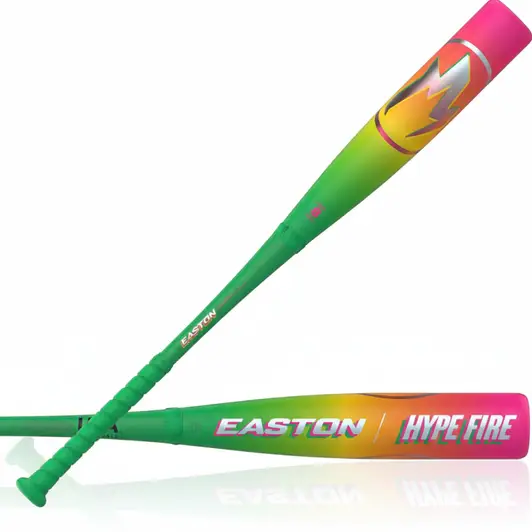
🔥 Easton 2026 Hype Fire USA
Best For: Youth and league players who want Easton's most proven composite USA design in the 2026 lineup — the player whose practice volume, temperature environment, and break-in timeline support the composite construction investment, and who wants the Hype Fire's barrel performance ceiling and vibration dampening in a design whose performance reputation across multiple Hype Fire product generations gives it one of the strongest composite track records in the USA certification category.
Construction: Two-piece composite construction with Easton's DOUBLE BARREL 3 technology — a construction that uses a two-wall composite barrel design to create the trampoline effect and barrel responsiveness that composite USA bats deliver at peak break-in, alongside a connection system that dampens the vibration from mishits before it reaches the hands and reduces the sting that off-center contact produces across a full youth batting practice session.
Material: Two-piece composite barrel and handle construction with Easton's DOUBLE BARREL 3 barrel engineering — composite fiber materials that deliver the barrel responsiveness and vibration dampening that Easton's most proven USA composite construction produces when the break-in period is completed and the composite fibers have loosened to the barrel's peak performance window.
Performance Feel: Explosive and forgiving — the Hype Fire delivers the composite contact experience that youth players who have completed the break-in period describe as a fundamentally different feel than alloy alternatives: soft and forgiving on mishits through the composite barrel's natural vibration dampening, explosive on well-struck balls when the DOUBLE BARREL 3 trampoline effect is fully activated at peak break-in, and balanced through the zone in a way that keeps barrel control consistent across the full range of pitch locations youth competition produces.
Ideal Player Type: Youth and league players whose practice environment includes enough batting practice volume to complete the 150 to 200 swing break-in period before the competitive season, whose spring league starts late enough or whose climate is warm enough to avoid the cold weather cracking risk that composite construction carries below 60 degrees, and who want Easton's most proven composite performance ceiling in the 2026 USA lineup.
Performance Overview: The Easton 2026 Hype Fire USA delivers Easton's flagship composite construction to the USA certification category — bringing the DOUBLE BARREL 3 barrel technology and the Hype Fire's proven performance reputation to the youth and league player whose development stage and practice environment support the composite investment. The Hype Fire's DOUBLE BARREL 3 construction uses a two-wall composite barrel design that creates the trampoline effect composite hitters are looking for — a barrel that flexes slightly at contact and snaps back, returning energy to the ball in a way that single-piece alloy construction cannot replicate at the USA certification level. The connection system between the composite barrel and handle dampens the vibration from mishits before it reaches the hands, which is the performance feature that separates composite designs from alloy alternatives in terms of comfort and consistency across the high pitch counts and long batting practice sessions that youth development programs produce. The Hype Fire requires the standard break-in period before reaching peak performance — planning ahead for that window before the season's most competitive stretch is the management step that determines whether the composite investment pays off at the level the construction is capable of delivering.
Why It Stands Out:
- DOUBLE BARREL 3 two-wall composite barrel construction creates the trampoline effect that composite USA hitters associate with maximum barrel performance — a flex-and-return response at contact that alloy construction cannot replicate and that reaches its full potential after the break-in period is properly completed before competitive use.
- Two-piece connection system dampens vibration from mishits before it reaches the hands — reducing sting and hand fatigue across long batting practice sessions and high-pitch-count youth at-bats in ways that directly affect how consistently young players maintain their approach through a full competitive day.
- Easton's most proven composite USA design across multiple Hype Fire product generations — performance reputation and construction track record that give parents and coaches confidence in what the barrel delivers at full break-in for the youth player whose practice environment supports the composite investment.
- Balanced swing weight profile keeps bat speed and barrel control consistent across the full range of pitch locations youth competition produces — accessible to youth players across a range of development stages rather than limited to the elite bat speed that end-loaded designs demand.
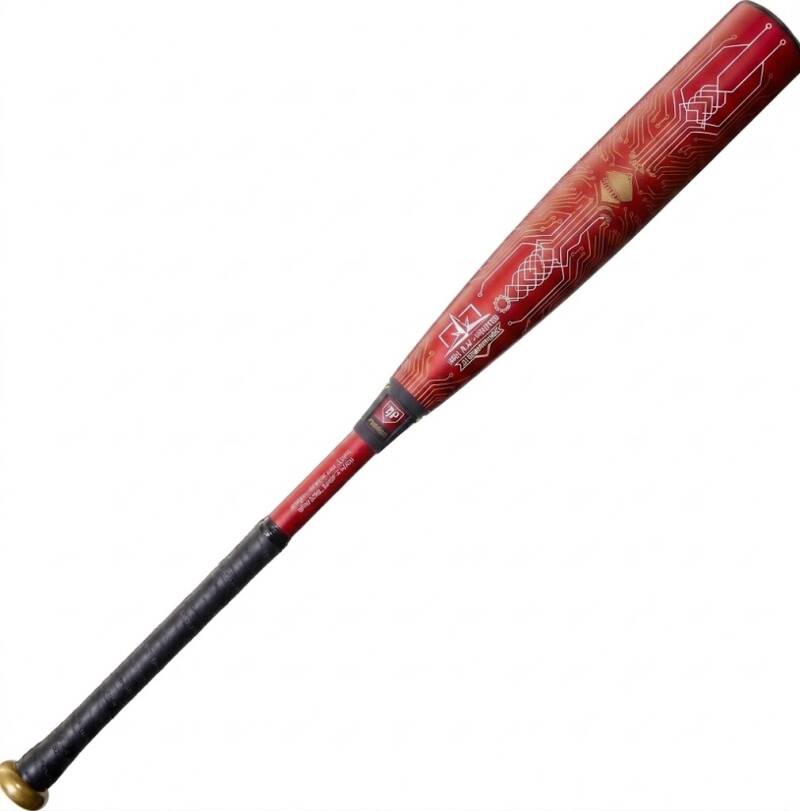
🧬 Louisville Slugger 2026 Meta USA
Best For: Youth and league players who want Louisville Slugger's most premium composite USA design — the player whose game demands the Meta's balanced composite construction, vibration dampening, and barrel performance ceiling in a design whose reputation as Louisville Slugger's flagship composite product at every certification level gives it the strongest brand credibility in the balanced composite USA category for 2026.
Construction: Two-piece composite construction with Louisville Slugger's premium composite barrel and handle joined at the connection system that defines the Meta's performance identity across every certification level — a design built around the balanced swing weight, composite barrel responsiveness, and vibration dampening that Louisville Slugger's most premium composite engineering produces when applied to the USA certification format for youth and league players.
Material: Premium composite barrel and handle construction providing the combination of barrel responsiveness, balanced swing weight distribution, and contact feel that the Meta has built its performance reputation on across multiple product generations — material specification that delivers the composite barrel's trampoline effect at peak break-in alongside the balanced swing profile that maximizes bat speed and barrel control for youth players across the broadest range of development stages.
Performance Feel: Premium, balanced, and composite — the Meta delivers the contact experience that youth players who have used Louisville Slugger's premium composite describe as the benchmark the balanced composite USA category reaches at its highest construction tier: soft and forgiving on mishits through the composite barrel's vibration dampening, explosive on well-struck balls at peak break-in through the trampoline effect that premium composite construction produces, and balanced through the zone in a way that makes the bat accessible to youth players at every development stage.
Ideal Player Type: Youth and league players whose practice environment and temperature conditions support the composite investment, and whose parents want Louisville Slugger's most premium composite construction behind the bat their player swings — players across every development stage whose game benefits from a balanced composite swing weight profile and the brand credibility that Louisville Slugger's Meta reputation delivers at the USA certification level.
Performance Overview: The Louisville Slugger 2026 Meta USA carries the most recognized name in Louisville Slugger's premium composite lineup to the USA certification category — bringing the Meta's balanced composite construction and performance reputation to the youth and league player whose development stage and practice environment match the composite investment. The Meta's balanced swing weight profile maximizes bat speed for the widest range of youth player development stages — making it accessible to the younger player still developing swing mechanics and the older youth player whose rotational strength is more fully developed, rather than limiting its optimal performance window to the elite bat speed that end-loaded designs demand from the players swinging them. Louisville Slugger's premium composite engineering behind the Meta gives the design a barrel performance ceiling that the brand's alloy alternatives at the same certification level cannot reach at full break-in, making the Meta the correct investment for the youth player whose practice volume and temperature environment support the 150 to 200 swing break-in period before the competitive season begins.
Why It Stands Out:
- Louisville Slugger's most premium balanced composite USA construction delivers the trampoline barrel response and vibration dampening that two-piece composite is built around — in a swing weight profile that maximizes bat speed for the widest range of youth player development stages.
- Balanced swing weight profile keeps barrel control and bat speed consistent across the full range of pitch locations youth competition produces — accessible to players at every development stage rather than limited to the elite bat speed that end-loaded alternatives require.
- Meta performance reputation across multiple product generations at every certification level gives parents and coaches confidence in the construction quality and barrel consistency that Louisville Slugger's most premium composite delivers at the USA certification level.
- Two-piece composite construction dampens vibration on mishits — reducing hand fatigue across long batting practice sessions and high-pitch-count youth at-bats in ways that directly affect how consistently young players maintain their approach through a full competitive day.
💣 DeMarini 2026 The Goods USA
Best For: Youth and league power hitters who want DeMarini's most aggressive USA bat design — the physically developed youth player whose rotational strength and swing mechanics are matched to the Goods' power-focused construction identity, and who wants the end-loaded barrel momentum and aggressive performance profile that DeMarini's Goods line delivers to power-first hitters at the USA certification level.
Construction: Two-piece construction with DeMarini's power-focused barrel engineering — the Goods' design built around the end-loaded swing weight and barrel geometry that power hitters who generate elite contact velocity specifically seek at the USA certification level, with the construction philosophy that the Goods line has built its power-first identity around across multiple product generations in the competitive bat market.
Material: DeMarini's power-oriented barrel and handle construction providing the combination of barrel stiffness, end-loaded swing weight distribution, and contact feel that the Goods delivers to the physically developed youth power hitter whose game is built around hard, aggressive contact in the barrel — material specification matched to the power-first performance identity that the Goods line communicates at every certification level DeMarini produces it at.
Performance Feel: Powerful and end-loaded — the Goods delivers the contact experience that physically developed youth power hitters whose swing mechanics are matched to its construction describe as the correct feel for their approach at the plate: barrel momentum through the zone, aggressive feedback on hard contact, and the power-first performance identity that the Goods line communicates in DeMarini's USA lineup for 2026.
Ideal Player Type: Physically developed youth power hitters whose rotational strength and swing mechanics are at the development stage that driving end-loaded barrel weight through the zone consistently demands — players whose game is built around hard aggressive contact in the barrel and who want DeMarini's most aggressive power-focused USA construction in the 2026 lineup.
Performance Overview: The DeMarini 2026 The Goods USA brings DeMarini's power hitter bat philosophy to the USA certification category — an aggressive construction built for the physically developed youth player whose swing mechanics and rotational strength are matched to a power-focused end-loaded design that lighter-swinging balanced alternatives don't fully serve. The Goods' construction prioritizes barrel momentum and power-focused geometry for the youth hitter whose game is built around driving the ball with authority rather than the bat speed and barrel control emphasis that balanced designs optimize for across a broader range of development stages. DeMarini's engineering behind the Goods gives youth power hitters the construction quality and brand credibility that the Goods name delivers at every certification level — a power-focused design backed by a manufacturer whose reputation in the power hitter bat category runs as deep as any brand in the competitive market.
Why It Stands Out:
- Power-focused end-loaded construction built for the physically developed youth player whose rotational strength and swing mechanics are matched to driving barrel momentum through the zone consistently — a construction matched to the power-first hitter profile rather than engineered for the broadest possible youth market.
- DeMarini's Goods line power identity applied to the USA certification format — brand credibility and construction track record that give physically developed youth power hitters confidence in the Goods' barrel engineering and swing weight consistency at the USA level.
- End-loaded swing weight maximizes barrel momentum on well-struck balls for hitters with the rotational strength to drive that weight through the zone consistently — the power performance advantage that physically mature youth players specifically seek above the balanced swing weight profiles that serve a broader development range.
- DeMarini's construction quality and power hitter reputation behind the USA Goods design — manufacturing experience that gives parents and coaches confidence in the build quality the Goods delivers across a full youth competitive season.
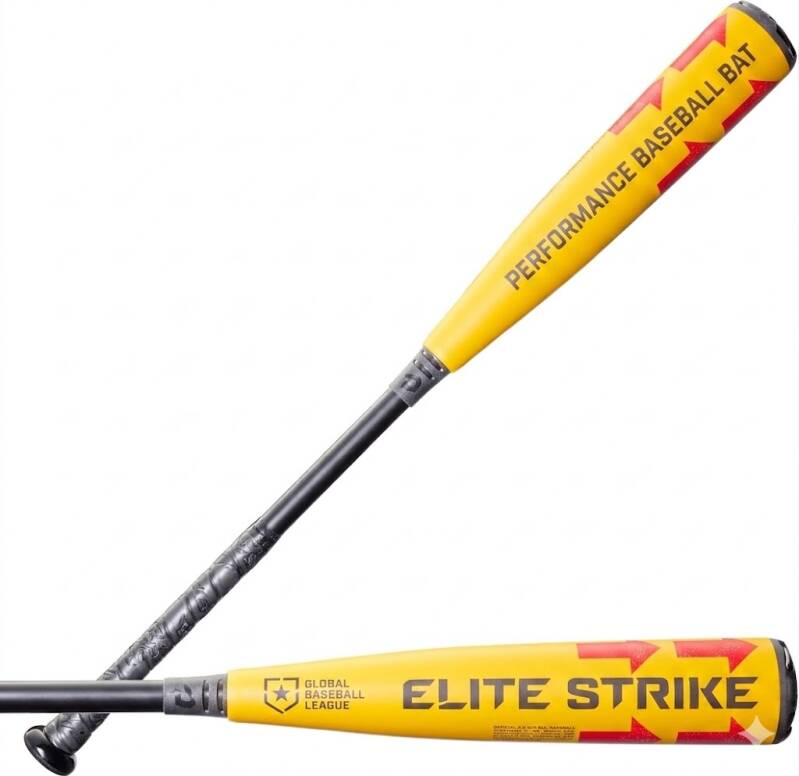
⚡ Performance Differences Between Composite and Alloy USA Bats
The most significant performance differences between the USA bats in this guide split cleanly along the composite vs alloy construction line — and understanding where those differences matter most in the youth baseball context determines which construction is the correct investment for the specific player, league environment, and practice situation the parent is buying for. The Easton Hype Fire, Louisville Slugger Meta, and DeMarini Goods represent the composite construction tier — designs whose performance ceiling at peak break-in exceeds what alloy alternatives at the same certification level produce, but whose cold weather restriction, break-in timeline, and higher price point create real management demands that the alloy alternatives eliminate entirely. The Rawlings ICON, Axe Avenge Pro 3, and Louisville Slugger Atlas represent the construction approaches that bridge or complement the core composite vs alloy decision — the ICON with Rawlings' composite engineering, the Axe Avenge Pro 3 with its composite construction and distinctive axe handle format, and the Atlas with Louisville Slugger's hybrid construction philosophy that uses elements of both material categories to serve the player whose game benefits from neither the pure composite nor the pure alloy experience. For youth players whose practice environment and temperature conditions don't support the composite break-in and cold weather management that composite construction demands, alloy and hybrid alternatives eliminate those variables without fully giving up the barrel performance that composite construction delivers at full break-in. 🦇 USA Bats for Youth Players (2026) covers the full youth-specific selection breakdown across every construction type. For the contact-first player whose swing weight and construction priorities are centered on bat speed and barrel control above power, 🎯 USA Bats for Contact Hitters (2026) covers the complete contact-oriented USA bat decision in detail.
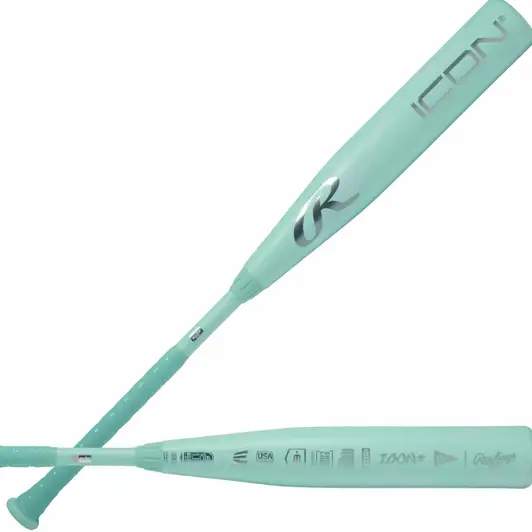
🎯 Rawlings 2026 ICON USA
Best For: Youth and league players who want Rawlings' premium composite USA design — the player whose game demands the ICON's composite barrel performance, balanced swing weight, and vibration dampening in a design backed by Rawlings' engineering reputation and construction quality in the youth bat market, and whose practice environment and temperature conditions support the composite investment that the ICON's construction requires before competitive use.
Construction: Two-piece composite construction with Rawlings' ICON barrel engineering — a design built around the balanced swing weight, composite barrel responsiveness, and vibration dampening that Rawlings' most premium composite construction delivers to youth and league players at the USA certification level, with the engineering philosophy and construction quality that Rawlings' ICON product line communicates across every certification format it appears in.
Material: Premium composite barrel and handle construction providing the combination of barrel responsiveness, balanced swing weight distribution, and contact feel that Rawlings' ICON engineering delivers at the USA certification level — material specification that produces the composite barrel's trampoline effect at peak break-in alongside the balanced swing profile that maximizes bat speed and barrel control for youth players across the broadest range of development stages.
Performance Feel: Premium and balanced — the ICON delivers the composite contact experience that youth players who have used Rawlings' premium composite describe as the benchmark Rawlings' engineering produces at the USA certification level: soft and forgiving on mishits through the composite barrel's vibration dampening, explosive on well-struck balls at peak break-in, and balanced through the zone in a way that makes the bat accessible to youth players at every development stage without the swing weight demands that end-loaded alternatives introduce.
Ideal Player Type: Youth and league players whose practice environment and temperature conditions support the composite investment, and whose game benefits from a balanced composite swing weight profile and Rawlings' premium construction quality at the USA certification level — players across every development stage who want Rawlings' ICON engineering and brand credibility behind the bat they swing in 2026 league and tournament competition.
Performance Overview: The Rawlings 2026 ICON USA brings Rawlings' premium composite engineering to the USA certification category — delivering the ICON's balanced composite construction and barrel performance ceiling to the youth and league player whose development stage and practice environment match the composite investment. The ICON's balanced swing weight profile maximizes bat speed for the widest range of youth player development stages — making it accessible to players across the full youth development spectrum rather than limiting its optimal performance window to a specific physical maturity or swing mechanics stage. Rawlings' composite engineering behind the ICON gives youth players the barrel performance ceiling that Rawlings' premium construction produces at peak break-in — a construction quality that the brand's engineering reputation in the youth bat market backs with the consistency that parents and coaches expect from a premium investment at the USA certification level.
Why It Stands Out:
- Rawlings' premium composite ICON engineering applied to the USA certification format — brand construction quality and engineering reputation that give parents and coaches confidence in the barrel consistency and swing weight accuracy the ICON delivers across a full youth competitive season.
- Balanced swing weight profile maximizes bat speed and barrel control for youth players across the broadest range of development stages — accessible to every player in the USA certification age group rather than limited to the physical maturity that end-loaded designs require.
- Two-piece composite construction dampens vibration on mishits — forgiving the off-center contact that youth players at every development stage consistently produce and keeping hand comfort consistent through the long competitive days that youth league schedules generate.
- Rawlings' ICON performance reputation across multiple product generations gives parents confidence in the construction quality they're investing in — a premium composite design backed by a manufacturer with one of the strongest track records in competitive youth baseball equipment.
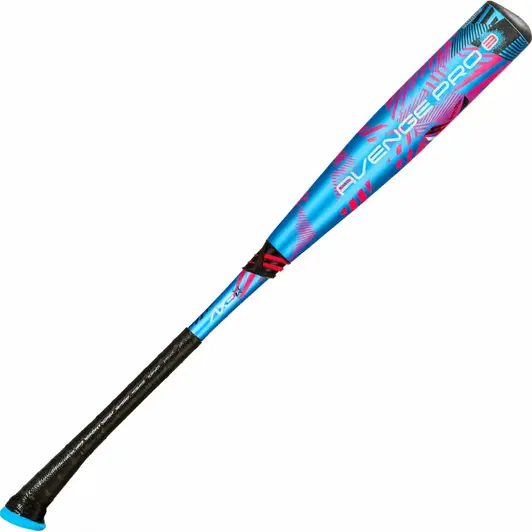
🪓 Axe Avenge Pro 3 Composite USA
Best For: Youth and league players who want premium composite USA performance in a distinctive axe handle format — the player whose swing mechanics benefit from the directional grip and single-sided barrel contact zone that the Axe handle's asymmetrical design delivers above conventional round handle alternatives, and whose game demands the Avenge Pro 3's composite barrel performance ceiling alongside the biomechanical hitting advantages that Axe's handle philosophy communicates across every certification level it produces bats for.
Construction: Two-piece composite construction with Axe's Avenge Pro 3 barrel engineering and asymmetrical axe handle format — a design that combines premium composite barrel performance with Axe's distinctive handle philosophy, delivering the composite barrel's trampoline effect and vibration dampening alongside the directional grip and wrist angle that the axe handle format produces for hitters whose swing mechanics benefit from the biomechanical advantages the asymmetrical design delivers above conventional round handle construction.
Material: Premium composite barrel and handle construction with Axe's asymmetrical handle material — composite fiber barrel materials that deliver the barrel responsiveness and vibration dampening that Axe's Avenge Pro 3 composite construction produces at peak break-in, alongside the axe handle's distinctive grip material that provides the directional contact and single-sided barrel wear pattern that Axe's handle philosophy is built around.
Performance Feel: Premium composite with distinctive handle feedback — the Avenge Pro 3 delivers the composite contact experience alongside the directional grip feel that the axe handle format produces, giving players the soft forgiving feel on mishits and explosive barrel response at peak break-in that composite construction delivers alongside the wrist angle and grip control that Axe's asymmetrical handle design adds above the conventional round handle format.
Ideal Player Type: Youth and league players whose swing mechanics specifically benefit from the directional grip and biomechanical advantages that Axe's handle format delivers — players who want premium composite barrel performance at the USA certification level alongside the handle philosophy that Axe's design communicates, and whose commitment to the axe handle format is based on the biomechanical hitting advantages rather than novelty.
Performance Overview: The Axe Avenge Pro 3 Composite USA combines premium composite barrel performance with Axe's distinctive handle philosophy — delivering the composite barrel's performance ceiling alongside the biomechanical hitting advantages that the axe handle format produces for the youth player whose swing mechanics are matched to the directional grip and single-sided barrel contact that Axe's design is built around. Axe's handle philosophy is based on the biomechanical argument that the natural wrist angle and grip position that an axe handle produces more closely matches the swing mechanics that hitting coaches teach than the conventional round handle format that every other manufacturer uses — a philosophy that a meaningful number of youth players and coaches have adopted across the competitive market since Axe introduced the format. The Avenge Pro 3's composite barrel delivers the premium performance ceiling that composite construction reaches at peak break-in alongside the handle advantage that Axe's design philosophy adds to the standard two-piece composite formula.
Why It Stands Out:
- Premium composite Avenge Pro 3 barrel engineering delivers the performance ceiling that two-piece composite construction reaches at peak break-in — trampoline barrel effect, vibration dampening on mishits, and the barrel responsiveness that alloy alternatives at the same certification level cannot match after proper break-in.
- Axe's distinctive handle format delivers the directional grip and biomechanical hitting advantages that the asymmetrical handle design produces for youth players whose swing mechanics benefit from the wrist angle and grip control that conventional round handles don't provide.
- Single-sided barrel contact zone extends barrel life by concentrating wear on the same face of the barrel on every swing — a practical durability advantage that round handle bats don't produce because hitters don't consistently contact the ball on the same barrel face across every swing.
- Axe's construction quality and handle philosophy applied to the premium composite USA format — brand identity and engineering commitment that give youth players and parents confidence in a handle design backed by a biomechanical philosophy rather than a novelty aesthetic.
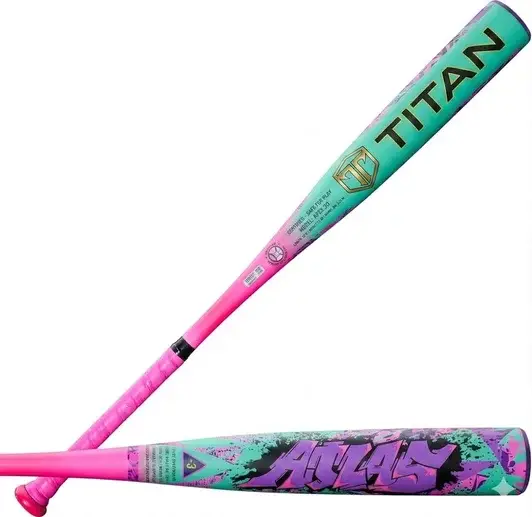
🏛️ Louisville Slugger 2026 Atlas USA
Best For: Youth and league players who want Louisville Slugger's balanced hybrid USA construction — the player whose game benefits from the hybrid construction philosophy that bridges the gap between the premium composite and alloy ends of the USA bat market, in a design backed by Louisville Slugger's 2026 engineering and the Atlas's identity as the balanced hybrid option in Louisville Slugger's competitive USA lineup.
Construction: Two-piece hybrid construction with Louisville Slugger's Atlas barrel engineering — a design whose construction philosophy and swing weight profile bridge the gap between the premium composite Meta and the power-focused Select PWR in Louisville Slugger's 2026 USA lineup, delivering the hybrid construction advantages of alloy barrel immediacy and composite handle dampening in a balanced swing weight profile that serves the broadest range of youth player development stages across the USA certification category.
Material: Louisville Slugger's hybrid barrel and handle construction providing the combination of alloy barrel stiffness, balanced swing weight distribution, and composite handle dampening that the Atlas delivers to the youth player whose game benefits from a construction that combines elements of both material categories — alloy's immediate readiness and consistent cold weather performance at the barrel alongside composite's vibration dampening at the handle.
Performance Feel: Balanced and hybrid — the Atlas delivers the construction experience that youth players who want a middle path between Louisville Slugger's premium composite Meta and its power-focused alternatives describe as the correct feel for their development stage and hitting approach: quick enough through the zone that barrel control stays consistent, stiff enough at the barrel that hard contact translates directly to ball flight, and forgiving enough at the handle that mishit sting doesn't accumulate into hand fatigue across a full youth practice session or competitive day.
Ideal Player Type: Youth and league players whose development stage benefits from a balanced hybrid swing weight profile — players at the mid-development stage whose rotational strength and swing mechanics are developed enough to benefit from hybrid barrel stiffness above full composite feel but who want the vibration dampening and two-piece construction comfort that the composite handle delivers above a fully single-piece alloy alternative, and who want Louisville Slugger's 2026 construction quality behind a balanced design that serves their current development stage.
Performance Overview: The Louisville Slugger 2026 Atlas USA occupies the balanced hybrid middle ground in Louisville Slugger's 2026 USA lineup — a design whose construction philosophy and swing weight profile serve the youth player who wants something between the premium composite Meta and the power-focused alternatives without fully committing to either end of the construction spectrum. The Atlas's hybrid design delivers the alloy barrel's immediate readiness and consistent performance alongside the composite handle's vibration dampening, in a balanced swing weight profile that keeps bat speed high enough for the broadest range of youth development stages to benefit from the construction. Louisville Slugger's 2026 engineering behind the Atlas gives youth players the brand quality and construction consistency that the Louisville Slugger name delivers at the USA certification level in a design that fills the balanced hybrid slot that the lineup's premium composite and power-focused alternatives leave open for the player whose game benefits from elements of both construction philosophies.
Why It Stands Out:
- Balanced hybrid construction bridges the gap between premium composite and alloy construction philosophies — serving the youth player whose game benefits from alloy barrel immediacy and composite handle dampening in a swing weight profile that keeps bat speed consistent across the full zone.
- Alloy barrel delivers immediate game-ready performance with no break-in period — the practical alloy advantage in a hybrid design that also provides composite handle comfort on mishits, eliminating the break-in timeline management that full composite alternatives require.
- Louisville Slugger's 2026 construction quality applied to the balanced hybrid USA format — brand engineering and manufacturing credibility that give youth players and parents confidence in the Atlas's barrel consistency and swing weight accuracy.
- Balanced swing weight profile accessible to the broadest range of youth development stages — from the younger player still developing rotational mechanics through the more physically developed player whose swing is closer to its full development, rather than limiting peak performance to the elite bat speed that end-loaded alternatives require.
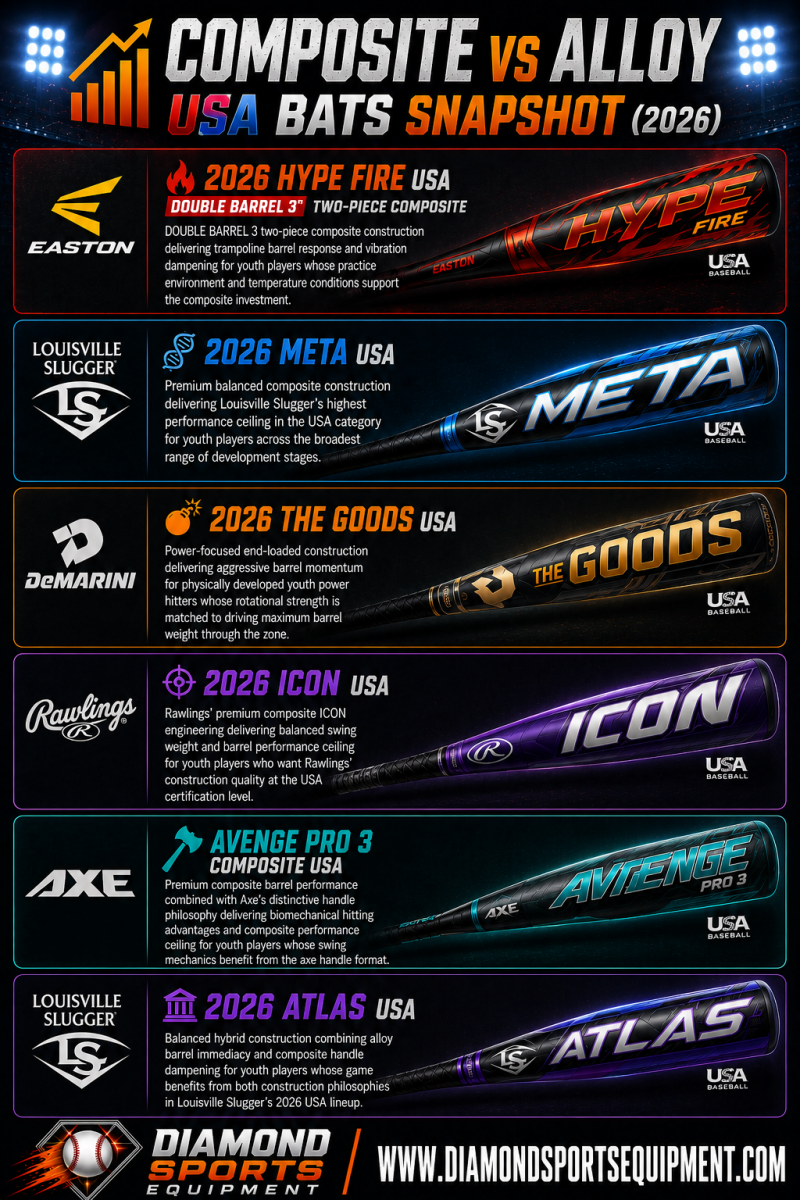
📊 Composite vs Alloy USA Bats Snapshot (2026)
- 🔥 Easton 2026 Hype Fire USA — DOUBLE BARREL 3 two-piece composite construction delivering trampoline barrel response and vibration dampening for youth players whose practice environment and temperature conditions support the composite investment.
- 🧬 Louisville Slugger 2026 Meta USA — Premium balanced composite construction delivering Louisville Slugger's highest performance ceiling in the USA category for youth players across the broadest range of development stages.
- 💣 DeMarini 2026 The Goods USA — Power-focused end-loaded construction delivering aggressive barrel momentum for physically developed youth power hitters whose rotational strength is matched to driving maximum barrel weight through the zone.
- 🎯 Rawlings 2026 ICON USA — Rawlings' premium composite ICON engineering delivering balanced swing weight and barrel performance ceiling for youth players who want Rawlings' construction quality at the USA certification level.
- 🪓 Axe Avenge Pro 3 Composite USA — Premium composite barrel performance combined with Axe's distinctive handle philosophy delivering biomechanical hitting advantages and composite performance ceiling for youth players whose swing mechanics benefit from the axe handle format.
- 🏛️ Louisville Slugger 2026 Atlas USA — Balanced hybrid construction combining alloy barrel immediacy and composite handle dampening for youth players whose game benefits from both construction philosophies in Louisville Slugger's 2026 USA lineup.
❓ FAQ
Should a youth player use a composite or alloy USA bat?
- Youth players whose spring league starts in cold weather, whose parents purchase bats close to the start of the season, or whose practice volume doesn't consistently reach 150 to 200 swings before competition are better served by alloy construction — the immediate readiness, cold weather performance, and lower price point eliminate the management demands that composite construction introduces without significantly reducing the performance available at the USA certification level.
- Youth players whose practice environment includes consistent warm weather batting practice volume, whose parents purchase bats early enough to complete the break-in period before the competitive season, and whose age and development stage mean they'll use the same bat through a full season before outgrowing it are well-matched to composite construction — the higher performance ceiling and vibration dampening that composite delivers at full break-in reward the management investment the construction requires.
Can composite USA bats be used in cold weather?
- Composite USA bats should not be used below 60 degrees Fahrenheit — the layered carbon fiber becomes brittle in cold conditions, the barrel loses its responsiveness, and the risk of cracking on mishits increases significantly enough that most manufacturers void their warranties on cold-weather composite damage.
- Alloy and hybrid USA bats with alloy barrels have no cold weather restriction and perform consistently across the full temperature range that youth spring and fall baseball produces — making them the correct construction choice for northern climate leagues whose spring seasons regularly begin in temperatures below the composite use threshold.
How long does it take to break in a composite USA bat?
- Composite USA bats require approximately 150 to 200 swings against a tee or soft toss before the composite fibers loosen and the barrel reaches its peak performance window — a break-in process that should be completed before the first competitive game rather than during live pitching where mishits on an unbroken barrel produce worse results than the construction is capable of at full break-in.
- Parents who purchase a composite bat mid-season or close to a tournament without completing the break-in period are paying a premium price for composite performance they won't access until the barrel has gone through the required contact volume — alloy's immediate readiness eliminates that timing risk entirely.
Are alloy USA bats less durable than composite?
- Alloy USA bats typically deliver longer functional lifespans than composite alternatives under high-volume batting practice conditions — aluminum alloy does not experience the fiber degradation that composite construction produces under sustained high-velocity contact, and alloy barrels don't crack in cold weather or develop dead spots under the batting practice volume that youth development programs put on a bat across a full season.
- Composite bats can crack on mishits in cold weather and occasionally develop dead spots under sustained high-velocity batting practice use — failure modes that alloy construction handles more durably, making alloy the longer-lasting investment for youth players whose practice volume is high enough to accelerate composite degradation or whose spring seasons begin in cold weather conditions that composite barrels aren't designed to handle.
🧢 Final Thoughts
The composite vs alloy decision for USA bats comes down to one honest question — does the player's practice environment, league temperature, and break-in timeline actually support what composite construction requires before it delivers what it's capable of? If the answer is yes, the Easton Hype Fire, Louisville Slugger Meta, Rawlings ICON, Axe Avenge Pro 3, and DeMarini Goods all represent the premium composite performance ceiling that the USA category reaches at its best. If the answer is no — or even maybe — alloy and hybrid construction eliminate the cold weather risk, the break-in timeline pressure, and the price premium without significantly reducing the performance available at the USA certification level for the youth player whose development stage is still building toward the swing mechanics that composite construction rewards most at full break-in. The Louisville Slugger Atlas sits in the middle of that decision — hybrid construction that delivers alloy barrel immediacy alongside composite handle comfort for the player who wants elements of both without fully committing to either. Match the construction to the player's actual practice situation rather than the performance ceiling — and the correct USA bat decision becomes straightforward. For the power-first USA bat options that serve the physically developed youth player whose swing is built around driving the ball, check out 🚀 USA Bats for Power Hitters (2026). For more gear guides across every category, visit 📝 Diamond Sports Equipment Blog & Gear Reviews.