Training tools are the piece of a player's development program that separates the athletes who improve every season from the ones who stay at the same level year after year. Game reps develop competitive instincts — but the specific mechanical improvements, bat speed gains, and timing refinements that push a player to the next level require the targeted, high-repetition training that purpose-built tools deliver in practice sessions away from the field. A swing trainer that isolates the path flaw a player cannot feel in game conditions. A speed sensor that makes bat speed development measurable rather than theoretical. A rope swing trainer that forces the connected, inside-out swing path that coaches describe but players struggle to feel without the physical feedback that the tool provides.
The training tools in this guide were selected for the specific skill development outcomes each one delivers — not for brand recognition or price point. Each tool targets a distinct mechanical or performance variable that affects how a player performs in competition, and each one delivers development value that standard fielding and batting practice cannot replicate on its own. For the full picture on building a complete training environment around these tools, pair this guide with 💪 Speed, Strength & Velocity Training Tools (2026) and ⚾ Best Baseball Training Tools & Equipment (2026) for everything a serious player needs to develop every aspect of their game.
⚾ What You Should Know About Training Tools
🎯 Targeted Training Produces Faster Improvement Than General Reps
A training tool that isolates a specific mechanical variable delivers more improvement per rep than general batting or fielding practice that engages the full skill without isolating the specific flaw. Players who train specific mechanics with purpose-built tools improve faster than those who rely entirely on game and practice reps to self-correct.
📊 Measurable Feedback Accelerates Development
Tools that provide objective performance data — bat speed, pitch velocity, swing path — allow players to track improvement and make targeted adjustments rather than relying on subjective feel alone. Measurable training produces faster, more consistent improvement than feel-based practice without objective feedback.
🔄 Swing Trainers Build Muscle Memory Through Repetition
The muscle memory that produces consistent swing mechanics in competition is built through thousands of repetitions of the correct movement pattern — not through occasional corrections during game at-bats. Swing trainers that force the correct path, connection, or tempo build the muscle memory that transfers to game performance faster than standard tee and soft toss work alone.
⏱️ Consistency of Use Determines the Training Tool's Value
A training tool used three times and stored in the garage delivers no development value. The tools in this guide are selected for designs that integrate naturally into regular practice routines — easy enough to set up and use that players actually use them consistently rather than reaching for them occasionally when motivation is high.
🏆 Training Tools That Build Real Skills
Six training tools built for swing mechanics development, bat speed improvement, and the targeted repetition that game performance demands at every competitive level.
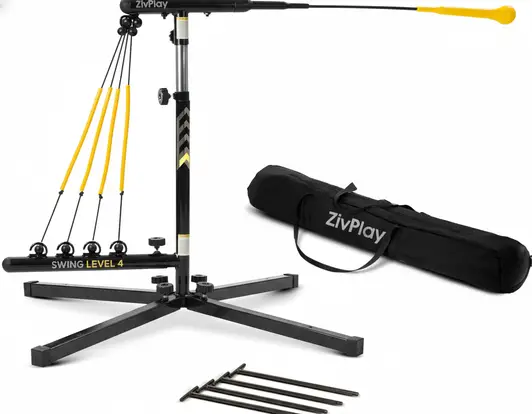
🔥 ZivPlay Baseball Hitting Trainer
Best For: Players who want a hitting trainer that provides immediate physical feedback on swing path and contact point without requiring a partner, pitching machine, or complex setup.
Construction: Portable hitting trainer design with adjustable ball positioning and physical swing path feedback mechanism.
Material: Durable polymer and steel construction with adjustable positioning components.
Performance Feel: Immediate and corrective — the ZivPlay hitting trainer provides physical feedback on swing path and contact point on every rep, giving the player the mechanical correction information that a coach watching from the side would provide without requiring anyone else to be present during the training session.
Ideal Player Type: Players at every level who want to develop swing path consistency and contact point awareness through targeted solo hitting repetitions without relying on live pitching or a training partner to generate productive practice reps.
Performance Overview: The ZivPlay Baseball Hitting Trainer is built for the player who wants to develop swing mechanics through targeted solo repetition without the logistics of setting up a pitching machine, finding a soft toss partner, or waiting for team batting practice to work on a specific mechanical issue. The trainer's design provides immediate physical feedback on the swing path and contact point that each rep produces — giving the player the corrective information they need to adjust mechanics between reps rather than repeating the same flawed path through an entire session without knowing whether improvement is occurring. Players who incorporate the ZivPlay into their regular practice routine develop the swing path consistency and contact point awareness that competitive hitting demands through the targeted, feedback-rich repetition that standard tee work alone cannot provide.
Why It Stands Out:
- Provides immediate physical feedback on swing path and contact point on every rep.
- Enables targeted mechanical correction without a coach, partner, or pitching machine present.
- Portable design integrates naturally into backyard and facility solo practice sessions.
- Builds swing path consistency through corrective feedback repetition rather than feel-based practice.
- Delivers the mechanical development value that solo hitting practice needs to produce real improvement.
💥 PLAYAPUT Baseball Softball Batting Tee with Tethered Ball Auto Reset Swing Trainer
Best For: Players who want a batting tee that auto-resets the ball after each swing — eliminating the ball retrieval interruption that breaks the rep rhythm of standard tee work and reducing the time between swings in solo hitting sessions.
Construction: Batting tee design with tethered ball system that auto-resets the ball to the hitting position after each swing.
Material: Durable tee construction with tethered ball mechanism and adjustable height components.
Performance Feel: Continuous and rhythmic — the tethered ball auto-reset eliminates the reach-and-replace motion that breaks the rep rhythm of standard tee work, allowing the player to stay in the hitting stance and take the next swing immediately after the previous one without stepping out of position to retrieve or replace the ball.
Ideal Player Type: Solo hitters who want to maximize the rep volume of their tee work sessions by eliminating the ball retrieval interruption between swings — the player who understands that rep rhythm and volume are the primary drivers of muscle memory development in hitting training.
Performance Overview: The PLAYAPUT Baseball Softball Batting Tee with Tethered Ball Auto Reset addresses the single most consistent rep rhythm problem in solo tee work — the ball retrieval interruption between swings that breaks the muscle memory training sequence and reduces the rep volume a solo hitter can complete in a fixed practice window. The tethered ball returns to the hitting position after each swing without requiring the player to step out of the stance, reach for the ball, or reposition the tee — keeping the player locked into the hitting rhythm that high-volume rep sessions demand for effective muscle memory development. Players who switch from standard tee work to the PLAYAPUT tethered system consistently report higher rep volume per session and better stance consistency across the full set of swings because the auto-reset keeps them in the hitting position rather than repeatedly breaking and re-entering it.
Why It Stands Out:
- Tethered ball auto-reset eliminates the ball retrieval interruption between swings.
- Keeps the player in the hitting stance through the full rep sequence for better stance consistency.
- Increases rep volume per session by removing the time lost to ball replacement between swings.
- Works for both baseball and softball across youth and adult player heights.
- Delivers more productive tee work in the same practice window than standard tee designs allow.

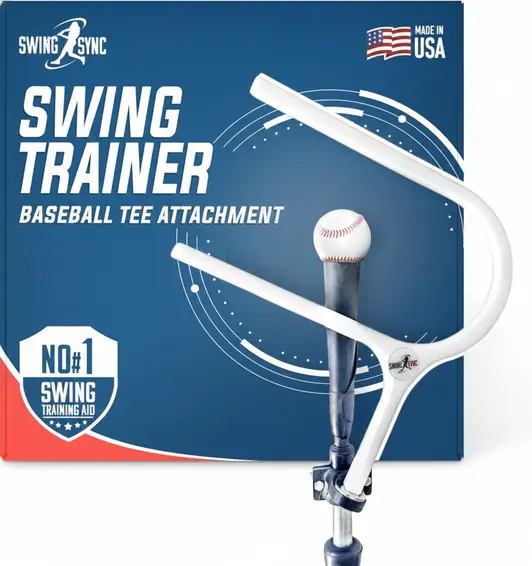
🎯 Swing Sync Baseball Swing Trainer
Best For: Players who want a swing trainer that develops the connected, synchronized swing mechanics that produce consistent barrel path and contact quality across the full range of pitch locations.
Construction: Wearable or attachment-based swing trainer design that provides physical feedback on swing synchronization and connection through the contact point.
Material: Durable training aid construction with adjustable fit and attachment components.
Performance Feel: Connected and corrective — the Swing Sync trainer provides physical feedback on the synchronization between the lower body rotation, hip turn, and hand path that produces the connected swing mechanics competitive hitting demands, giving the player a corrective sensation when the sequence breaks down and a reinforcing feel when the connection is correct.
Ideal Player Type: Players at the intermediate and competitive level who have the foundational swing mechanics in place and want a training tool specifically designed to develop the connected, synchronized sequence that separates average contact from consistent quality contact in competitive at-bats.
Performance Overview: The Swing Sync Baseball Swing Trainer is built for the player who understands that the connected swing is not a single motion but a synchronized sequence — and that developing that synchronization through physical feedback training produces the consistent barrel path and contact quality that feel-based coaching cues alone cannot build as efficiently. The trainer provides physical feedback on the specific connection points in the swing sequence that break down under competitive pressure, developing the muscle memory of the correct synchronized sequence through corrective repetition rather than the theoretical understanding of the sequence that verbal instruction delivers without the physical reinforcement. Players who incorporate the Swing Sync into their regular training develop the swing synchronization that produces consistent contact quality across the full range of pitch locations that competitive pitching attacks.
Why It Stands Out:
- Develops the connected, synchronized swing sequence that produces consistent contact quality.
- Provides physical corrective feedback on swing synchronization rather than theoretical instruction.
- Builds muscle memory of the correct connected sequence through targeted corrective repetition.
- Designed for players with foundational mechanics who want to develop connection and synchronization.
- Delivers the swing development value that feel-based coaching cues cannot build as efficiently alone.
⚡ Performance Differences Between Training Tools
The most significant performance difference between training tools is the type of feedback each one delivers — and it determines how quickly the player can make the mechanical adjustments that improvement requires. Tools that provide immediate physical feedback on every rep give the player corrective information in real time, allowing mechanical adjustment between swings rather than after a session when feel-based memory has already faded. Tools that provide measurable data feedback — bat speed numbers, swing path angles, velocity readings — give the player objective performance markers that make development trackable and goal-oriented rather than relying on subjective feel to determine whether improvement is occurring. The players who develop fastest are the ones whose training tools provide both physical and measurable feedback on every rep, creating the corrective loop that accelerates mechanical improvement beyond what standard practice alone produces. For more on building a complete training setup, see 🏏 Best Batting Tees for Baseball & Softball (2026 Guide) and 🥅 Best Hitting Nets for Baseball & Softball (2026 Guide).
Portability and setup simplicity are the second major performance differentiators — and the ones that determine whether a training tool actually gets used consistently enough to deliver its development value. A training tool that requires 20 minutes of setup, a specific facility, or a training partner to operate gets used occasionally when conditions are perfect and stored the rest of the time. A training tool that sets up in under two minutes, works in a backyard or garage, and requires no partner gets used daily — and daily use is the variable that separates training tools that change a player's performance from ones that collect dust in the equipment bag. Every tool in this guide was selected for the setup simplicity and portability that makes consistent daily use realistic for players whose practice time and facility access are limited by school, travel, and team schedule demands.
⚡ GoSports Baseball & Softball Rope Swing Trainer
Best For: Players who want a rope-based swing trainer that forces the inside-out, connected swing path through physical resistance that teaches proper bat path mechanics faster than feel-based instruction alone.
Construction: Rope-based swing trainer design that attaches to a fixed point and provides resistance-based feedback on swing path through the hitting zone.
Material: Durable rope construction with attachment hardware and adjustable positioning components.
Performance Feel: Resistive and path-corrective — the rope provides physical resistance that forces the inside-out swing path through the zone, giving the player the kinesthetic feedback of the correct bat path that verbal instruction describes but cannot physically enforce through the contact point.
Ideal Player Type: Players at every level who want to develop the inside-out, connected swing path through physical resistance training rather than feel-based coaching instruction — particularly players who understand the correct path conceptually but cannot feel the difference between the correct path and their current habit without physical feedback forcing the adjustment.
Performance Overview: The GoSports Baseball & Softball Rope Swing Trainer delivers the physical resistance-based swing path training that coaches have used for decades to correct the casting, rolling over, and disconnected swing paths that undermine contact quality in competitive hitting. The rope attachment forces the bat to travel through the inside-out path that quality contact demands — if the swing drifts outside or casts early, the rope provides immediate physical resistance that stops the incorrect path before it reaches the contact point. Players who train with the rope trainer develop the kinesthetic feel of the correct inside-out path through physical repetition rather than the theoretical understanding of the path that verbal instruction delivers without the corrective resistance that the rope provides on every swing.
Why It Stands Out:
- Rope resistance forces the inside-out swing path through physical correction on every rep.
- Provides kinesthetic feedback on the correct bat path that verbal instruction cannot physically enforce.
- Works for both baseball and softball players across every age and competitive level.
- Corrects casting, rolling over, and disconnected swing paths through resistance-based repetition.
- Delivers bat path development that feel-based coaching instruction alone cannot produce as efficiently.

🌟 AERO-SWING Baseball & Softball Swing Trainer with 12 Durable Foam Balls
Best For: Players who want a complete swing trainer and ball package that delivers contact mechanics training with foam balls in any indoor or outdoor space without the ball retrieval and safety concerns that standard baseballs and softballs create in confined practice environments.
Construction: Swing trainer design with 12 included foam training balls sized for baseball and softball contact mechanics practice.
Material: Durable swing trainer construction with 12 high-density foam ball training aids.
Performance Feel: Safe and productive — the foam balls deliver real contact feedback on swing path and bat-to-ball connection without the retrieval logistics and space requirements that standard balls demand in backyard, garage, and indoor facility training environments.
Ideal Player Type: Players who train in confined spaces — garages, basements, indoor batting facilities, and small backyard areas — where standard baseballs and softballs create safety and retrieval problems that limit the rep volume and training quality of contact mechanics sessions.
Performance Overview: The AERO-SWING Baseball & Softball Swing Trainer with 12 Durable Foam Balls solves the space and safety problem that keeps players from taking high-volume contact mechanics reps in the environments where they have the most available practice time — the garage, the basement, the backyard with limited clearance. The 12 included foam balls deliver real bat-to-ball contact feedback that wiffle balls and other training ball alternatives cannot match in terms of contact feel and swing path information, and the durable foam construction handles repeated contact without deformation that reduces the feedback quality across a full session. Players who incorporate the AERO-SWING into their regular training can complete full contact mechanics sessions in spaces that standard ball training would make unsafe or impractical.
Why It Stands Out:
- 12 included foam balls enable contact mechanics training in confined indoor and outdoor spaces.
- Foam balls deliver real bat-to-ball feedback that wiffle balls and lighter alternatives cannot match.
- Eliminates the safety and retrieval concerns that standard balls create in confined practice environments.
- Durable foam construction handles repeated contact without deformation across full training sessions.
- Enables high-volume contact mechanics reps in the spaces where players have the most available practice time.

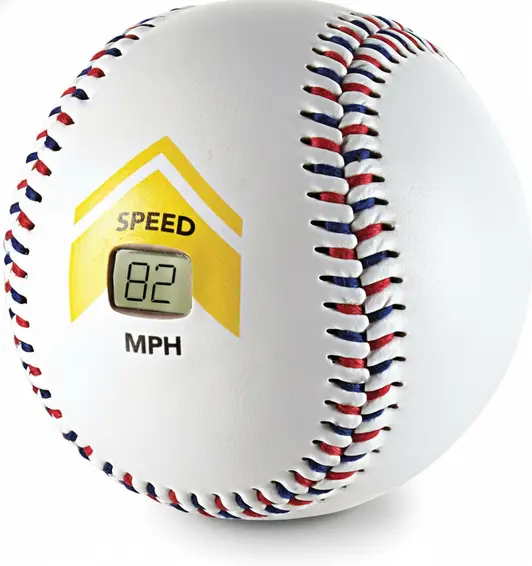
🏹 SKLZ Bullet Ball Baseball Pitching Speed Sensor
Best For: Pitchers who want an affordable, easy-to-use pitching speed sensor that makes velocity development measurable without the cost and setup complexity of a dedicated radar gun.
Construction: Ball-integrated speed sensor design that measures pitch velocity and displays the reading immediately after each throw.
Material: Durable ball construction with integrated speed sensor and digital readout system.
Performance Feel: Immediate and objective — the integrated speed sensor delivers a velocity reading on every pitch without requiring a separate radar gun operator, a specific facility, or any setup beyond throwing the ball toward the target and reading the display after each pitch.
Ideal Player Type: Youth, recreational, and developing competitive pitchers who want to make velocity development measurable and trackable without investing in a dedicated radar gun — the pitcher who understands that objective velocity data makes development faster but needs it in a format that works in backyard and practice field throwing sessions without a second person operating a separate device.
Performance Overview: The SKLZ Bullet Ball Baseball Pitching Speed Sensor gives pitchers the objective velocity feedback that makes development trackable in a format that works anywhere — backyard sessions, warm-up routines, bullpen work, and long toss programs — without requiring a second person to operate a radar gun or a specific facility setup that limits when and where velocity training can happen. The ball-integrated sensor design delivers a velocity reading immediately after each pitch, allowing the pitcher to track velocity trends across a session and make the mechanical adjustments that objective data informs rather than relying on feel alone to gauge whether velocity is improving, holding steady, or dropping through a training session. Players who track velocity objectively develop faster than those who train without measurable feedback because the data creates the improvement accountability that feel-based training cannot provide.
Why It Stands Out:
- Ball-integrated speed sensor delivers velocity readings without a separate radar gun or operator.
- Works in any throwing environment — backyard, bullpen, warm-up, or long toss sessions.
- Makes velocity development measurable and trackable without dedicated radar gun investment.
- Immediate post-pitch readout allows real-time mechanical adjustment based on objective data.
- Delivers the velocity feedback that accelerates development for pitchers at every level.

📊 Training Tool Snapshot (2026)
- 🔥 ZivPlay Baseball Hitting Trainer — provides immediate physical feedback on swing path and contact point for targeted solo mechanical development.
- 💥 PLAYAPUT Baseball Softball Batting Tee with Tethered Ball Auto Reset Swing Trainer — tethered ball auto-reset eliminates retrieval interruption and maximizes rep volume in solo tee sessions.
- 🎯 Swing Sync Baseball Swing Trainer — develops the connected, synchronized swing sequence that produces consistent contact quality across the full strike zone.
- ⚡ GoSports Baseball & Softball Rope Swing Trainer — rope resistance forces the inside-out swing path through physical correction that feel-based instruction cannot enforce.
- 🌟 AERO-SWING Baseball & Softball Swing Trainer and 12 Durable Foam Balls — 12 foam balls enable full contact mechanics training in confined indoor and outdoor spaces safely.
- 🏹 SKLZ Bullet Ball Baseball Pitching Speed Sensor — ball-integrated speed sensor makes velocity development measurable and trackable without a dedicated radar gun.
❓ FAQ
What training tool is best for developing swing mechanics?
- The GoSports Rope Swing Trainer and Swing Sync Baseball Swing Trainer both develop specific mechanical aspects of the swing through physical feedback — the rope for inside-out path correction, the Swing Sync for connection and synchronization development.
- Match the tool to the specific mechanical variable being developed rather than using a general swing trainer that addresses multiple issues without isolating any one of them.
Can training tools replace standard batting practice?
- No — training tools supplement batting practice by isolating specific mechanical variables that standard practice engages without targeting.
- The most effective development programs use training tools for mechanical isolation work and standard batting practice for applying those mechanics in game-speed conditions.
What is the benefit of a tethered ball batting tee?
- The PLAYAPUT tethered ball system eliminates the ball retrieval interruption between swings, keeping the player in the hitting stance and increasing the rep volume achievable in a fixed practice window.
- Higher rep volume in the same practice time means faster muscle memory development for the mechanical pattern being trained.
Is the SKLZ Bullet Ball accurate for measuring pitch velocity?
- The ball-integrated sensor provides a reliable velocity reading that is accurate enough for development tracking and session-to-session comparison.
- It is not a replacement for a professional radar gun in scouting or evaluation contexts, but it delivers the objective velocity data that development tracking requires in practice environments.
Can these training tools be used indoors?
- Yes — the AERO-SWING with foam balls and the PLAYAPUT tethered tee are specifically designed for confined indoor training environments where standard balls create safety and retrieval problems.
- The GoSports Rope Swing Trainer and Swing Sync Trainer also work indoors in any space with adequate swing clearance.
🧢 Final Thoughts
The training tools in this guide are not accessories — they are the development infrastructure that separates players who improve intentionally from those who rely on game reps alone to develop the mechanics, bat speed, and velocity that competitive play demands. From the auto-reset rep efficiency of the PLAYAPUT tethered tee to the inside-out path correction of the GoSports Rope Swing Trainer to the objective velocity tracking of the SKLZ Bullet Ball, each tool in this guide targets a specific development variable that standard practice cannot address as efficiently on its own. Use them consistently, use them with intention, and the mechanical improvements they produce will show up in game performance every time a player steps to the plate or takes the mound.
For more on building a complete training environment around these tools, check out ⚾ Best Baseballs for Practice (2026) for the ball options that pair best with these trainers in daily development sessions. And for everything across every category of baseball and softball gear, visit 📝 Diamond Sports Equipment Blog & Gear Reviews.
Add comment
Comments