Every hitter has a flaw they can feel but can't fix. The roll-over that costs them the pull-side line drive. The long path that gets them jammed inside. The casting that bleeds bat speed before the barrel ever reaches the zone. The timing issue that makes them early on offspeed and late on velocity on the same count. These aren't problems that more tee work fixes — because tee work without the right training stimulus just gives the flaw more reps. Swing trainers exist to interrupt that pattern. The best ones introduce a physical correction, a resistance, a constraint, or a timing challenge that forces the swing to change in a specific, measurable way rather than asking the hitter to think their way through a mechanical adjustment at game speed. The difference between a hitter who grinds through a slump for two months and one who breaks out of it in a week is almost always a tool that gave them something specific to work against.
The six swing trainers in this guide cover every major mechanical variable that separates an efficient swing from an inefficient one — path correction, timing development, lead arm extension, hip-to-shoulder separation, bat speed through the zone, and the rotational consistency that ties all of those qualities together into a swing that performs under pressure. Each one was selected from confirmed inventory, matched to a specific mechanical problem, and written to help you identify which tool matches the specific flaw you're trying to fix. For hitters who want to pair these swing trainers with the path and contact training tools that address the underlying mechanical picture, 🎯 Swing Path & Contact Trainers (2026) covers that side of the development equation in full. For pitching, fielding, and all-around tools alongside swing trainers, check the ⚒️ Training Tools for Ball Players.
⚾ What You Should Know About Swing Trainers
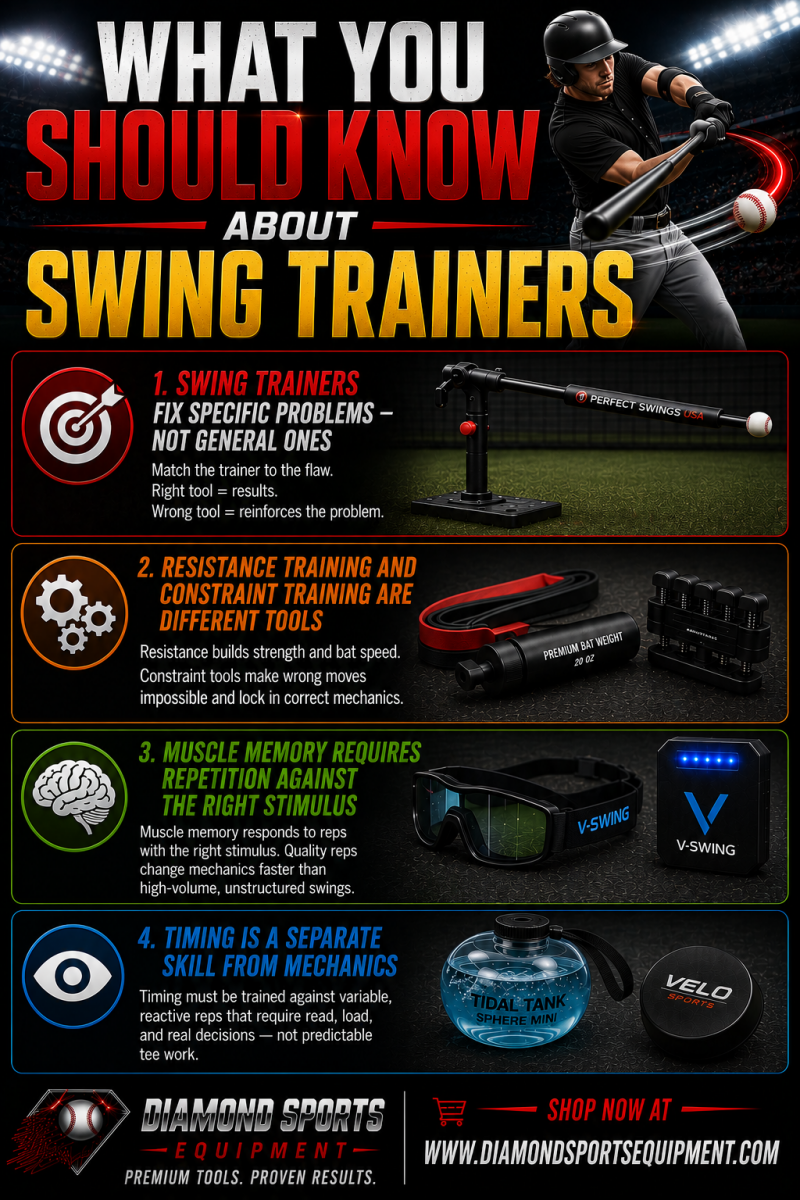
🎯 Swing Trainers Fix Specific Problems — Not General Ones
Before buying any trainer, identify the specific mechanical problem first — the trainer that matches the flaw produces results, and the one that doesn't match produces nothing but reps that reinforce the wrong pattern. A casting problem needs a path constraint tool, a bat speed problem needs a resistance tool, and confusing the two produces a more athletic version of the same fault rather than the correction the hitter actually needs.
⚙️ Resistance Training and Constraint Training Are Different Tools
Resistance trainers build bat speed and strength by making the swing harder to complete — weighted implements, drag devices, and band-loaded swings all fall into this category and develop the physical capacity that gives correct mechanics something to work with. Constraint trainers fix mechanics by making the wrong movement physically impossible on every rep, which is why they produce faster muscle memory correction than verbal instruction or video review can deliver at the same rep volume.
🔬 Muscle Memory Requires Repetition Against the Right Stimulus
Muscle memory doesn't respond to descriptions — it responds to physical experience repeated consistently enough to overwrite the existing pattern, which is why even 20 purposeful trainer reps can produce more mechanical change than 200 unstructured cage swings against the same fault. The right training stimulus applied consistently across a full development block is what separates a hitter whose mechanics improve steadily from one who takes the same swing into every season regardless of how much they practice.
👀 Timing Is a Separate Skill From Mechanics
A hitter can have a mechanically perfect path and still make weak contact consistently if their timing isn't developed against a variable, reactive stimulus that demands a real load and trigger commitment on every rep. Tools that present the ball on a different schedule every rep — or that require the hitter to read and react rather than set up against a known target — develop the timing skill that static tee work structurally cannot address no matter how many reps it produces.
🏆 Best Swing Trainers for Hitters
Six trainers selected to cover every major mechanical variable in the swing — from path and bat speed through timing, lead arm, and full rotational power development.
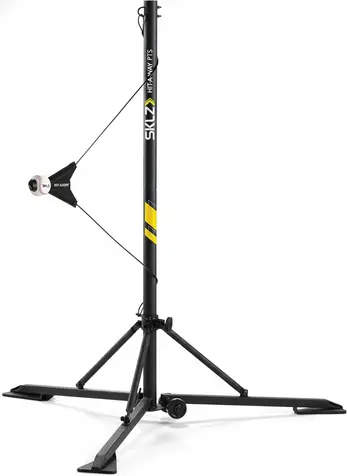
🎯 SKLZ Hit-A-Way Portable Baseball Training-Station Swing Trainer with Stand
Best For: Hitters who want a high-rep solo swing trainer that delivers a moving ball target on every rep — developing tracking, timing, and contact mechanics without a pitcher, a toss partner, or a cage.
Construction: Freestanding portable swing station with a ball suspended on an elastic cord from an adjustable stand — delivering a moving ball target that swings away from contact and resets for the next rep, enabling continuous high-rep swing sessions without ball retrieval breaks that interrupt training rhythm.
Material: Durable elastic cord and adjustable stand construction built for the sustained swing volume that daily batting practice produces — engineered to maintain its reset consistency through high-rep sessions without the cord stretch degradation that cheaper alternatives develop quickly under daily use.
Performance Feel: The Hit-A-Way produces a distinctly different training feel from tee work because the ball moves — the hitter's eyes track instead of stare, and the timing commitment the moving target demands activates the load and trigger sequence that static tee work never requires. The elastic return rhythm keeps sessions moving without the dead time that ball retrieval creates, which means more quality reps in less time than any standard cage setup provides.
Ideal Player Type: Youth through high school hitters who want to maximize solo practice rep volume — particularly players who don't have consistent access to a pitching partner, a machine, or a cage, and need a tool that delivers quality swing reps in a backyard or driveway without infrastructure.
Performance Overview: SKLZ Hit-A-Way Portable Baseball Training-Station Swing Trainer with Stand closes the rep volume gap between players who have consistent team practice access and those developing most of their swing on their own time. The single biggest limitation of tee work is the static ball — it trains contact mechanics but not tracking or timing, which means a hitter who exclusively trains off a tee is developing only half the skill set that live pitching demands. The moving ball target the Hit-A-Way provides requires the same eye engagement, load timing, and trigger commitment that a real pitch demands — making every solo rep a more complete training stimulus than anything a stationary tee can deliver. The freestanding portable design removes the infrastructure barrier that keeps most at-home practice sessions from happening as consistently as development requires, putting quality daily swing reps within reach for any player with flat ground and twenty minutes.
Why It Stands Out:
- Moving ball target develops the tracking and timing that static tee work structurally cannot train.
- Freestanding portable design enables daily solo swing sessions without a facility, cage, or partner.
- Elastic cord reset keeps rep volume high without retrieval breaks that interrupt the training rhythm.
- Adjustable stand height accommodates different player heights and pitch zone work.
- The most accessible high-rep swing training investment available for players building their swing independently.
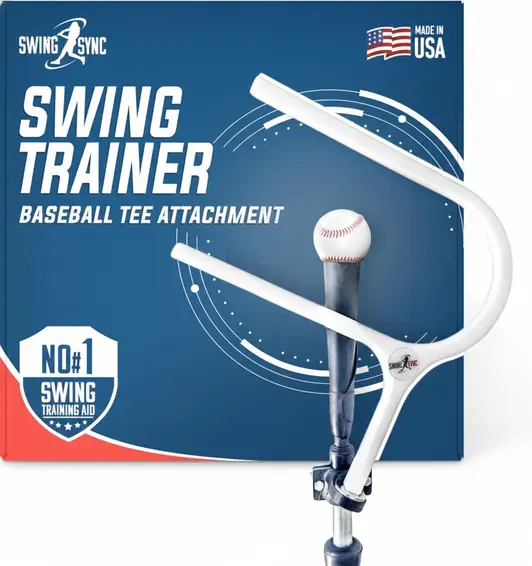
🔄 Swing Sync Baseball Swing Trainer
Best For: Hitters focused on developing swing synchronization — the coordination between hip rotation, shoulder turn, and hand path that produces efficient bat speed rather than an arm-dominant swing that pulls with the hands and leaves the lower half's power completely out of the equation.
Construction: Swing synchronization training device designed to connect the body's rotational sequence to the hand path through the zone — training the hitter to lead with the lower half and let the hands follow rather than allowing the arms to fire independently of the rotation that generates the power behind every efficient swing.
Material: Durable training construction built to maintain its synchronization feedback function through the sustained daily rep volume that swing coordination development requires — designed to hold its structural integrity through the full range of swing speeds from deliberate slow-motion reps to full-effort training swings against live toss or off the tee.
Performance Feel: Training with the Swing Sync produces a specific feeling of being connected through the swing that arm-dominant hitters immediately notice as different from their default pattern — the device physically reinforces the sequence that keeps the body linked from the ground up rather than allowing the hands to fire ahead of the rotation. Players who have been coached on using their hips for years without feeling the connection will feel it for the first time in the first few reps.
Ideal Player Type: Hitters of any age whose swing is arm-dominant — pulling with the hands, casting the barrel, or losing the connection between hip turn and hand path that power generation requires — and coaches who want a physical tool that teaches the rotational sequence more effectively than verbal instruction alone has ever managed to deliver consistently.
Performance Overview: Swing Sync Baseball Swing Trainer targets the mechanical problem that costs more hitters power than any other single variable — disconnection between the lower half's rotation and the hands' path to the ball. A hitter who fires the hands independently of the hips generates only upper-body power, leaving the ground-force transfer and hip rotation that produce the majority of bat speed completely out of the swing chain. The Swing Sync trains that connection physically, making every rep a coordinated full-body swing rather than an arm-dominant pattern that has been reinforced across hundreds or thousands of previous reps. Verbal instruction tells the hitter to use their hips. The Swing Sync makes using their hips the only way the rep happens correctly — and that physical experience, repeated consistently enough, is what overwrites the disconnected pattern that coaching cues alone consistently fail to fix.
Why It Stands Out:
- Physically reinforces the rotational connection that arm-dominant hitters lose between the lower half and the hands.
- Develops the coordinated swing sequence that produces bat speed from the ground up rather than the arms alone.
- Works across every age and skill level where disconnected swing mechanics are limiting power output.
- Provides physical correction on every rep rather than relying on verbal cues the hitter has to self-monitor mid-swing.
- The right tool for coaches who want a training aid that teaches body sequencing more efficiently than instruction alone can deliver.
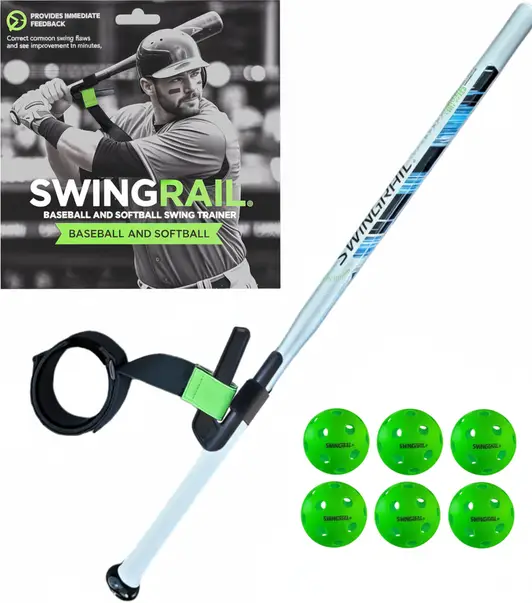
🦾 SWINGRAIL Baseball & Softball Swing Trainer
Best For: Hitters who want a wearable swing trainer that corrects lead arm collapse, barring, and the disconnected front arm mechanics that produce a long, looping path to the ball rather than the tight, connected swing that generates consistent hard contact across the full zone.
Construction: Wearable swing training device that attaches to the lead arm and physically constrains the barring and collapsing mechanics that produce a long path — forcing the lead arm to maintain the connection and extension through the hitting zone that efficient swing mechanics require on every single rep.
Material: Durable wearable training construction built for the sustained tee, front toss, and soft toss rep volume that lead arm correction requires — designed to maintain its constraint function and comfortable fit through the extended daily sessions that meaningful muscle memory change demands across a full training block.
Performance Feel: Wearing the SWINGRAIL during swing training produces an immediate physical sensation of constraint on the lead arm that hitters with barring habits recognize instantly — the device prevents the arm from straightening prematurely and forces the elbow to stay connected to the body through the zone, which produces a distinctly tighter, shorter path feel that most hitters describe as feeling more powerful even before the contact results begin confirming the improvement.
Ideal Player Type: Youth through competitive high school hitters with identified lead arm mechanical faults — barring, early extension, or collapsing the front elbow through the zone — and coaches looking for a wearable correction tool that provides physical feedback on the lead arm's path without requiring a partner to monitor and correct between every rep.
Performance Overview: SWINGRAIL Baseball & Softball Swing Trainer addresses the lead arm mechanical faults that produce the long, inefficient path that contact hitters cannot afford and power hitters lose exit velocity to on every swing where the front arm breaks down before the contact point. The lead arm is the guide rail of the swing — when it bars out or collapses through the zone, the barrel takes a longer, less efficient route to the contact point that reduces both bat speed and the hitter's ability to cover the full pitch zone with authority. The SWINGRAIL's wearable constraint keeps the lead arm in the correct position through the complete swing motion, making proper lead arm mechanics the only available option on every rep until the corrected pattern becomes the default — which is the same outcome that months of coaching-cued practice attempts to produce and consistently fails to deliver as efficiently as physical constraint achieves.
Why It Stands Out:
- Wearable design provides physical lead arm constraint across every tee, toss, and cage rep without requiring a coach or partner.
- Directly corrects barring, early extension, and front elbow collapse — the most common and impactful lead arm faults.
- Works for both baseball and softball hitters at every competitive level.
- Delivers physical feedback on every rep that the hitter feels in real time rather than seeing in post-session video review.
- The most direct lead arm correction investment for hitters whose front arm mechanics are limiting their swing efficiency and zone coverage.
⚡ Performance Differences Between Swing Trainers
The most important performance difference in the swing trainer category is between tools that correct mechanical faults and tools that build physical capacity — and identifying which one your swing actually needs before purchasing determines whether the investment produces measurable results or just adds more reps to a program that already has enough of them. Path correction and constraint tools like the SWINGRAIL and the Swing Sync fix the movement pattern by physically constraining or reinforcing specific positions and sequences — they are the right investment when the hitter's problem is a movement fault that repeats across sessions despite coaching. Capacity tools like the Momentus Speed Hitter and the AERO-SWING build the bat speed and rotational strength that give correct mechanics something to work with — they are the right investment when the hitter's mechanics are sound but the physical output isn't matching their development stage. Running a capacity tool on a movement fault problem produces a stronger version of the same flawed swing. Running a correction tool on a capacity problem produces mechanically correct swings that don't generate the power their physical development should be producing. The hitter who correctly identifies which problem they're actually solving before choosing the tool develops faster than the one who buys what's popular without matching the tool to the specific fault. For players building the complete physical development picture alongside these swing trainers, 💪 Speed, Strength & Velocity Training Tools (2026) covers the athletic performance tools that support everything the swing demands at the physical level. Players who want a complete at-home hitting station to deploy these trainers in should check out 🏏 Best Batting Tees for Baseball & Softball (2026 Guide) for the tee setups that pair with every trainer in this guide.
The second key performance difference is between trainers that require a partner or infrastructure and those that work completely solo. The SKLZ Hit-A-Way and the AERO-SWING are fully solo tools — no toss partner, no pitcher, no machine required. The SWINGRAIL and Swing Sync work with any ball delivery format including solo tee work. The GoSports Rope Swing Trainer and the Momentus Speed Hitter are pure solo implements that develop specific mechanical qualities with no ball at all. For players whose practice time is primarily unsupervised and self-directed, the ability to train without a partner or facility is not a minor convenience — it is the factor that determines whether daily swing work actually happens with the consistency that meaningful mechanical development requires.
💨 Momentus Speed Hitter Baseball Swing Trainer
Best For: Hitters who want to develop bat speed through overload resistance training — swinging a weighted implement that forces the swing muscles to work harder than a standard bat requires, producing the strength and speed adaptation that translates directly to faster barrel velocity on a game-weight bat.
Construction: Weighted swing training bat designed for overload resistance work — heavier than a standard game bat to load the swing muscles through the complete hitting motion, developing the rotational strength, forearm power, and through-zone bat speed that overload training consistently produces when applied progressively across a full development block.
Material: Durable weighted bat construction built for the sustained daily swing volume that bat speed development through overload training requires — weighted specifically to deliver meaningful resistance without the excessive load that compromises swing mechanics in ways that introduce more problems than the speed development is worth.
Performance Feel: Swinging the Momentus Speed Hitter feels like swinging through resistance — the weight is noticeable through the entire arc, engaging the forearms, core, and rotational muscles more actively than a standard bat does on the same swing path. The contrast effect of picking up a game-weight bat after consistent overload training sessions is the adaptation the tool is specifically designed to produce — and players who have experienced it describe the game bat as feeling lighter and faster than it did before the overload work began.
Ideal Player Type: Competitive hitters at the high school and travel ball level who want to develop bat speed through a structured overload training program — and players whose mechanics are sound but whose bat speed isn't matching their physical development because they haven't been training the swing muscles with the progressive overload that strength development actually requires.
Performance Overview: Momentus Speed Hitter Baseball Swing Trainer develops bat speed the same way weighted ball work develops arm velocity — by loading the movement pattern with more resistance than the target implement requires, forcing the muscles to develop strength and speed in the exact movement that game performance demands. The key advantage over generic weight training is movement specificity: the Momentus Speed Hitter loads the swing in the swing's own arc rather than building strength in adjacent movements that improve overall athleticism but don't transfer as directly to the barrel speed and through-zone acceleration that contact quality and exit velocity both depend on. Every overload rep is a swing-specific strength rep — and that specificity is what makes the adaptation show up in game performance rather than just in the weight room numbers.
Why It Stands Out:
- Overload resistance training develops bat speed through the specific movement pattern that game performance actually requires.
- More transfer-specific than generic strength training because it loads the swing itself rather than adjacent movement patterns.
- Contrast effect after consistent overload sessions produces measurable perceived bat speed improvement on return to game weight.
- Develops rotational strength, forearm power, and through-zone acceleration simultaneously in a single daily implement.
- The right bat speed development investment for mechanically sound hitters whose swing speed isn't matching their current physical capacity.
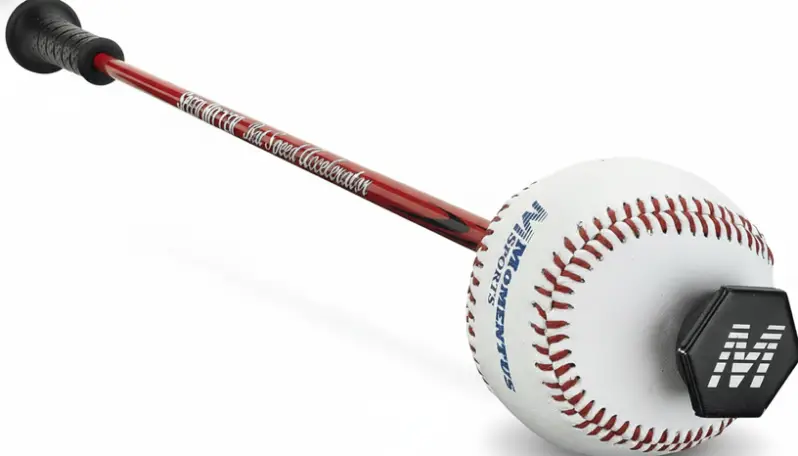
🌀 AERO-SWING Baseball & Softball Swing Trainer
Best For: Hitters who want aerodynamic resistance training that loads the swing through air drag rather than added weight — developing bat speed and swing path efficiency through a resistance mechanism that scales with swing speed rather than providing a fixed load regardless of effort.
Construction: Aerodynamic swing resistance trainer designed to create drag through the air during the swing arc — loading the rotational muscles and swing path through resistance that increases proportionally with swing speed, so the faster the hitter swings, the more resistance the training stimulus provides on that rep.
Material: Durable aerodynamic construction built for sustained swing training volume — designed to maintain its resistance profile and structural integrity through the high-rep daily sessions that bat speed development requires without material fatigue that degrades the drag characteristic that makes the training stimulus consistent across sessions.
Performance Feel: The AERO-SWING produces a resistance feel that's distinctly different from a weighted bat — the drag builds as the swing accelerates rather than being present from the first moment of the swing arc. That speed-proportional resistance creates a training challenge that naturally rewards aggressive, fast swings, which means the tool self-regulates toward the training behavior that bat speed development is trying to build rather than encouraging the slow, controlled swings that fixed overload weight sometimes produces in players who try to manage the weight rather than attack through it.
Ideal Player Type: Hitters who want aerodynamic resistance as an alternative or complement to weighted bat overload training — and players who find weighted bat training mechanically disruptive but still want a resistance-based swing speed development tool in their daily training rotation.
Performance Overview: AERO-SWING Baseball & Softball Swing Trainer brings aerodynamic resistance training into the at-home swing development toolkit — providing a bat speed building stimulus that doesn't require purchasing a separate weighted training bat and doesn't produce the swing weight change that some hitters find mechanically disruptive during the transition back to game-weight equipment. The speed-proportional resistance is the AERO-SWING's specific advantage over fixed-weight alternatives: the training load scales with the hitter's effort rather than imposing the same resistance regardless of swing speed. That scaling means the tool naturally pushes the hitter toward the aggressive, high-effort swings that bat speed training is trying to build — creating a self-reinforcing training dynamic where more aggressive effort produces more resistance and therefore more adaptation than cautious effort does.
Why It Stands Out:
- Aerodynamic resistance scales with swing speed — faster swings produce more resistance, naturally rewarding aggressive training effort.
- Develops bat speed without the swing weight change that weighted bat alternatives introduce between reps and sessions.
- Works for both baseball and softball hitters across every age and competitive level.
- Self-regulating resistance dynamic encourages the aggressive swing effort that bat speed development requires.
- The right alternative for hitters who want resistance-based bat speed training without the mechanical disruption of weighted implement work.
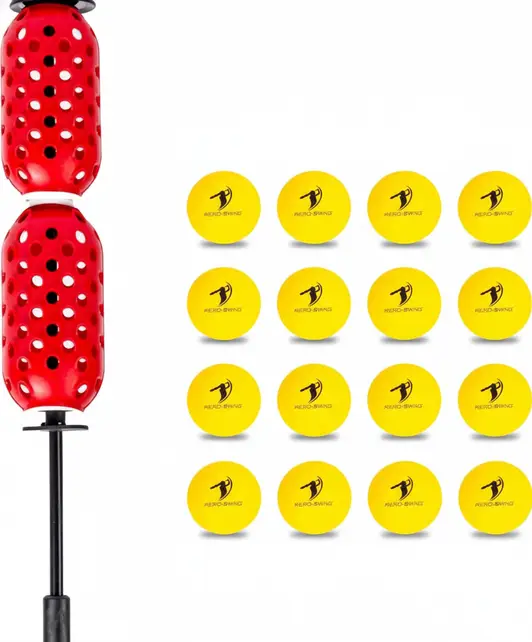
🪢 GoSports Baseball & Softball Rope Swing Trainer
Best For: Hitters and coaches who want a rope-based swing development tool that trains hip-to-shoulder separation, lead arm extension, and the full rotational sequence through a medium that provides immediate physical feedback on sequencing quality without requiring a ball, a cage, or any infrastructure.
Construction: Rope-based swing training implement designed to train the complete swing sequence through the physical feedback that rope dynamics produce — the rope loads through the swing arc, responds to the hitter's sequencing with distinct feedback on whether the hips or the hands led the movement, and develops the extension and follow-through mechanics that efficient swing completion requires at the contact point and through the zone.
Material: Durable rope construction built for the sustained daily swing volume that mechanical development training demands — designed to maintain its tension, feedback dynamics, and attachment integrity through the high-rep sessions that rope swing work produces across a full off-season or in-season maintenance program without the material fatigue that degrades the training stimulus over time.
Performance Feel: Swinging a rope trainer produces a feedback experience that no bat-based training tool can replicate — the rope responds to the swing's sequencing in real time, loading differently when the hips lead correctly versus when the hands fire early. That immediate physical signal tells the hitter whether the rep's sequencing was right before any coach, any camera, or any post-session review delivers the same information — which is what makes the rope swing trainer one of the most self-correcting development tools available.
Ideal Player Type: Hitters at every level who want to develop hip-to-shoulder separation and full rotational sequence through a no-ball training tool that can be used anywhere — and coaches who want a team-wide swing mechanics training implement that every player can use simultaneously without requiring facility access or equipment setup.
Performance Overview: GoSports Baseball & Softball Rope Swing Trainer develops the complete swing sequence through a training medium that provides feel-based feedback on sequencing in real time — making it one of the most coach-friendly swing development tools available because the rope's physical response to correct and incorrect sequencing tells the hitter immediately what the rep produced. A player who sequences correctly feels the rope load smoothly through the arc and extend fully through the finish. A player who fires the hands early or collapses the rotation before completion feels the rope respond differently — and that instant tactile feedback delivers the corrective information that makes the next rep better without requiring the coach to say a word. The no-ball format means it works anywhere, at any time, in any space — making it the daily mechanical maintenance tool that closes the rep gap between practice days for every player on the roster.
Why It Stands Out:
- Rope dynamics provide immediate feel-based feedback on hip-to-shoulder separation and swing sequencing quality on every rep.
- No-ball format enables swing mechanical training anywhere without a cage, tee, or toss partner.
- Works for both baseball and softball hitters across every competitive level from youth through adult.
- Team-friendly design allows multiple players to train simultaneously without equipment competition or facility requirements.
- The most portable and infrastructure-independent swing sequencing development tool in this guide.
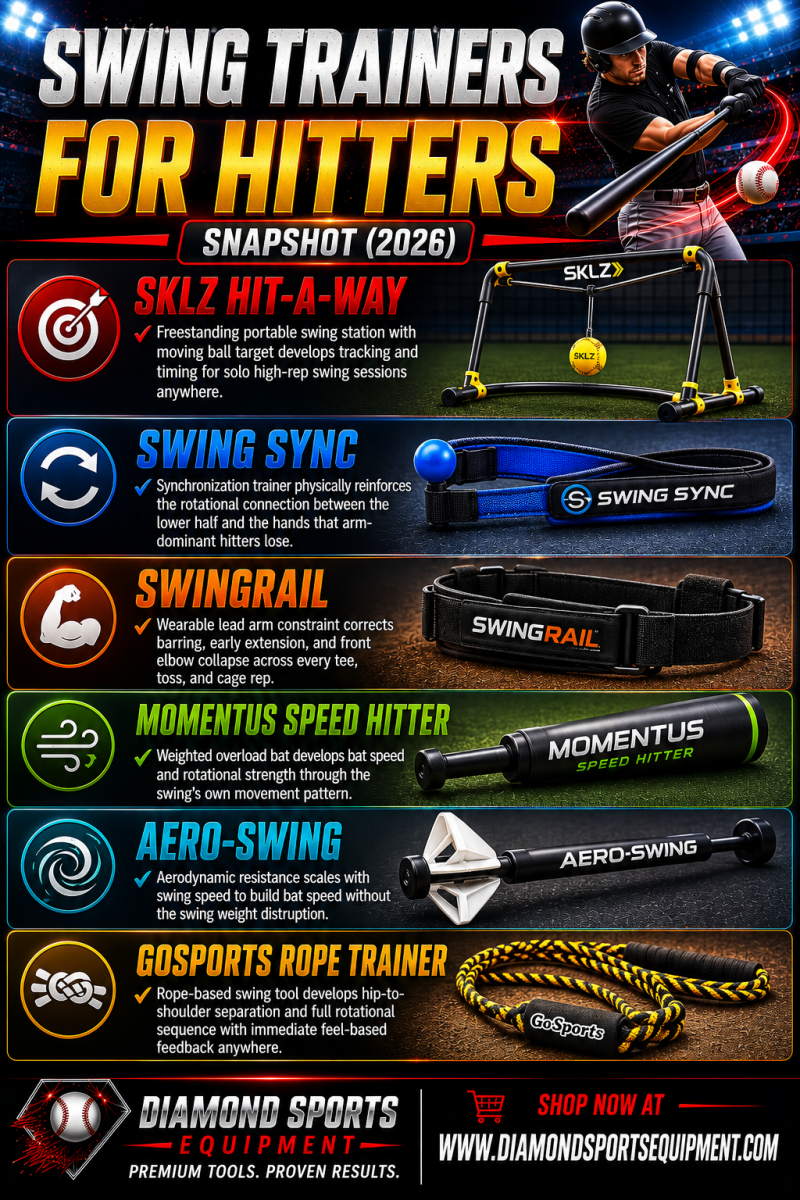
📊 Swing Trainers for Hitters Snapshot (2026)
- 🎯 SKLZ Hit-A-Way Portable Baseball Training-Station Swing Trainer with Stand — freestanding portable swing station with moving ball target develops tracking and timing for solo high-rep swing sessions anywhere.
- 🔄 Swing Sync Baseball Swing Trainer — synchronization trainer physically reinforces the rotational connection between the lower half and the hands that arm-dominant hitters consistently lose.
- 🦾 SWINGRAIL Baseball & Softball Swing Trainer — wearable lead arm constraint corrects barring, early extension, and front elbow collapse across every tee, toss, and cage rep.
- 💨 Momentus Speed Hitter Baseball Swing Trainer — weighted overload bat develops bat speed and rotational strength through the swing's own movement pattern for mechanically sound hitters.
- 🌀 AERO-SWING Baseball & Softball Swing Trainer — aerodynamic resistance scales with swing speed to build bat speed without the swing weight disruption that weighted bat alternatives produce.
- 🪢 GoSports Baseball & Softball Rope Swing Trainer — rope-based swing tool develops hip-to-shoulder separation and full rotational sequence through immediate feel-based feedback anywhere, no ball required.
❓ FAQ
Which swing trainer is best for fixing a casting problem?
- The SWINGRAIL directly constrains the lead arm barring that produces casting, making it the most targeted physical correction for that specific fault.
- The Swing Sync addresses the disconnected sequencing that often causes casting by reinforcing the rotational connection between the lower half and the hands on every rep.
Can swing trainers replace regular batting practice?
- No — swing trainers develop specific mechanical qualities that regular practice doesn't address as efficiently, but they don't replace the timing and recognition development that live pitching and machine reps produce.
- The most effective approach combines swing trainer work for mechanical development with regular batting practice for timing, pitch recognition, and live contact reps.
How often should hitters use swing trainers?
- Most players benefit from two to three structured swing trainer sessions per week alongside their regular batting practice schedule.
- Daily use is appropriate for the no-ball trainers like the GoSports Rope Swing Trainer and the Momentus Speed Hitter since they don't produce the contact volume fatigue that high-rep cage sessions create.
Are these swing trainers appropriate for youth players?
- Yes — the SKLZ Hit-A-Way, GoSports Rope Swing Trainer, and SWINGRAIL are all appropriate for youth players and are particularly effective for developing proper mechanics before incorrect patterns become deeply ingrained habits.
- Weighted tools like the Momentus Speed Hitter should be used with age-appropriate supervision to ensure the load matches the player's current physical development stage and doesn't compromise the mechanics the program is trying to correct.
🧢 Final Thoughts
Swing trainers work when they're matched to the right problem — and they produce almost nothing when they're purchased without a clear mechanical target in mind. The hitter who identifies the specific fault first and selects the trainer that addresses it directly will develop faster and more consistently than the one who buys the most popular training tool and hopes it fixes whatever is wrong with their swing. Every trainer in this guide was selected to address a specific mechanical variable: path correction with constraint-based muscle memory overwriting, rotational connection with physical sequencing reinforcement, lead arm mechanics with wearable correction, bat speed with overload resistance, aerodynamic resistance for speed-proportional loading, and full rotational sequence development through feel-based rope feedback. The hitter who understands which of those variables is their specific limiting factor and builds their training around the tool that addresses it is making a development decision that unstructured cage volume alone will never match for efficiency or precision. Start with the variable that's limiting your performance most right now, add the trainer that targets it directly, execute it with enough consistency to actually overwrite the existing pattern, and build the complete toolkit from there as each correction takes hold. For players who want to strengthen the knowledge foundation that makes every mechanical adjustment more intentional and sustainable, 📚 Best Baseball Training Books (2026) covers the reading resources that build hitting IQ alongside physical tool training. For the complete library of gear guides and equipment reviews across every category of baseball and softball equipment, 📝 Diamond Sports Equipment Blog & Gear Reviews has everything organized and ready.
Add comment
Comments