Every pitcher wants more velocity. More command. A stronger arm that holds up deep into starts and through back-to-back tournament weekends. What most pitchers don't realize is that the mound is where those qualities get tested — not where they get built. The physical attributes that produce elite pitching performance are developed between sessions, through structured tool-based training that targets arm strength, explosive mechanics, and command precision with more specificity than any bullpen session alone can deliver. A pitcher who throws four bullpens a week and does nothing else is accumulating mound volume. A pitcher who pairs that same mound work with weighted ball protocols, plyometric training, and command feedback systems is building a completely different arm — one that's measurably stronger, faster, and more accurate by the time the next season begins.
The tools in this guide cover every variable in the arm development equation: weighted ball sets for progressive velocity building, seamed plyometric balls for explosive full-motion throwing, a strike zone command trainer that tells the pitcher exactly where every pitch went, weighted training baseballs for entry-level overload work, wall anchors that make daily band-based arm care executable at home every single day, and a sensor-based analyzer that turns every softball swing and delivery into a data point worth acting on. Every product is pulled directly from confirmed inventory and matched to a specific development goal. For players who want the broader athletic development picture alongside this arm training guide, 💪 Speed, Strength & Velocity Training Tools (2026) covers the full performance training toolkit. For hitting, fielding, and all-around tools alongside arm work, check the ⚒️ Training Tools for Ball Players.
⚾ What You Should Know About Pitching & Arm Development Tools
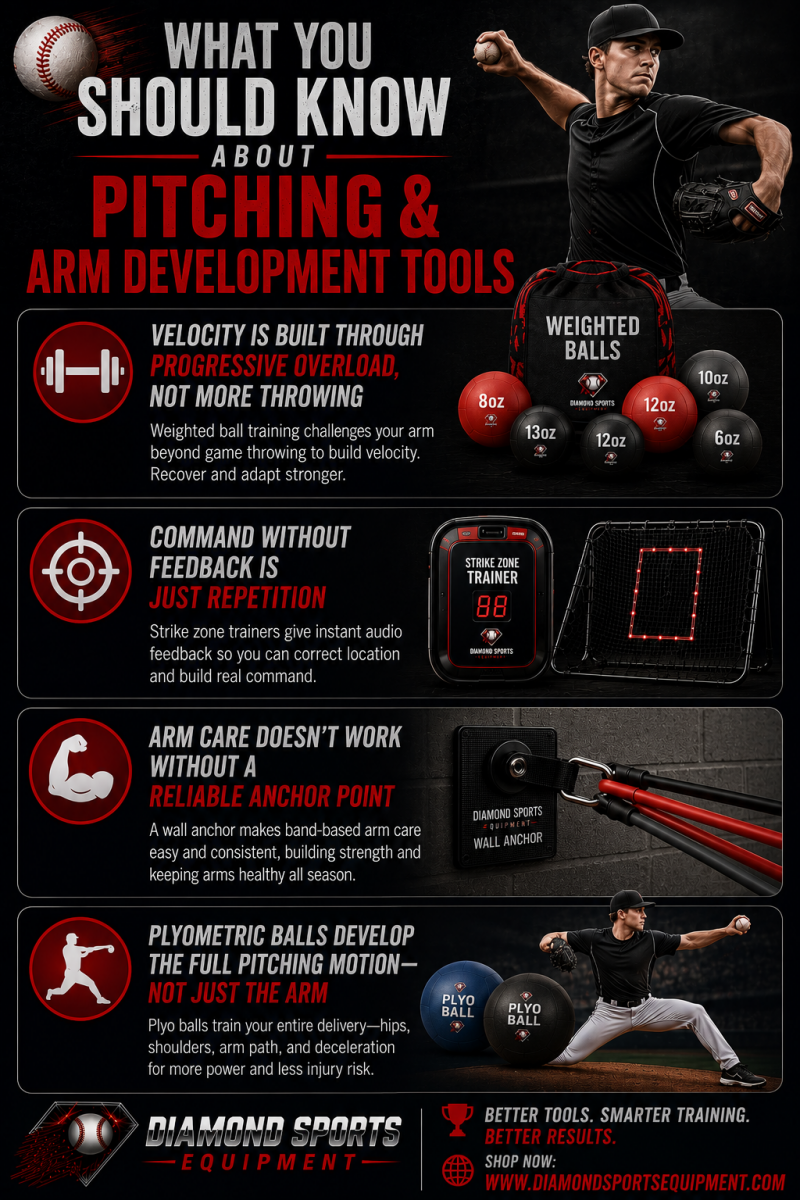
🏋️ Velocity Is Built Through Progressive Overload, Not More Throwing
Throwing more pitches doesn't make the arm faster — it makes it tired. Velocity gains come from systematically challenging the arm with resistance beyond what standard game ball throwing requires, then allowing it to recover and adapt stronger than before. That's what weighted ball protocols are designed to do, and it's why pitchers who train with them consistently outgain peers who rely on mound volume alone.
🎯 Command Without Feedback Is Just Repetition
A pitcher who throws two hundred bullpen pitches a week into a net with no target is building arm endurance, not command. Command is a skill that requires feedback — an immediate signal after every pitch that confirms or corrects location. Strike zone trainers with audible feedback close that gap by giving the pitcher's nervous system the corrective information it needs to adjust on the next throw, not after the session is over.
⚡ Arm Care Doesn't Work Without a Reliable Anchor Point
Band-based arm care is the standard at every professional level for a reason — it develops rotator cuff strength, posterior shoulder stability, and the structural resilience that keeps pitching arms healthy through a long competitive season. But band work only happens consistently when the anchor point is already in place. A wall anchor turns arm care from something that requires setup into something that just happens every day.
🔁 Plyometric Balls Develop the Full Pitching Motion — Not Just the Arm
Standard weighted ball work loads the arm. Plyometric ball throwing loads the entire pitching motion — hip rotation, hip-to-shoulder separation, arm path, and the deceleration mechanics that protect the elbow and shoulder on every throw. That full-motion development is why plyometric protocols produce more complete mechanical improvement than isolated arm strength training produces on its own.
🏆 Best Pitching & Arm Development Tools for Players
Six tools selected to build a complete arm development program — from the weighted ball set that drives velocity gains to the sensor that makes every softball delivery measurable and improvable.
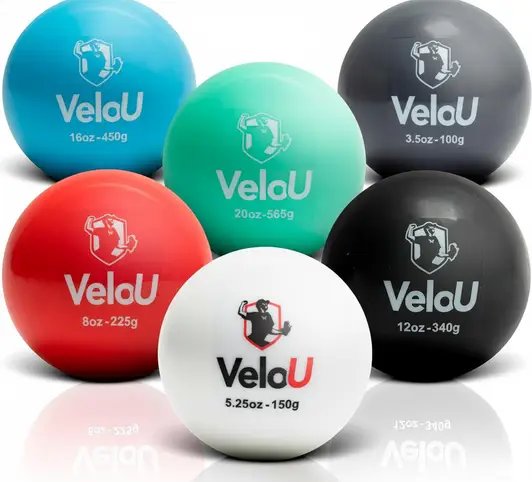
🥇 VeloU Weighted Balls for Baseball 6 Ball Set
Best For: Competitive pitchers running a structured off-season velocity program who need the complete overload and underload ball weight range — not a partial set that limits the depth of the protocol.
Construction: Six-ball weighted set spanning underload through significant overload weight — covering the complete spectrum that properly designed weighted ball programs use to produce neuromuscular adaptation across the full range of throwing loads.
Material: Leather or synthetic leather construction with standard 9-inch baseball diameter and seam profile maintained across all six weights, so grip pressure and release mechanics stay consistent with the game ball throughout the entire training protocol.
Performance Feel: Training through the full VeloU weight spectrum in a single session produces a distinctly different arm feel than single-weight overload work alone. The lighter underload balls train the nervous system to fire faster. The heavier overload balls build the arm strength that sustains those firing patterns when the load returns to game ball weight. Together, that contrast is what drives the velocity gains that single-weight training consistently fails to produce at the same rate.
Ideal Player Type: High school and competitive travel ball pitchers in a structured off-season velocity development block, and serious position players who want the same arm strength protocols that pitching programs use.
Performance Overview: VeloU Weighted Balls for Baseball 6 Ball Set gives pitchers what partial weighted ball sets never can — the complete overload and underload training range that a properly designed velocity program requires to work. Velocity programs that use only a heavy ball develop arm strength in one direction. Programs that use the full weight spectrum from underload through overload develop strength, neuromuscular speed, and the contrast adaptation that produces the fastest velocity gains across an off-season block. VeloU's consistent construction across all six weights means the grip and release feel that pitchers develop during weighted ball sessions transfers directly to standard game ball performance on the mound — the mechanics built in training are the same ones that show up in competition.
Why It Stands Out:
- Full six-ball weight spectrum delivers the overload and underload range that structured velocity programs require to produce real adaptation.
- Standard game ball diameter across all weights preserves grip and release mechanics that transfer directly to the mound.
- Complete set in a single purchase — no sourcing individual weights from multiple products to build a functional protocol.
- Durable construction handles the high-rep volume that a serious off-season weighted ball program produces across a full training block.
- The most complete single-purchase velocity development tool available for pitchers serious about gaining measurable speed.
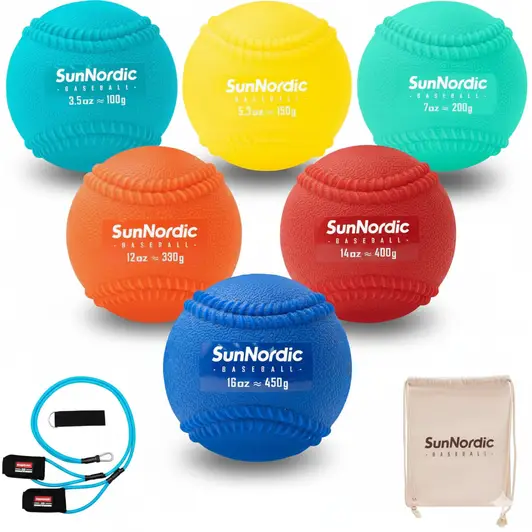
🥈 SunNordic 6/9 Pack Seams Plyometric Weighted Baseball Set
Best For: Pitchers who want to develop explosive arm action, hip-to-shoulder separation, and full-motion pitching efficiency through plyometric weighted ball throwing — not just isolated arm strength work.
Construction: 6 or 9-ball plyometric weighted set with seam construction across all weights — engineered for the full throwing motion distance and arm speed that plyometric protocols demand, with proper grip surfaces that develop finger pressure and wrist snap alongside the explosive mechanics the program targets.
Material: Durable outer construction with seam profile that mirrors standard baseball sizing and grip feel — allowing pitchers to use proper four-seam and two-seam grips throughout the plyometric session rather than adapting to a smooth surface that changes how the fingers load and release.
Performance Feel: The seamed surface is what separates this set from the smooth-shell alternatives — and it matters more than it looks on paper. Every plyometric throw engages the fingers actively through the release point, and a pitcher who develops wrist snap and finger pressure against a properly seamed ball is building the same mechanical habits in the weighted ball session that the mound demands. Smooth-surface plyometric balls skip that variable entirely.
Ideal Player Type: Pitchers running plyocare-style development programs focused on full-motion arm development and mechanical efficiency, and position players building throw distance and arm action through plyometric protocols.
Performance Overview: SunNordic 6/9 Pack Seams Plyometric Weighted Baseball Set is built for the training methodology that produces the most complete arm development results — plyometric full-motion weighted ball throwing that trains hip rotation, arm path, and explosive delivery mechanics all in the same rep. The seam construction is the distinguishing feature: plyometric programs that specifically target grip mechanics, spin rate development, and wrist snap require a seamed ball surface to do the work correctly, and smooth alternatives shortcut the grip development variable that the protocol is partially designed to address. The 6 or 9-ball format options let pitchers match the set to their current program structure without buying more inventory than the protocol requires.
Why It Stands Out:
- Seam construction across all weights develops proper grip mechanics, finger pressure, and wrist snap that seamless sets cannot train.
- Full-motion plyometric design supports explosive throwing mechanics at distance — not just limited-range weighted toss patterns.
- 6 or 9-ball format options match the set size to the pitcher's current protocol design and training stage.
- Develops the complete physical picture of efficient pitching — arm action, hip separation, deceleration — alongside arm strength.
- The right plyometric ball investment for pitchers who want their weighted ball work to build mechanics and velocity simultaneously.
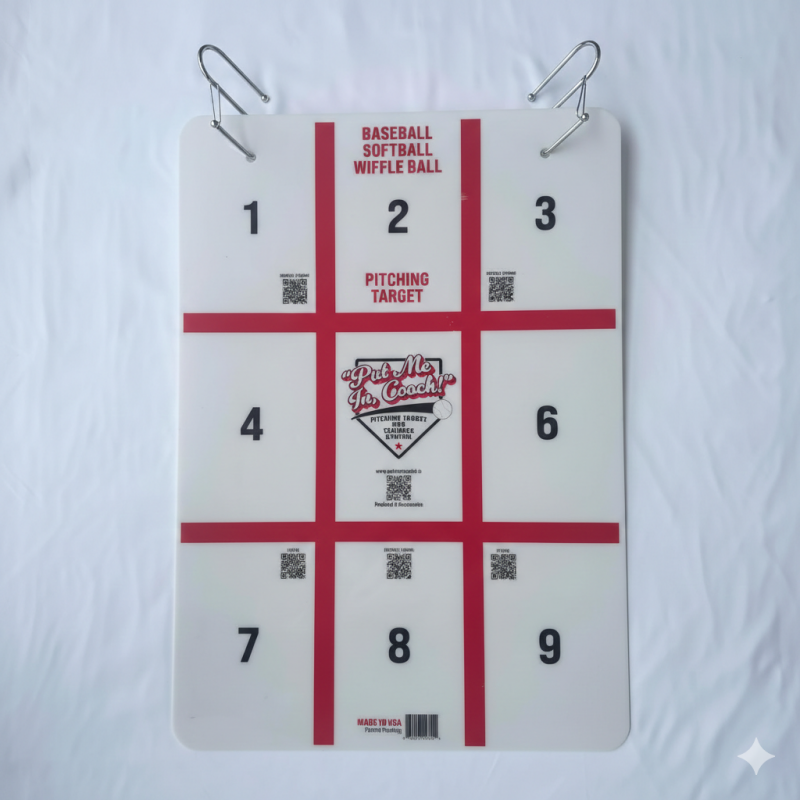
🥉 Pitching Target Strike Zone Trainer with Audible Feedback
Best For: Pitchers at any level who want to replace subjective feel-based command evaluation with an objective, pitch-by-pitch feedback system that accelerates location development through immediate corrective signals on every throw.
Construction: Strike zone training panel with integrated audible feedback system that confirms pitch contact location in real time — giving pitchers the immediate signal that command development requires on every rep rather than waiting for a catcher's assessment or a post-session coaching review to deliver corrective information.
Material: Durable strike zone panel and target construction engineered for sustained high-rep bullpen use — built to hold up through the pitch volume that a serious command development program produces week after week without degrading the feedback accuracy that makes the system worth using.
Performance Feel: The difference between throwing into a net and throwing at this trainer is the difference between training and practicing. Every pitch into the net produces no information. Every pitch at this trainer produces an immediate result — the audible confirmation or the silence that tells the pitcher instantly whether the ball hit its target. That information changes the quality of the next throw in a way that blind repetition never can.
Ideal Player Type: Competitive pitchers from youth through high school who want to develop the pitch-to-spot consistency that coaches at every level evaluate — and who are tired of throwing bullpen sessions that feel productive without producing measurable command improvement.
Performance Overview: Pitching Target Strike Zone Trainer with Audible Feedback is the simplest, most direct investment a pitcher can make in command development — because it installs the feedback loop that command training actually requires into every single rep of every bullpen session. Command doesn't improve through volume. It improves through the corrective feedback cycle that tells the nervous system immediately when the throw missed its intended target and forces the mechanical adjustment that brings the next throw closer to the spot. This trainer provides that signal on every pitch. The audible confirmation of strike zone contact gives pitchers something no standard bullpen session can offer: objective, instantaneous location feedback that makes each throw a learning rep rather than just another pitch.
Why It Stands Out:
- Audible feedback converts every bullpen pitch from a volume rep into an immediate, actionable data point on location.
- Trains pitchers to target a specific zone on every throw rather than evaluating direction subjectively after the session.
- Immediate corrective signal allows mechanical adjustments between pitches — closing the development gap faster than any unguided session.
- Durable enough to handle the sustained pitch volume a serious command program produces across a full training season.
- The most direct command development investment available for pitchers who want to turn their bullpen sessions into measurable improvement.
⚡ Performance Differences Between Pitching & Arm Development Tools
The clearest performance divide in this category is between tools that make the arm stronger and tools that make it more accurate — and confusing the two is one of the most common mistakes pitchers make when building a development program. Weighted ball sets and resistance anchors develop physical capacity: arm strength, muscular endurance, shoulder stability, and the structural resilience that keeps a pitching arm healthy deep into a long competitive season. They don't develop command. A pitcher who gets significantly stronger through a weighted ball block will likely gain velocity — but will not automatically gain the pitch-to-spot consistency that command requires, because command is a neurological skill developed through feedback, not a physical attribute developed through load. The strike zone trainer addresses a completely separate variable than the weighted ball set does, which is exactly why pitchers who want to improve both velocity and command need tools from both categories working simultaneously in their program. For pitchers building a complete grip management setup to pair with their arm development work, 🌫️ Best Rosin Bags for Baseball & Softball (2026 Guide) covers the rosin and grip tools that every serious pitcher needs on the mound. Players who want a purpose-built throwing environment to go alongside their arm training should check out 🥅 Best Hitting Nets for Baseball & Softball (2026 Guide) for the net setups that turn a backyard or facility into a full training station.
The second key performance difference is between tools that develop the arm in isolation and tools that train the complete pitching motion. Band work loaded through a wall anchor builds rotator cuff strength and shoulder stability through controlled, isolated joint movements — which is exactly what arm care requires and exactly what it's designed to do. That same isolation is also its limitation: the rotational mechanics, hip-to-shoulder separation, and full-body sequencing that produce efficient pitching velocity are not developed through isolated band exercises. Plyometric weighted ball throwing develops all of those qualities at once because the plyometric throw is a complete athletic action — and that's why the best arm development programs use both. Band anchor work to protect and maintain the structural integrity of the arm. Plyometric and overload weighted ball work to build the power and mechanical efficiency that performance requires.
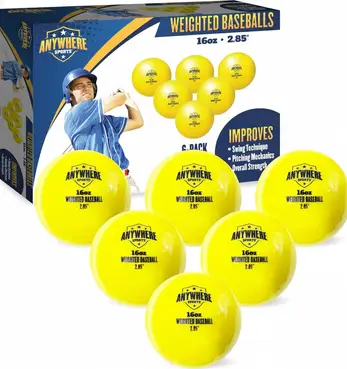
⚡ Anywhere Sports Weighted 16 oz Training Baseballs
Best For: Pitchers and position players starting a weighted ball program who want a meaningful overload stimulus in a standard game ball size — without the full multi-weight set investment that a complete protocol requires at the beginning of a development block.
Construction: Weighted 16 oz training baseball in standard 9-inch game ball diameter — delivering the overload resistance that arm strength training requires against the familiar grip circumference and seam feel that pitchers develop their mechanics around in every standard bullpen session.
Material: Durable training baseball construction built to handle the sustained throwing volume that overload arm development sessions produce — maintaining weight consistency and grip feel across a full training season without the compression degradation that cheaper weighted ball alternatives develop quickly under high-rep use.
Performance Feel: The Anywhere Sports weighted ball feels like a baseball — because dimensionally it is one — until the first throw reveals the extra resistance that 16 oz produces against the arm through the full delivery. That combination of familiar mechanics with unfamiliar load is the specific training effect that overload ball work is built around: the arm has to work harder than it does with a game ball to produce the same throw, which is exactly what builds the strength that game ball velocity gains come from.
Ideal Player Type: Pitchers and position players at any competitive level who want to add a weighted overload ball to their development program — particularly those building a first weighted ball protocol who want an effective entry point before expanding into a full multi-weight set.
Performance Overview: Anywhere Sports Weighted 16 oz Training Baseballs give pitchers a clean entry point into weighted ball training without the learning curve of a full multi-weight protocol. The 16 oz weight sits in the meaningful overload range — heavy enough to produce the arm strength adaptation that makes the training worthwhile, but not so heavy that it changes the mechanics of the throw in ways that compromise the technique development the program is supposed to support. Standard game ball diameter means every grip, every wrist snap, and every release angle developed with the Anywhere Sports weighted ball is the same one that game ball performance requires — nothing learned in the weighted ball session has to be unlearned on the mound.
Why It Stands Out:
- Standard game ball diameter keeps grip and release mechanics consistent between weighted training and standard game ball performance.
- 16 oz overload weight builds meaningful arm strength without the mechanical compromise that excessively heavy loads produce.
- Effective, low-barrier entry into weighted ball training for pitchers not yet ready for a full multi-weight program.
- Durable construction maintains weight consistency through the high-rep sessions that arm development training demands over a full season.
- Works for both pitchers targeting velocity gains and position players developing throw strength and distance through overload training.
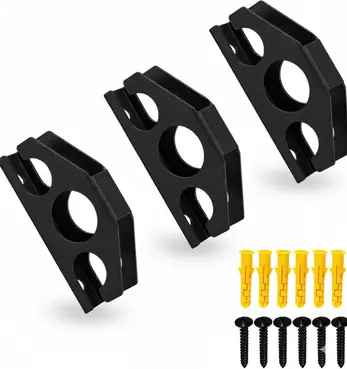
🛡 KSWLOR Resistance Band Wall Anchors
Best For: Serious pitchers and players who want a permanent, reliable band anchor point at home — making daily arm care and velocity band work a fixed habit rather than a session that has to be set up from scratch every time.
Construction: Wall-mounted resistance band anchor hardware designed to handle the full load demands of baseball and softball arm care and velocity band work — providing a fixed, secure attachment point that maintains its position and holding strength through every exercise in a complete band protocol across years of daily training use.
Material: Durable hardware built for permanent wall installation — engineered to hold resistance band loads from multiple angles without loosening, shifting, or degrading the secure attachment that safe, consistent band work requires every single training day.
Performance Feel: Having the anchor already in place changes the psychology of arm care. When the anchor is mounted, arm care is a two-minute commitment to walk over and get started. When it isn't, arm care is a project that requires finding a door, testing the attachment, and adjusting the height before the first rep — and that friction is exactly why arm care gets skipped on the days it matters most. The wall anchor removes that friction entirely.
Ideal Player Type: Competitive pitchers who perform daily band-based arm care as part of a structured maintenance program, and coaches building team training stations that need reliable anchor points for group arm care sessions involving multiple players.
Performance Overview: KSWLOR Resistance Band Wall Anchors address the single most practical barrier to consistent at-home arm care: the absence of a proper anchor point. Door-mounted alternatives shift position between exercises, limit the angles available to the protocol, and create uncertainty about whether the attachment is actually secure enough to load confidently. The wall anchor eliminates every one of those variables — fixed position, consistent height, full 360-degree exercise access from a single mount point, and the structural security that loading band resistance from any angle at any intensity requires. For pitchers whose arm care program includes the full range of rotator cuff, posterior shoulder, scapular loading, and velocity pull-down work that professional programs prescribe, the wall anchor is the infrastructure that makes executing that program at home the same reliable experience every training day.
Why It Stands Out:
- Permanent installation eliminates the setup friction that causes arm care to get skipped on high-training-volume days.
- Fixed position ensures band loads the correct muscle groups at the correct angle on every single rep — not just when the setup is right.
- Handles the full range of arm care, shoulder stability, and velocity band loads from multiple angles without shifting or loosening.
- Turns at-home arm care from a sporadic habit into a consistent daily routine that compounds across a full training season.
- The foundational infrastructure investment every serious pitcher needs before any other arm care tool becomes fully effective.
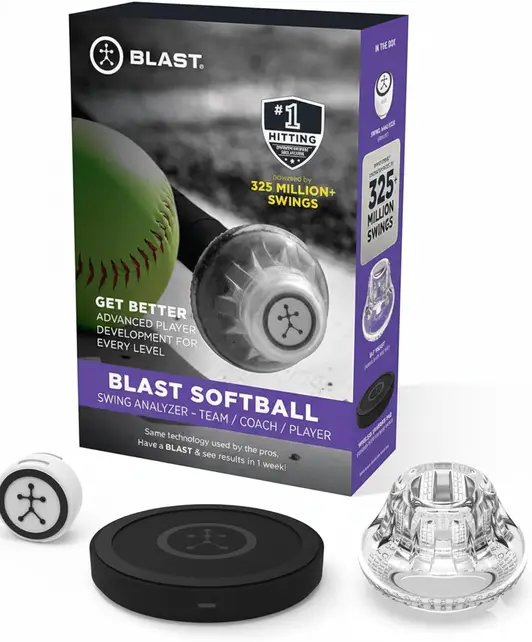
👟 Blast Softball Swing Analyzer
Best For: Fastpitch softball players who want to replace feel-based swing evaluation with real, measurable performance data — and coaches who want objective metrics to guide development conversations rather than relying on visual assessment alone.
Construction: Compact sensor unit that attaches to the bat knob and syncs to a connected mobile app — measuring bat speed, peak hand speed, attack angle, time to impact, and early connection on every swing and delivering that data to the player and coach immediately after each rep.
Material: Sports-grade sensor hardware built for the physical demands of regular batting practice — designed to maintain measurement accuracy through the high-rep volume that serious softball hitting training produces without developing calibration issues or sensor drift that undermines data reliability over time.
Performance Feel: The first time a player uses the Blast Softball Analyzer in a live batting practice session and sees her actual bat speed number after a swing, the conversation about development changes. The number is either better than expected or worse — and either way it's honest, and it's immediately actionable. That objectivity is what makes every subsequent session different from every session that came before it.
Ideal Player Type: Competitive fastpitch softball players at the high school and travel ball level who want to quantify their development and identify the specific swing variables limiting their performance — and coaches building data-driven development programs for multiple players simultaneously.
Performance Overview: Blast Softball Swing Analyzer is the tool that turns a well-intentioned practice session into a purposeful development session — because it answers the question that feel-based evaluation never can: exactly what is this swing producing? Bat speed, attack angle, time to impact, and hand speed are all measurable quantities with known relationships to hitting performance at the competitive level, and the Blast Softball Analyzer puts all of those numbers in the player's hand after every swing. For fastpitch players who've been putting in the work without seeing consistent performance improvement, the analyzer is often what reveals the specific mechanical variable — a slow time to impact, an attack angle that's inconsistent between swings, a bat speed plateau — that the training sessions were failing to address because no one could see it precisely enough without the data.
Why It Stands Out:
- Real-time sensor metrics convert every swing from a subjective feel experience into an objective, immediately actionable data point.
- Identifies the specific mechanical variable limiting hitting performance with a precision that visual coaching assessment alone cannot match.
- Makes development progress measurable and trackable across a full training block — so players and coaches can see exactly what's improving and what isn't.
- Fastpitch-specific design addresses the swing metrics that matter most in the competitive softball hitting environment.
- Transforms high-volume practice sessions into targeted development work aimed at a specific, measurable mechanical outcome.
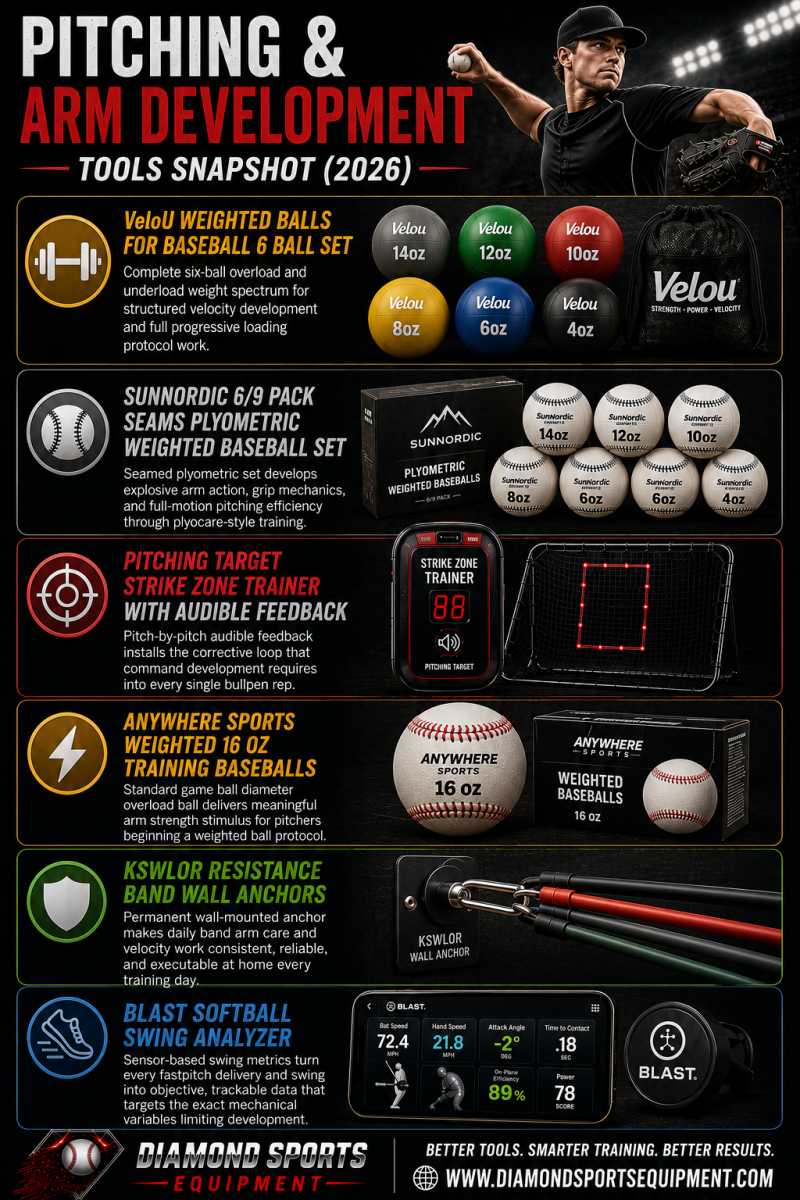
📊 Pitching & Arm Development Tools Snapshot (2026)
- 🥇 VeloU Weighted Balls for Baseball 6 Ball Set — complete six-ball overload and underload weight spectrum for structured velocity development and full progressive loading protocol work.
- 🥈 SunNordic 6/9 Pack Seams Plyometric Weighted Baseball Set — seamed plyometric set develops explosive arm action, grip mechanics, and full-motion pitching efficiency through plyocare-style training.
- 🥉 Pitching Target Strike Zone Trainer with Audible Feedback — pitch-by-pitch audible feedback installs the corrective loop that command development requires into every single bullpen rep.
- ⚡ Anywhere Sports Weighted 16 oz Training Baseballs — standard game ball diameter overload ball delivers meaningful arm strength stimulus for pitchers beginning a weighted ball protocol.
- 🛡 KSWLOR Resistance Band Wall Anchors — permanent wall-mounted anchor makes daily band arm care and velocity work consistent, reliable, and executable at home every training day.
- 👟 Blast Softball Swing Analyzer — sensor-based swing metrics turn every fastpitch delivery and swing into objective, trackable data that targets the exact mechanical variables limiting development.
❓ FAQ
What is the difference between plyometric weighted balls and standard weighted balls?
- Plyometric balls are designed for full-motion explosive throwing at distance, developing hip rotation, arm path, and deceleration mechanics alongside arm strength in the same rep.
- Standard weighted balls focus on progressive overload arm strength development through shorter-distance throwing protocols that specifically target the velocity-building physical adaptation.
How often should pitchers use weighted balls in their training program?
- Most established weighted ball protocols recommend two to three sessions per week with full rest days between to allow the arm to recover and adapt before the next loading session.
- Pitchers should always follow a program designed by a qualified coach and should never increase load or session volume faster than the protocol prescribes — arm health comes first.
Do wall anchors work for arm care at every competitive level?
- Yes — band-based arm care and shoulder stability work is prescribed at every level from youth competitive through professional play for a reason: it builds the rotator cuff resilience that keeps pitching arms healthy.
- The key variable is exercise load, not the anchor itself — pitchers should start light and progress gradually to match the resistance to their current arm strength and training age.
What swing metrics does the Blast Softball Analyzer actually measure?
- The Blast Softball Analyzer measures bat speed, peak hand speed, attack angle, time to impact, and early connection — the core biomechanical metrics that define swing quality at the competitive fastpitch level.
- All data is delivered in real time through the connected app so players and coaches can review and act on performance numbers immediately after every swing during the session.
🧢 Final Thoughts
The pitchers who show up to the next season measurably better than the last one aren't the ones who threw the most bullpens — they're the ones who used the right tools between mound sessions to build the physical and mechanical qualities that live throwing alone can't develop at the same rate. Weighted ball protocols build velocity through progressive overload. Plyometric ball sets develop the full-motion mechanics that power and efficiency both require. Command trainers install the feedback loop that turns bullpen volume into location improvement. Wall anchors make the daily arm care that protects all of that development actually happen every single day. Every tool in this guide targets a specific gap in the arm development picture that mound reps leave unfilled — and filling those gaps is exactly what separates a pitcher who develops steadily from one who plateaus. For pitchers who want to pair the physical tools in this guide with the knowledge framework that makes every training decision more intentional, 📚 Best Baseball Training Books (2026) covers the reading resources built for serious player development at every level. For the complete library of equipment guides and gear reviews across every category, 📝 Diamond Sports Equipment Blog & Gear Reviews has everything organized and ready.