The slowpitch softball sitting in the pitcher's hand before the first toss of a rec league game or a competitive travel ball tournament looks simple from the outside — a yellow or optic yellow ball covered in synthetic or genuine leather, stitched around a cork or rubber core, certified to a COR and compression standard that the governing body determined was appropriate for the format and the level. What that simple-looking object actually is, from the perspective of the hitter developing timing and contact mechanics against it across a full season, is the primary training stimulus of the sport — every batting practice rep, every hitting session, every round of live pitching that a slowpitch hitter takes in practice and competition is calibrating timing responses, contact feel, and barrel path decisions against the specific compression and flight characteristics of the ball they are swinging at. A softer ball produces longer dwell time at contact and a different contact feel than a firmer certified game ball. A ball with a lower COR travels differently off the barrel than one whose COR is at the top of the league-approved range. A synthetic cover interacts with the bat differently than a split leather cover under the same contact conditions. None of these differences are invisible to the hitter's mechanics — they accumulate in the timing and contact responses that practice develops, and they create discrepancies that show up as inconsistency when the practice ball and the game ball differ significantly enough in their performance characteristics to produce different feels at contact.
The 2026 slowpitch softball market covers every performance tier, certification standard, and supply format that recreational and competitive slowpitch programs need from their game and practice ball supply — the Skyline SL-12's 6-pack for teams who need a reliable standard practice supply at an accessible price, PHINIX's Split Leather construction for programs whose cover preference runs toward genuine leather's contact feel rather than synthetic alternatives, Tebery and HANKLENSS standard 12-inch practice designs for everyday batting practice and fielding drill supply, the Champro ASA-certified .44 COR 375 compression ball for programs whose league specifically certifies to ASA standards, and the Poosue Bucket of 13 for coaches whose training volume demands bucket-quantity supply depth without the individual small pack purchasing that consistently runs short mid-session. For the complete slowpitch and fastpitch softball overview across every format and certification standard, check out 🥎 Best Softballs for Games & Practice (2026). For the breakdown specific to the Slow-Pitch and Fastpitch format differences that affect ball selection across those two fundamentally different competition formats, 🥎 Best Softballs for Practice (2026) covers every distinction worth understanding before committing to a seasonal ball supply.
⚾ What You Should Know About Slowpitch Softballs
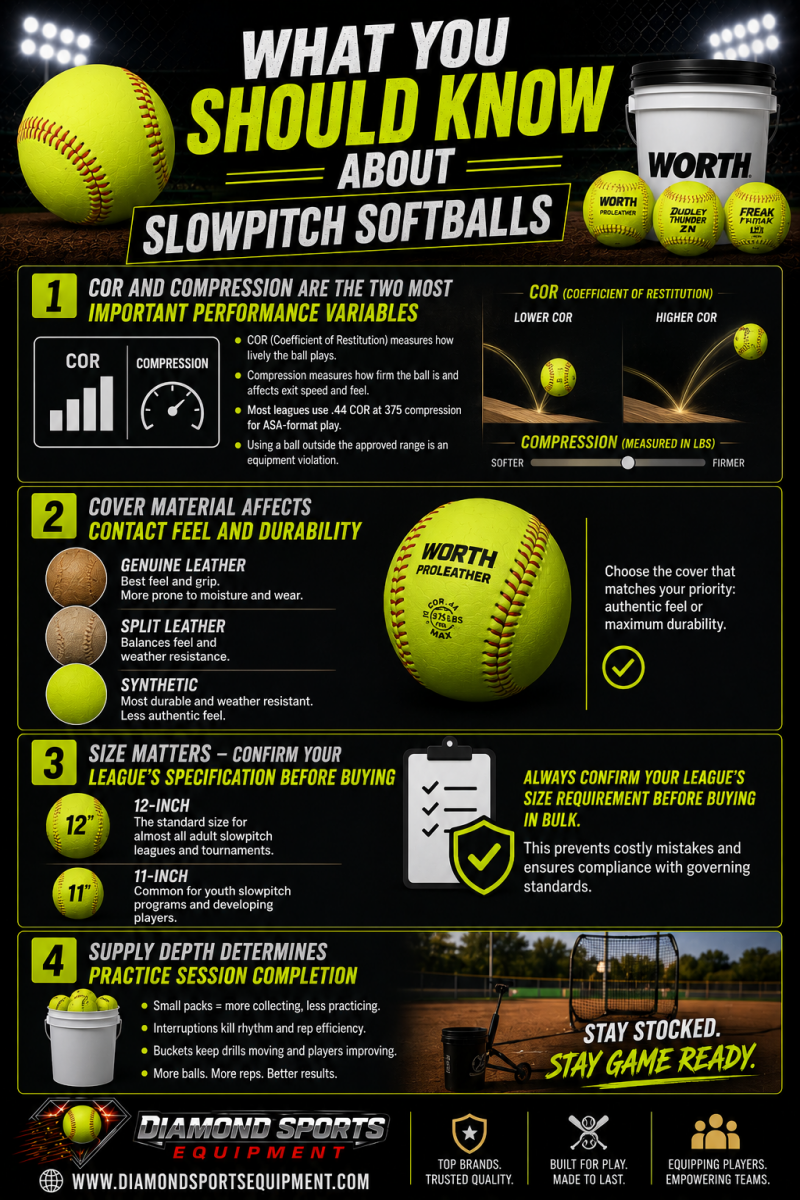
📊 COR and Compression Are the Two Most Important Performance Variables
The COR — Coefficient of Restitution — and compression rating of a slowpitch softball are the two performance variables that determine how lively the ball plays, how far it travels off the barrel, and whether it meets the governing standard that the specific league or tournament uses to certify acceptable equipment for sanctioned competition. COR measures how much energy the ball returns after impact — a higher COR produces more ball speed off the bat and longer hit distances. Compression measures how much force is required to deform the ball a fixed distance — a higher compression number means a firmer ball that produces a different contact feel and typically a higher exit speed under the same swing force. Most organized slowpitch leagues specify both a maximum COR and a compression range — typically .44 COR at 375 compression for ASA-format play — and using a ball outside those parameters in certified competition creates an equipment violation regardless of how the ball looks or feels.
🧵 Cover Material Affects Contact Feel and Durability
The cover material of a slowpitch softball determines two practically important variables: the feel at contact and how long the ball holds up through sustained batting practice and game use before the cover degrades to the point where the ball's performance characteristics become unpredictable. Genuine leather covers produce the most authentic contact feel and grip texture for fielders but are more susceptible to moisture damage and wear under sustained outdoor use. Split leather covers deliver a balance between genuine leather's contact feel and synthetic's weather resistance. Synthetic covers are the most durable under outdoor conditions and sustained use but sacrifice some of the contact feel authenticity that leather options provide. The right cover material depends on the training priority — maximum authenticity and game-realistic feel, or maximum durability through the weather and use volume the ball will experience across a full practice season.
📏 Size Matters — Confirm Your League's Specification Before Buying
Slowpitch softballs are almost universally 12 inches in circumference across organized adult leagues at every competition level — but confirming the specific size requirement of the league before purchasing in bulk prevents the expensive mistake of stocking a full season's supply of balls that don't meet the governing standard the program competes under. Youth slowpitch programs may use 11-inch softballs whose smaller circumference is more appropriate for developing players whose hand dimensions and fielding mechanics are still building toward the adult standard. Any bulk purchase should begin with a confirmed understanding of the league's specific size requirement rather than the assumption that the most common adult size automatically applies to every format the program participates in.
📦 Supply Depth Determines Practice Session Completion
A slowpitch program that runs batting practice, fielding drills, and live pitching sessions with a supply of six or twelve balls spends as much time collecting and re-feeding as it does actually practicing — and the constant interruption that an undersized ball supply creates in every practice session that demands more volume than the available supply can sustain without stoppage undermines the rhythm and rep efficiency that productive practice requires. Bucket-quantity purchasing gives coaches the supply depth to run complete batting stations and full fielding drill rotations without the collection interruption that small packs force on every practice session whose rep volume exceeds the available supply.
🏆 Slowpitch Softballs for 2026
These six slowpitch softballs cover every performance tier, cover material preference, certification standard, and supply format that recreational and competitive slowpitch programs need from their ball inventory — from 6-pack standard practice designs through certified ASA game construction and bucket-quantity supply depth options.
🌟 Skyline SL-12 Softballs 6 Pack
Best For: Slowpitch teams and coaches who need a reliable 6-pack of standard 12-inch practice softballs at an accessible price — the everyday batting practice and fielding drill supply option for recreational and competitive programs whose practice volume is adequately served by a 6-ball pack and whose priority is consistent, dependable performance at the price point that makes restocking throughout a full season financially practical
Construction: Standard 12-inch slowpitch construction in a 6-pack format providing the supply depth for a complete individual hitting station or small-group fielding drill session — a ball whose construction delivers reliable practice performance at the price point that recreational and early competitive programs need from a supply they go through regularly enough that per-ball cost is a genuine purchasing consideration across a full season
Material: Quality cover construction providing consistent compression and flight characteristics through the batting practice and fielding drill volume that a complete slowpitch practice session produces — materials that hold up through the sustained outdoor use that slowpitch programs experience across a full competitive season without the premature deterioration that the cheapest budget alternatives experience under the same conditions
Performance Feel: Consistent and practice-appropriate — the Skyline SL-12 delivers the everyday practice softball experience that coaches and players who use the ball across regular batting practice and fielding drill sessions describe as reliable, consistent, and appropriate for the recreational and early competitive training volume their program produces
Ideal Player Type: Recreational and early competitive slowpitch programs whose practice volume is adequately served by a 6-pack supply — teams and coaches who want a reliable everyday practice softball at an accessible price that makes regular restocking throughout the season financially practical without the premium investment of certified competition construction
Performance Overview: The Skyline SL-12 Softballs 6 Pack is the practical everyday practice supply in this guide — a 6-pack of standard 12-inch slowpitch softballs whose construction delivers the consistent batting practice and fielding drill performance that recreational and early competitive programs need from a practice ball they go through regularly enough that per-ball cost is a real purchasing variable across a full season. The 6-pack format provides the supply depth for a complete individual hitting station or small-group fielding session without the investment of a full bucket whose quantity exceeds what lower-volume practice setups actually require. For any recreational or early competitive slowpitch program whose priority is reliable everyday practice performance at an accessible price that makes regular restocking throughout the season financially practical, the Skyline SL-12 is the straightforward supply answer.
Why It Stands Out:
- 6-pack format provides adequate supply depth for complete individual hitting stations and small-group fielding drill sessions without the bucket-quantity investment that lower-volume practice setups don't require.
- Consistent compression and flight characteristics through batting practice and fielding drill volume — a practice softball that delivers predictable performance across the full 6-ball rotation rather than the variability that the cheapest budget alternatives introduce under the same use conditions.
- Accessible per-ball pricing makes regular restocking throughout a full season financially practical for recreational and early competitive programs whose ball consumption rate makes per-ball cost a genuine purchasing consideration.
- Standard 12-inch construction covers the adult slowpitch format requirement that the majority of organized recreational and competitive leagues specify for sanctioned competition and practice.
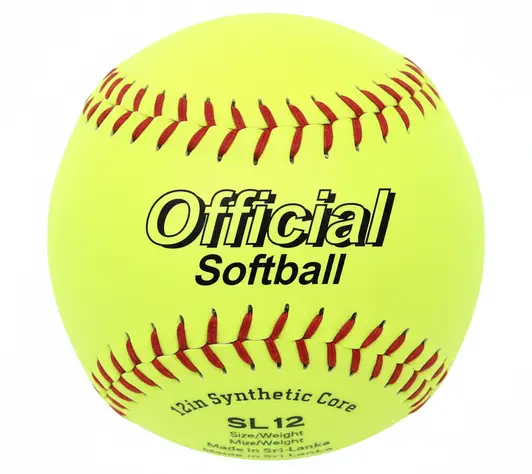
🔵 PHINIX Slow-Pitch Split Leather Softballs
Best For: Slowpitch players and programs who specifically prefer split leather cover construction over synthetic alternatives — the player whose contact feel preference runs toward the authentic leather texture that split leather provides and whose practice volume and outdoor storage conditions fall within the range that split leather construction handles without the weather sensitivity that full genuine leather experiences under the same conditions
Construction: Split leather cover construction delivering the balance between genuine leather's contact feel authenticity and synthetic's weather resistance — a cover material that provides a more authentic grip texture and contact response than synthetic alternatives while maintaining better moisture resistance and durability under outdoor storage and use conditions than full genuine leather covers that are more susceptible to the cracking and deterioration that sustained moisture exposure accelerates
Material: PHINIX's split leather cover providing the contact feel and grip texture that leather-preference players specifically seek in their practice and game softballs — a material that splits the difference between the authentic leather experience and the practical durability that outdoor slowpitch use demands, giving players the leather contact feel they prefer without the care requirements and weather sensitivity that full genuine leather imposes on outdoor practice use
Performance Feel: Authentic and leather-textured — the PHINIX Split Leather Softball delivers the contact experience that players who specifically prefer leather cover construction describe as a meaningfully different and more authentic feel than any synthetic alternative: a grip texture under the fielding glove that responds more like a game ball, a contact feel at the barrel that more closely approximates the leather cover sound and sensation that experienced slowpitch hitters have developed timing responses around
Ideal Player Type: Slowpitch players and programs whose cover preference specifically favors split leather over synthetic construction — players who have used both cover types and who specifically prefer the leather contact feel and grip texture that split leather provides, and who want that preference satisfied in a ball whose weather resistance and durability profile is better suited for outdoor practice use than full genuine leather alternatives
Performance Overview: The PHINIX Slow-Pitch Split Leather Softballs serve the leather-preference segment in this guide — a split leather construction that delivers the authentic contact feel and grip texture that leather-preference players specifically seek without the weather sensitivity and care requirements that full genuine leather imposes on outdoor slowpitch practice use. PHINIX has built their position in the practice softball market by producing constructions that address specific player preferences rather than defaulting to the synthetic cover that dominates the budget end of the practice ball market regardless of the player's contact feel preference. The split leather cover delivers a contact feel that players whose timing responses are calibrated around leather construction recognize immediately as more authentic than synthetic alternatives — the texture, the sound, and the feel at the barrel that leather cover produces and that no synthetic alternative fully replicates regardless of how closely it approximates the physical properties of leather in other performance dimensions.
Why It Stands Out:
- Split leather cover delivers the authentic contact feel and grip texture that leather-preference players specifically seek — the material that provides a more authentic hitting and fielding experience than synthetic alternatives for the players whose preferences and timing responses are calibrated around leather construction.
- Better weather resistance than full genuine leather construction makes split leather more practical for the outdoor storage and use conditions that slowpitch practice consistently produces — leather contact feel without the moisture sensitivity that limits genuine leather's durability under sustained outdoor conditions.
- PHINIX's practice softball construction quality applied to a leather-cover preference product — the brand whose practice ball lineup covers specific player preferences rather than defaulting to the synthetic standard that most budget alternatives provide regardless of the player's cover feel priority.
- Serves the leather-preference player population that synthetic-dominant practice ball alternatives consistently underserve — the specific cover material that experienced slowpitch players who have used both types specifically seek out when their practice ball selection is based on contact feel authenticity rather than per-ball cost alone.
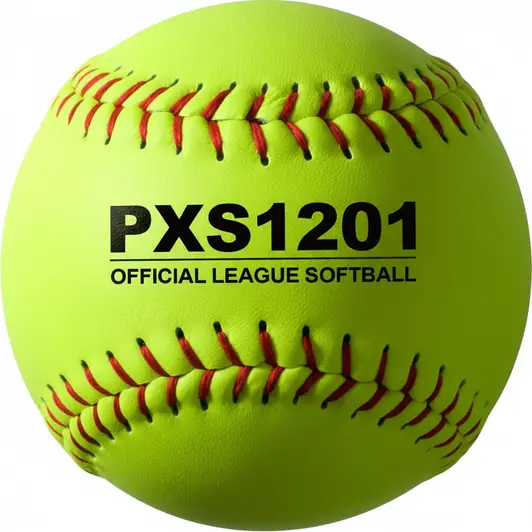
🟡 Tebery 6 Pack Sports Practice Softballs, 12-Inch Official Size and Weight Slowpitch Softball
Best For: Slowpitch players and coaches who need an official size and weight 12-inch practice softball in a 6-pack at a cost-effective price — the everyday batting practice supply for recreational and competitive programs whose session volume is served by a 6-ball pack and whose priority is official size and weight compliance in their practice ball alongside the accessible pricing that makes regular restocking practical
Construction: Official size and weight 12-inch construction in a 6-pack format ensuring that the ball dimensions and weight comply with the standard that organized slowpitch leagues specify for sanctioned competition and practice — a construction that maintains the official size and weight parameters that give the practice ball the same flight characteristics and barrel contact feel as the game ball rather than the dimensional discrepancies that non-official size alternatives introduce into the practice environment
Material: Quality construction providing consistent compression and cover integrity through batting practice and fielding drill volume — materials that maintain official size and weight compliance across every ball in the 6-pack while delivering the consistent performance that predictable practice stimulus demands from every ball in the rotation
Performance Feel: Official and consistent — the Tebery 6 Pack delivers the practice softball experience that coaches and players who specifically want official size and weight compliance in their everyday practice ball describe as importantly different from non-official alternatives: a ball whose dimensions and weight match the game ball closely enough that timing and contact responses developed in practice transfer accurately to game situations where the official ball's flight characteristics are what the player actually encounters
Ideal Player Type: Recreational and competitive slowpitch players whose practice philosophy centers on official size and weight compliance — coaches who want their players developing timing and contact responses against a ball that matches the game ball's dimensions and weight rather than the dimensional variations that non-official alternatives introduce into the practice environment at an accessible 6-pack price
Performance Overview: The Tebery 6 Pack Sports Practice Softballs deliver official size and weight compliance in an everyday 6-pack practice format whose accessible price makes the supply practical for the regular restocking that a full slowpitch season demands. The official 12-inch size and correct weight ensure that the practice ball's flight characteristics and barrel contact dimensions match the game ball closely enough to build the timing and contact responses that transfer directly to game situations — the compliance foundation that every practice ball should maintain but that non-official size alternatives sacrifice at the cost of the mechanical consistency that game-realistic practice requires. For any slowpitch program whose coaches specifically want official size and weight in their everyday practice supply at a 6-pack price that makes regular restocking affordable, the Tebery 6 Pack is the straightforward compliance-and-value answer.
Why It Stands Out:
- Official size and weight compliance ensures the practice ball's dimensions and flight characteristics match the game ball — building timing and contact responses in practice that transfer accurately to game situations rather than the dimensional discrepancies that non-official alternatives introduce.
- 6-pack format provides practical supply depth for complete individual hitting sessions and small-group drill work at the accessible price point that makes regular restocking throughout the season financially manageable.
- Consistent compression and cover integrity across all 6 balls in the pack ensures the same performance stimulus from every ball in the rotation — the uniformity that predictable practice development requires from every pitch and contact rep.
- Cost-effective per-ball pricing at the 6-pack quantity makes official size and weight compliance in everyday practice affordable for recreational and competitive programs whose per-ball budget makes individual pricing a genuine purchasing consideration.
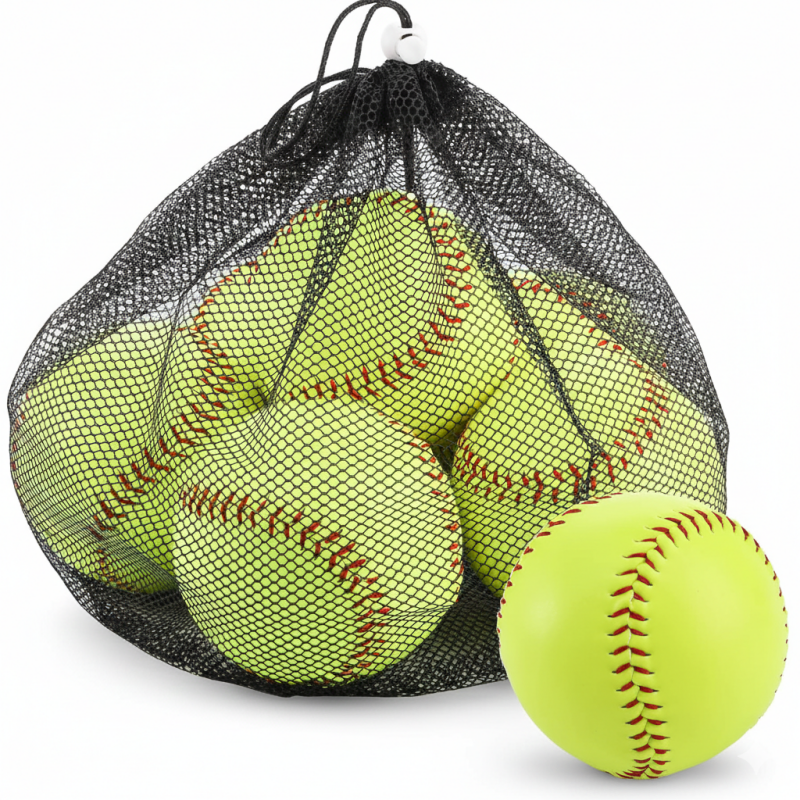
⚡ Performance Differences Between Slowpitch Softballs
The most significant performance differences between the slowpitch softballs in this guide are cover material, certification standard, COR and compression rating, and supply quantity. The PHINIX Split Leather stands apart on cover material — the only leather-cover option in this guide whose authentic contact feel serves the leather-preference player population that synthetic alternatives consistently underserve. The Champro ASA Game Ball stands apart on certification standard — the only ASA-certified option in this guide whose .44 COR and 375 compression specifically serve programs whose league certifies to ASA standards. The Skyline SL-12, Tebery, and HANKLENSS represent the accessible everyday practice tier — consistent practice performance at the price points that recreational and competitive programs need from supply they go through regularly. The Poosue Bucket of 13 represents the bulk supply tier — the quantity that coaches running team rotations and complete hitting stations specifically need to eliminate the re-feeding interruptions that 6-pack alternatives create at higher practice volumes.
For the machine softball options that pair with pitching machine setups for high-volume slowpitch and fastpitch hitting sessions, check out 🥎 Best Softball Pitching Machine Balls (2026) for every machine-compatible option. For the pitching machine options that create the demand for bulk softball supply, 💨 Best Pitching Machines for Practice (2026 Guide) covers every machine worth considering.
🟠 HANKLENSS Sports Practice Softballs - 12-Inch Official Size and Weight Slowpitch Softball
Best For: Slowpitch coaches and players who want official size and weight 12-inch practice softballs with the HANKLENSS brand's construction quality — the everyday practice supply for batting stations and fielding drill sessions whose priority is consistent official-size performance at a cost-effective price that makes the regular supply restocking a full slowpitch season demands financially practical
Construction: Official size and weight 12-inch construction delivering the dimensional compliance and consistent performance that slowpitch practice sessions demand from a ball that develops the timing and contact responses players need to transfer accurately to game situations where official size and weight are what they will encounter in competition — construction quality that reflects HANKLENSS's position in the practice ball market as a reliable everyday training supply rather than a premium certified competition alternative
Material: Practice-grade construction providing consistent compression and cover integrity through the batting practice and fielding drill volume that a complete slowpitch practice session produces — materials that hold up through the sustained outdoor use conditions that full season practice schedules consistently expose practice softballs to without the premature cover deterioration that the cheapest budget alternatives experience under the same use volume
Performance Feel: Consistent and official-size compliant — the HANKLENSS 12-Inch Practice Softballs deliver the everyday practice experience that coaches and players who use the ball across regular batting practice and fielding drill sessions describe as dependable and consistent: official size and weight that keep the practice stimulus aligned with game conditions, consistent compression through the full ball rotation that predictable timing development requires, and cover integrity that holds up through a full practice session without the degradation that undermines the training quality of cheaper alternatives before the session reaches its planned conclusion
Ideal Player Type: Recreational and competitive slowpitch programs whose everyday practice volume makes official size and weight compliance in a cost-effective practice supply the primary purchasing priority — coaches who want the dimensional consistency that official size balls provide without the premium construction investment of certified competition alternatives, and who need a supply that makes regular restocking throughout the season financially practical
Performance Overview: The HANKLENSS Sports Practice Softballs - 12-Inch deliver the official size and weight compliance that consistent slowpitch practice development requires in a cost-effective everyday supply format whose per-ball pricing makes regular restocking throughout a full season financially practical for the recreational and competitive programs that go through practice softballs at the volume a complete batting and fielding practice schedule consistently produces. The official 12-inch size and correct weight ensure that every batting practice rep and fielding drill develops timing and contact responses against a ball whose dimensional and weight parameters match the game ball closely enough to produce responses that transfer accurately to competition. HANKLENSS has built their position in the practice ball market by delivering consistent construction quality at the price point that high-volume practice programs specifically need from a supply they consume regularly — and the 12-inch practice softball applies that construction philosophy to the slowpitch format's most fundamental practice supply requirement.
Why It Stands Out:
- Official size and weight compliance keeps practice timing and contact responses calibrated to the dimensional and weight parameters that game balls share — the consistency that practice-to-game transfer requires from every ball in the training supply.
- Practice-grade construction holds up through the sustained batting practice and fielding drill volume of a complete slowpitch session without the premature cover deterioration that undermines the training quality of cheaper alternatives.
- Cost-effective per-ball pricing makes regular restocking throughout a full season financially practical — the supply economics that high-volume practice programs specifically need from the softball that feeds every batting and fielding rep on the practice schedule.
- HANKLENSS construction quality at the everyday practice supply price point — reliable, consistent, official-size compliant performance from a brand whose practice ball lineup serves the high-volume training demand that competitive slowpitch programs produce across a full season.
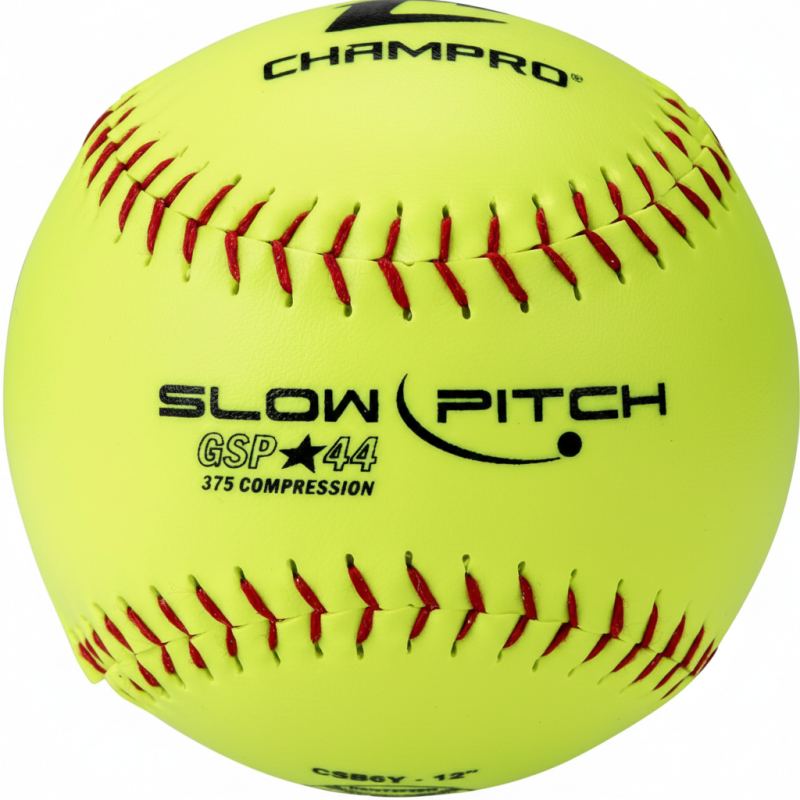
🔴 Champro Game ASA Slow Pitch .44 COR, 375 Compression, Poly Synthetic Cover, Red Stitches (Optic Yellow, 12-Inch)
Best For: Slowpitch programs whose league specifically certifies to ASA standards and whose game ball supply requires the .44 COR and 375 compression parameters that ASA certification specifies — the coach or program director who needs an ASA-certified 12-inch slowpitch game ball from a brand whose construction quality and certification credibility make it a reliable choice for the league play and tournament competition where ASA certification is the governing standard
Construction: ASA-certified 12-inch construction with .44 COR and 375 compression specifically meeting the parameters that ASA-format slowpitch competition requires — a poly synthetic cover in optic yellow with red stitches delivering the game ball appearance and performance standard that ASA leagues expect from every ball sitting in the umpire's bag across a sanctioned competition
Material: Poly synthetic cover construction providing the weather resistance and cover durability that game ball use under outdoor competitive conditions demands — a synthetic cover that maintains its surface integrity and grip texture through the innings and tournament schedules that competition softballs absorb, combined with the .44 COR and 375 compression core that ASA certification requires for sanctioned play
Performance Feel: Certified and game-ready — the Champro ASA Game Ball delivers the competition softball feel that ASA league players and coaches recognize as the certified standard their format requires: the .44 COR and 375 compression that produce the ball flight and exit velocity characteristics ASA competition is built around, a poly synthetic cover whose grip texture and surface feel match what ASA league players are accustomed to receiving from certified game balls, and the optic yellow color with red stitches that provides the visibility and appearance that umpires and players expect from certified competition softballs
Ideal Player Type: Slowpitch programs competing in ASA-certified leagues and tournaments whose game ball supply specifically requires .44 COR and 375 compression certification — coaches and program directors who need a reliable ASA-certified game ball from Champro whose construction quality and certification credibility make it appropriate for the sanctioned competition where certification compliance is both a requirement and a quality expectation
Performance Overview: The Champro Game ASA Slow Pitch .44 COR 375 Compression is the certified competition game ball in this guide — the only product whose ASA certification, specific COR rating, and compression parameter specifically serve the programs whose league governing standard requires certified construction rather than practice ball alternatives that don't meet the COR and compression specifications that ASA sanctioned competition mandates. Champro has built their position in the softball ball market by producing certified constructions whose quality reflects genuine manufacturing investment in the COR and compression parameters that governing bodies test and certify — and the ASA Game Ball's .44 COR and 375 compression reflect that investment in a construction that meets every requirement ASA certification imposes. The poly synthetic cover in optic yellow with red stitches delivers the game ball appearance and surface feel that ASA league players expect from certified competition, and the 12-inch size covers the adult slowpitch format standard that the majority of ASA-certified leagues specify. For any ASA-certified slowpitch program whose game ball supply requires certified construction, the Champro ASA Game Ball is the direct, compliant choice.
Why It Stands Out:
- ASA-certified .44 COR and 375 compression specifically meets the parameters that ASA-format slowpitch competition requires — the only certified game ball in this guide for programs whose league governing standard specifies ASA certification for sanctioned competition.
- Poly synthetic cover delivers weather resistance and cover durability appropriate for outdoor competition use — maintaining surface integrity and grip texture through the innings and tournament schedules that game ball use under competitive conditions produces.
- Optic yellow color with red stitches provides the game ball appearance and visibility that umpires and players expect from certified competition softballs — the visual standard that ASA league play has established across its sanctioned competition formats.
- Champro's certified softball construction quality applied to ASA game ball specifications — the manufacturing investment and certification credibility that programs whose league requires certified construction specifically look for in their game ball purchasing decision.
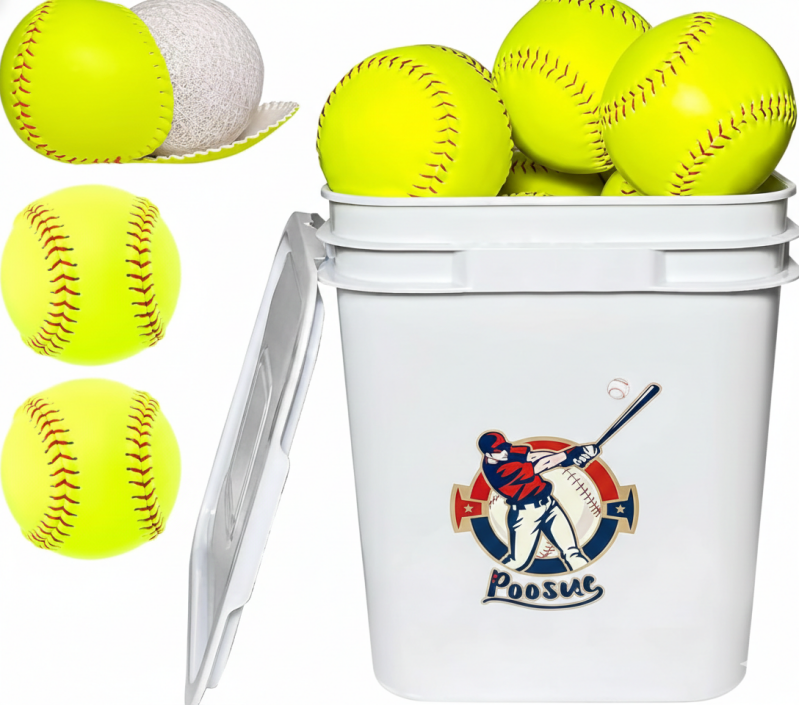
🪣 Poosue Bucket of 13 Practice Softballs
Best For: Slowpitch teams, coaches running multi-player hitting stations, and programs whose practice volume makes 6-pack supply insufficient for a complete team rotation or extended batting practice session — the bulk supply option for the slowpitch program that needs bucket-quantity depth to run complete team practices without the constant collection and re-feeding that smaller packs force on every session whose rep volume exceeds what a 6-ball supply can sustain without interruption
Construction: 13-ball bucket format providing the highest supply depth in this guide — a quantity that gives coaches enough balls to run complete team batting rotations, extended individual hitting stations, and full fielding drill sequences without stopping mid-session to collect balls and re-feed the supply that smaller packs exhaust before the practice plan is finished
Material: Practice-grade 12-inch construction maintaining consistent compression and cover integrity across all 13 balls in the bucket through the sustained batting practice and fielding drill contact that a complete team practice session produces — materials that hold up through the use volume that a 13-ball rotation generates across a full practice without the premature deterioration that undermines the training quality of cheaper bulk alternatives under the same sustained contact conditions
Performance Feel: Supply-deep and practice-consistent — the Poosue Bucket of 13 delivers the team practice experience that coaches running complete batting rotations describe as the supply answer their training setup required: enough balls to complete the full team rotation without stopping, consistent compression and flight characteristics across all 13 balls that keep the training stimulus predictable from the first rep through the last, and the bucket format that makes field transport and storage practical for the team-level practice volume the supply was designed to serve
Ideal Player Type: Slowpitch teams and coaches whose practice volume consistently exceeds the supply depth that 6-pack alternatives provide — the program whose batting practice sessions involve multiple players rotating through hitting stations, whose fielding drill sequences require more than six balls to complete the full repetition volume the drill was designed to produce, and who want the bulk supply depth that eliminates the collection interruptions that undersized supplies force into every practice session at team-level training volume
Performance Overview: The Poosue Bucket of 13 Practice Softballs is the team practice supply answer in this guide — a 13-ball bucket format whose quantity specifically addresses the most practically frustrating problem that slowpitch programs encounter when their practice volume exceeds what smaller pack alternatives can sustain without the constant collection and re-feeding that interrupts the session rhythm and reduces the rep efficiency that productive team practice requires. Running a full team batting rotation with a 6-pack means the coach is collecting after every player — and the interruption that constant collection creates in the practice rhythm destroys the batting station flow that makes machine and live pitching sessions productive. The Poosue Bucket of 13 gives coaches enough balls to complete the full rotation before collection is required, maintaining the session flow that team batting practice efficiency depends on. The bucket format makes field transport and storage practical for the team-level use volume the supply was designed to serve, and the consistent construction across all 13 balls keeps the training stimulus predictable from the first pitch through the last.
Why It Stands Out:
- 13-ball bucket format provides the highest supply depth in this guide — the quantity that allows complete team batting rotations and extended fielding drill sequences without the collection interruptions that 6-pack alternatives force on every session whose volume exceeds six balls.
- Bucket format makes field transport and storage practical for the team-level practice volume that coaches running complete batting and fielding sessions consistently produce — the physical supply format that team practice management requires alongside the quantity.
- Consistent compression and cover integrity across all 13 balls maintains the predictable training stimulus that team-level batting practice development requires from every ball in the rotation rather than the variability that inconsistent construction quality introduces at higher quantities.
- The supply depth that eliminates session interruption — giving coaches the ability to focus on coaching rather than collecting, maintaining the practice flow that productive team training depends on from the first pitch of the session through the last out of the drill sequence.
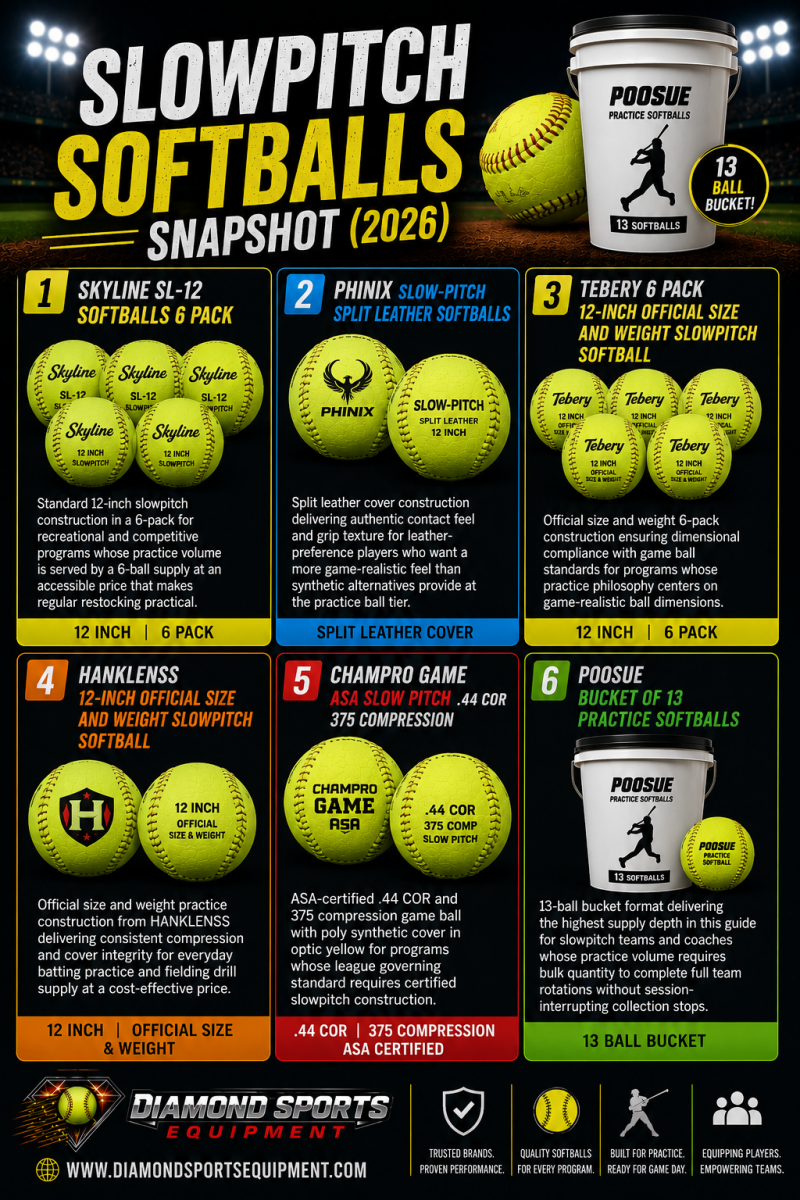
📊 Slowpitch Softballs Snapshot (2026)
- 🌟 Skyline SL-12 Softballs 6 Pack — Standard 12-inch slowpitch construction in a 6-pack for recreational and competitive programs whose practice volume is served by a 6-ball supply at an accessible price that makes regular restocking practical.
- 🔵 PHINIX Slow-Pitch Split Leather Softballs — Split leather cover construction delivering authentic contact feel and grip texture for leather-preference players who want a more game-realistic feel than synthetic alternatives provide at the practice ball tier.
- 🟡 Tebery 6 Pack 12-Inch Official Size and Weight Slowpitch Softball — Official size and weight 6-pack construction ensuring dimensional compliance with game ball standards for programs whose practice philosophy centers on game-realistic ball dimensions.
- 🟠 HANKLENSS 12-Inch Official Size and Weight Slowpitch Softball — Official size and weight practice construction from HANKLENSS delivering consistent compression and cover integrity for everyday batting practice and fielding drill supply at a cost-effective price.
- 🔴 Champro Game ASA Slow Pitch .44 COR 375 Compression — ASA-certified .44 COR and 375 compression game ball with poly synthetic cover in optic yellow for programs whose league governing standard requires certified slowpitch construction.
- 🪣 Poosue Bucket of 13 Practice Softballs — 13-ball bucket format delivering the highest supply depth in this guide for slowpitch teams and coaches whose practice volume requires bulk quantity to complete full team rotations without session-interrupting collection stops.
❓ FAQ
What does .44 COR mean on a slowpitch softball?
- COR stands for Coefficient of Restitution — it measures how much energy the ball returns after impact, expressed as a ratio between 0 and 1. A .44 COR ball returns 44% of the energy it absorbs at impact, which determines how lively the ball plays and how far it travels off the barrel under the same swing force.
- Most ASA and USA Softball governed slowpitch leagues specify a maximum .44 COR for sanctioned competition — a limit designed to keep ball flight distances within the range that field dimensions and competitive balance require across different skill levels and age groups.
What is the difference between ASA and USSSA certified softballs?
- ASA — now USA Softball — certification governs slowpitch competition under the USA Softball governing body, with specific COR and compression parameters that sanctioned competition must use to comply with the organization's equipment standards.
- USSSA certification governs slowpitch competition under the United States Specialty Sports Association, which has its own COR and compression standards that differ from ASA/USA Softball's parameters — the two certifications are not interchangeable, and using a USSSA-certified ball in an ASA-governed league creates a certification compliance issue regardless of how similar the balls appear.
How many practice softballs does a slowpitch team need for a full season?
- A recreational slowpitch team running batting practice and fielding drills once or twice per week typically goes through three to six dozen practice softballs per season — balls that absorb batting practice contact degrade over time and need replacement to maintain the consistent flight and feel that productive practice sessions require.
- Competitive programs whose practice schedule is more intensive benefit from purchasing in bucket quantities at the start of the season rather than making frequent smaller purchases — the per-ball savings of bulk purchasing and the supply reliability of having adequate stock on hand at all times both favor the larger upfront purchase.
Can I use game softballs for batting practice?
- Yes — game-certified softballs like the Champro ASA Game Ball can be used for batting practice, and using the game ball for practice is the most direct way to ensure that timing and contact responses developed in practice match the game ball's feel exactly.
- The practical consideration is cost — certified game balls cost more per unit than practice-grade alternatives, and the high-contact volume that batting practice produces degrades cover and compression faster than game use, making the cost-per-rep of practice-grade alternatives more efficient for programs whose budget requires managing per-ball cost across a full season of high-volume practice.
🧢 Final Thoughts
Every softball in this guide represents a different answer to the same slowpitch supply question — what does this specific program, team, or player need from the ball in their practice bucket and game bag, at their competition level, under their governing body's certification standard, and within their purchasing budget? The Skyline SL-12 is for the recreational program whose everyday practice volume is served by an accessible 6-pack. The PHINIX Split Leather is for the leather-preference player whose contact feel priority makes authentic cover construction worth seeking out in their practice ball. The Tebery 6 Pack is for the coach whose practice philosophy centers on official size and weight compliance in their everyday supply. The HANKLENSS 12-Inch is for the program whose cost-effective official-size practice ball needs are served by the consistent everyday construction HANKLENSS provides. The Champro ASA Game Ball is for the ASA-certified league whose competition requires certified .44 COR and 375 compression construction. The Poosue Bucket of 13 is for the team whose practice volume makes bucket-quantity depth the only supply format that keeps complete batting rotations running without session-interrupting collection stops. Match the ball to the format, the certification to the league, and the quantity to the practice volume — and never let the supply run out before the session plan is finished. For the full practice softball breakdown across every format and option, check out 🥎 Fastpitch Softballs for 2026 . For more gear guides and equipment reviews across every category, visit 📝 Diamond Sports Equipment Blog & Gear Reviews.
Add comment
Comments