No human pitcher can throw the same pitch at the same speed, location, and release point five hundred times in a row — and that repetition is exactly what builds the muscle memory, timing, and pitch recognition that separates hitters who perform under competitive pressure from those who only produce in favorable counts. A pitching machine removes the variability that makes live arm batting practice inconsistent as a development tool and replaces it with the controlled, repeatable rep quality that genuine skill building requires. The machine that makes the most sense for a given player or program is not necessarily the most expensive one or the one with the most features — it is the one that matches the player's current competition level, the training environment it will be used in, and the specific development needs the program prioritizes for the season it serves. A youth player building basic timing and contact mechanics needs a simple, consistent pitch at a manageable speed. A competitive high school program developing pitch recognition needs three-wheel ball movement that forces hitters to read and react rather than just time a mechanical feed. A family without reliable power access at their backyard field needs battery-powered portability above all else. The six machines in this guide cover every one of those needs — from the professional-grade consistency of the Jugs BP1 and the elite pitch realism of the Hack Attack through the youth-accessible Louisville Slugger Blue Flame and the power-independent Zooka ZS740. Every machine is confirmed in inventory and matched to a specific player level, training environment, and development priority. Players who want additional context on the broader pitching machine landscape should also check out 💨 Best Pitching Machines for Hitters (2025) for the full category overview, and coaches and players building a complete practice setup should explore ⚾ Best Pitching Machine Baseballs (2026) for the machine ball options that pair with every machine in this guide.
⚾ What You Should Know About Pitching Machines
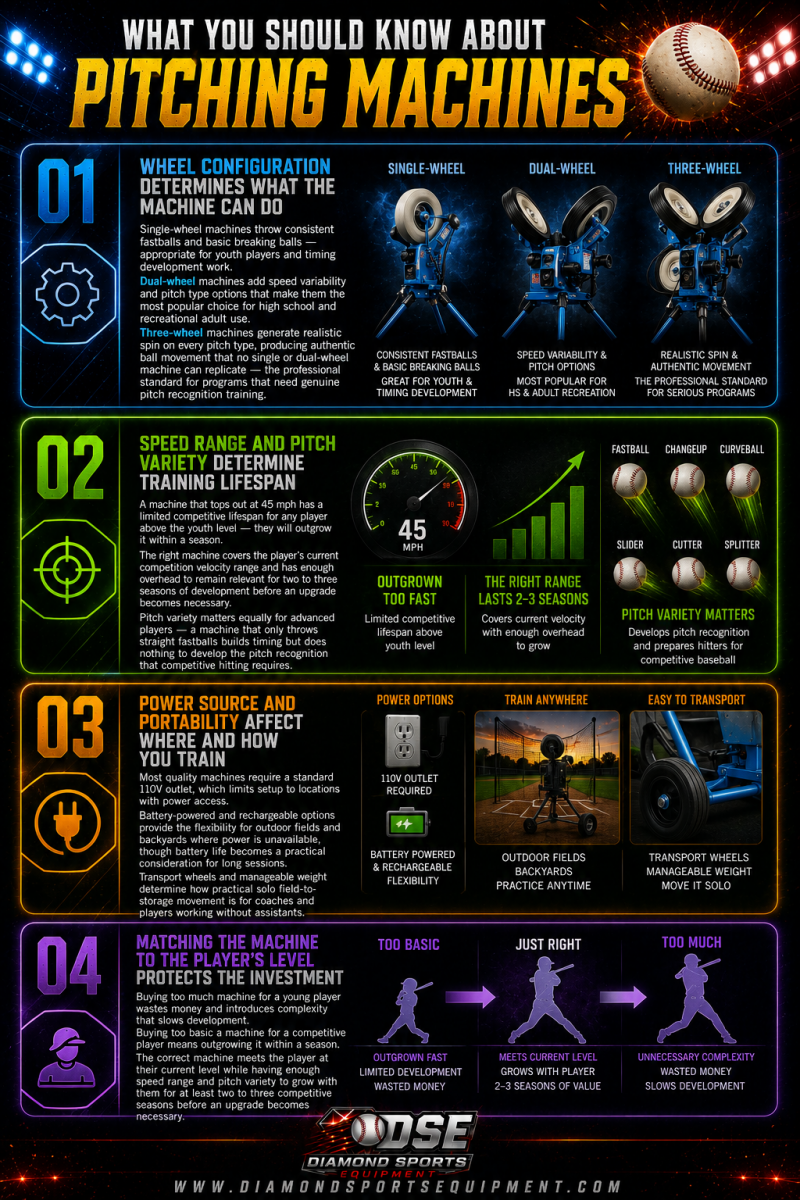
⚙️ Wheel Configuration Changes Training Capability
Single-wheel machines are strongest for repeatable fastballs, timing work, and high-volume contact reps, while two-wheel systems add greater control over spin and pitch movement. Three-wheel machines expand that control further by independently adjusting multiple wheels, making it easier to create a wider variety of realistic pitch shapes and locations for advanced recognition work.
🎯 Speed Range and Pitch Variety Determine Training Lifespan
A machine that tops out at 45 mph has a limited competitive lifespan for any player above the youth level — they will outgrow it within a season. The right machine covers the player's current competition velocity range and has enough overhead to remain relevant for two to three seasons of development before an upgrade becomes necessary. Pitch variety matters equally for advanced players — a machine that only throws straight fastballs builds timing but does nothing to develop the pitch recognition that competitive hitting requires.
🔌 Power Source and Portability Affect Where and How You Train
Most quality machines require a standard 110V outlet, which limits setup to locations with power access. Battery-powered and rechargeable options provide the flexibility for outdoor fields and backyards where power is unavailable, though battery life becomes a practical consideration for long sessions. Transport wheels and manageable weight determine how practical solo field-to-storage movement is for coaches and players working without assistants.
🧒 Matching the Machine to the Player's Level Protects the Investment
Buying too much machine for a young player wastes money and introduces complexity that slows development. Buying too basic a machine for a competitive player means outgrowing it within a season. The correct machine meets the player at their current level while having enough speed range and pitch variety to grow with them for at least two to three competitive seasons before an upgrade becomes necessary.
🏆 Best Pitching Machines for Practice (2026 Guide)
Six machines covering every wheel configuration, speed range, power source, and player level — from youth recreational through elite competitive program use.
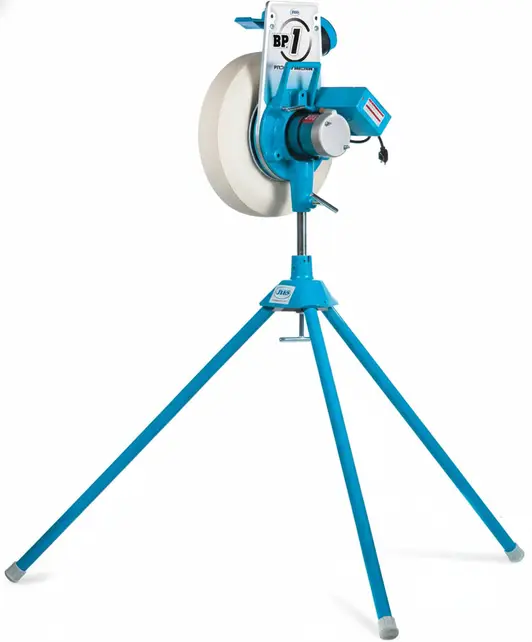
⚡ Jugs BP1 Baseball Only Pitching Machine
Best For: High school programs, travel ball organizations, and competitive adult players who need a professional-grade single-wheel machine built for high-volume daily batting practice at game-relevant velocities with the feed consistency and durability that serious program use demands
Construction: Professional-grade single-wheel design on a heavy-duty steel tripod frame with an adjustable pitching head that tilts to simulate pitches from different arm angles — the same fundamental construction architecture that Jugs has used in professional baseball programs for decades, refined and updated through generations of program feedback into the most field-proven single-wheel design in the category
Material: Heavy-gauge steel frame with weather-resistant powder coat finish and Jugs' proprietary rubber wheel compound — the wheel material maintains consistent grip and spin on regulation baseballs through thousands of pitches without the grip degradation that lower-quality rubber compounds develop under the heavy use loads that serious batting practice programs produce across a full competitive season
Performance Feel: One of the most consistent pitch feeds in the single-wheel category — the ball exits the BP1 with true rotation and a realistic trajectory that gives hitters genuine game-like timing challenges at every speed setting, and the breaking ball capability produces enough movement to develop real pitch recognition rather than the flat-spin breaking ball approximation that lesser single-wheel machines deliver
Ideal Player Type: High school varsity players, travel ball programs, and competitive adult organizations that prioritize consistent high-volume batting practice reps at game-relevant velocities and need a machine that holds its calibration and performs reliably through a full season of daily heavy use without the maintenance issues and feed inconsistencies that affect lower-quality alternatives
Performance Overview: The Jugs BP1 Baseball Only Pitching Machine earns the top position in this guide through a combination of professional-grade construction, feed consistency that lower-tier machines cannot approach, and a track record of performance built across decades of use at the highest levels of the game. Jugs machines are the industry standard for a specific reason — the BP1 delivers pitch after pitch at the exact speed and trajectory the operator sets without the feed irregularities and velocity drift that affect single-wheel machines built to lower construction tolerances. The breaking ball capability adds a training dimension that straight-fastball-only machines cannot provide — giving hitters the pitch recognition work that develops their ability to identify and handle off-speed pitches in a way that no amount of consistent fastball repetition alone builds. The adjustable head angle simulates pitches from multiple arm angles and release points, adding another dimension of realistic timing variability that keeps batting practice sessions genuinely challenging rather than mechanically predictable. For programs that take batting practice seriously and need a machine that performs at the professional standard through years of heavy daily use, the BP1 is the most trusted choice in the single-wheel category.
Why It Stands Out:
- Professional-grade Jugs construction used by MLB organizations and Division I programs across the country.
- Feed consistency delivers pitch after pitch at the exact set velocity without the drift that lower-quality machines produce.
- Breaking ball capability adds pitch recognition training value beyond what straight-fastball-only machines provide.
- Adjustable head angle simulates pitches from multiple arm angles for realistic timing variability.
- Heavy-gauge steel frame built to survive years of heavy outdoor program use without maintenance issues.
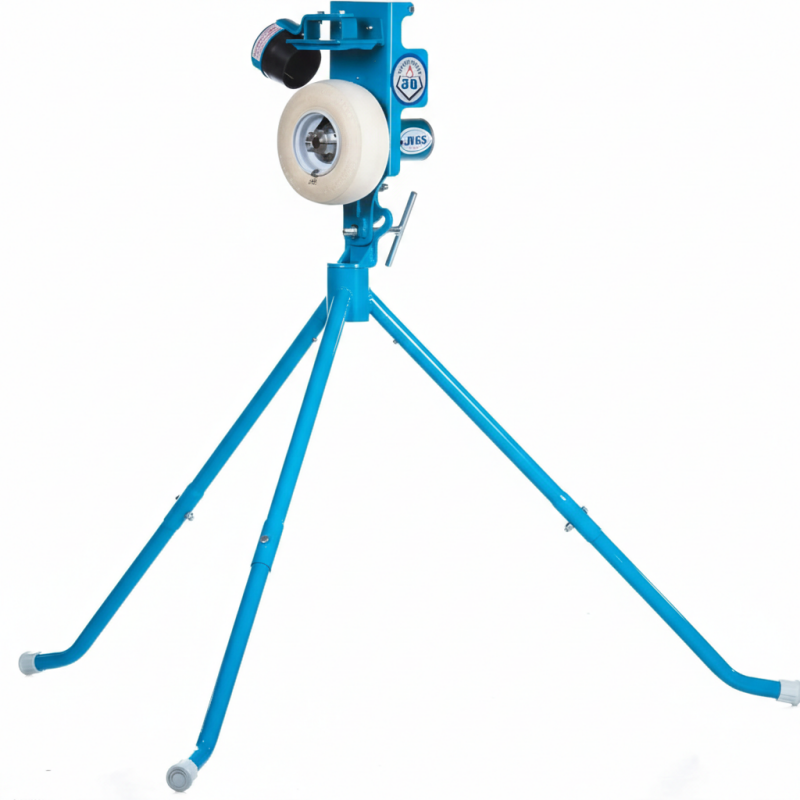
🔧 JUGS PS50 Baseball and Softball Pitching Machine
Best For: Multi-sport programs, high schools running both baseball and softball teams, and families with players in both sports who want professional Jugs performance from a single machine investment that covers every practice need across both sports without purchasing separate equipment
Construction: Dual-sport design platform engineered to handle both regulation baseballs and softballs through a single machine with clean conversion between sports — the PS50's pitching head, feeding mechanism, and wheel are built to accept both ball sizes and accommodate the different spin characteristics of baseball and softball without requiring wheel changes or mechanical adjustments between sports
Material: Same heavy-gauge steel construction and professional-grade wheel compound found across Jugs' full pitching machine lineup — the dual-sport wheel material is engineered to maintain consistent grip and spin on both baseball and softball surfaces across the thousands of pitches that a busy multi-sport program produces through a full competitive season
Performance Feel: The consistent, reliable Jugs pitch feed that coaches and players recognize from professional-level use — maintained across both ball types with the characteristic velocity accuracy and trajectory consistency that defines every machine in the Jugs lineup regardless of the wheel configuration or specific model
Ideal Player Type: Programs that operate baseball and softball simultaneously, high schools with both teams sharing practice equipment, and families with multiple players in both sports who want to maximize the training value of a single machine investment rather than maintaining separate machines for each sport
Performance Overview: The JUGS PS50 Baseball and Softball Pitching Machine earns its second-place position by combining the professional standard of the Jugs brand with genuine dual-sport versatility that significantly expands the value of the investment for any program or family serving both baseball and softball players. The ability to transition between sports without a second machine, a wheel swap, or a mechanical conversion process that introduces new calibration variables is a practical advantage that makes the PS50 the most efficient single-machine investment available for multi-sport environments. Jugs' construction quality ensures the machine performs at the same professional standard for both sports across years of heavy use — the same feed consistency, the same velocity accuracy, and the same build reliability that the BP1 delivers for baseball-only programs applied to the full dual-sport use case that the PS50 is specifically designed to serve. The wide speed range covers youth development velocities through competitive adult play across both sports, giving the PS50 a training lifespan that extends through multiple players and multiple competitive levels before an upgrade becomes necessary.
Why It Stands Out:
- Dual-sport design handles both regulation baseballs and softballs from a single machine without wheel changes.
- Professional Jugs construction delivers the same feed consistency and velocity accuracy across both sports.
- Quick sport conversion eliminates the mechanical complexity that separate machines or wheel-swap systems introduce.
- Wide speed range covers youth through competitive adult velocities for both baseball and softball.
- Most efficient single-machine investment for programs and families serving both sports simultaneously.
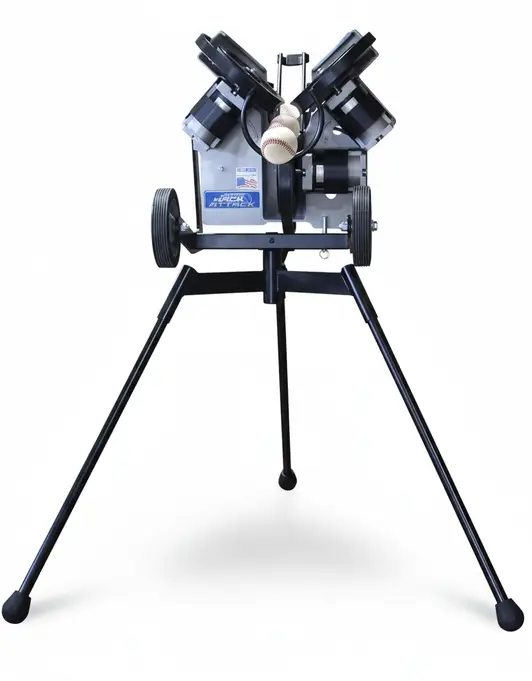
🏟️ Junior Hack Attack Baseball Pitching Machine by Sports Attack
Best For: Competitive travel ball programs, high school organizations, and serious training families who want three-wheel pitching machine performance — realistic ball movement, authentic pitch spin, and genuine pitch variety — at a more accessible investment level than the full-size Hack Attack
Construction: Three-wheel pitching machine platform scaled for baseball use — three independently adjustable wheels mounted on a heavy-duty steel frame that allow operators to dial in virtually any pitch type with realistic spin and velocity by adjusting each wheel's speed independently relative to the other two, the same fundamental engineering principle that makes the full-size Hack Attack the professional standard applied to a more accessible package
Material: Sports Attack's proprietary rubber wheel compound on all three wheels, with heavy-duty steel frame construction throughout — the wheel material maintains consistent grip across thousands of pitches without the significant wear degradation that lower-quality rubber compounds develop under the daily use loads that competitive programs produce across a full training season
Performance Feel: A pitch quality that no single or dual-wheel machine can match — the three-wheel configuration generates genuine ball movement with realistic spin on every pitch type, forcing hitters to read the rotation and trajectory rather than simply timing a consistent mechanical feed, which is the specific training stimulus that develops real pitch recognition rather than machine timing
Ideal Player Type: Travel ball coaches, high school programs, and competitive families who have reached the ceiling of what single and dual-wheel machines can deliver for their players' development and need the training quality that realistic three-wheel pitch movement provides — but whose budget or program scale makes the full Hack Attack a larger investment than the current situation requires
Performance Overview: The Junior Hack Attack Baseball Pitching Machine by Sports Attack earns its third-place position by bringing genuine three-wheel pitching machine performance into the range of competitive programs that cannot justify the full Hack Attack investment — delivering the pitch variety, realistic ball movement, and authentic spin that are qualitatively different from anything a single or dual-wheel machine produces. The ability to throw realistic breaking balls, off-speed pitches, and fastballs with true rotation gives hitters the pitch recognition training that competitive performance at the plate requires and that single-wheel machine repetition alone never develops — because recognizing a breaking ball from a fastball out of the hand is a skill built through exposure to realistic ball movement, not through timing a consistent flat-spin mechanical feed at increasingly higher speeds. Sports Attack's construction quality ensures the machine holds its three-wheel calibration and delivers consistent pitch types through the heavy program use that competitive training schedules produce, making this the strongest mid-tier investment in this guide for programs that prioritize pitch variety and training realism over raw batting practice volume.
Why It Stands Out:
- Three-wheel configuration delivers realistic ball movement and authentic spin unavailable from any single or dual-wheel machine.
- Can throw virtually any pitch type — fastballs, curveballs, sliders, changeups, and two-seamers — with true rotation.
- Forces hitters to read and react to pitch type rather than timing a consistent mechanical feed.
- Sports Attack construction quality maintains three-wheel calibration through heavy competitive program use.
- Brings three-wheel performance into a more accessible range than the full-size Hack Attack requires.
⚡ Performance Differences Between Pitching Machines
The biggest performance differences between pitching machines come from wheel configuration, pitch variety, velocity range, feed consistency, and how easily the machine fits the player’s actual training environment. Single-wheel machines work well for repeatable timing and contact reps, while multi-wheel systems give advanced hitters more control over pitch movement and location for recognition work. Power source matters just as much as pitch capability — a professional electric machine may deliver excellent repetition but still be the wrong choice for a player who trains at fields without reliable outlets, while battery-powered designs trade some top-end capability for much greater flexibility. Programs building a permanent high-volume machine station can compare containment options in 🥅 Best Batting Cage Nets (2026 Guide), while hitters who want to pair machine timing work with mechanics-focused training can add 🏏 Swing Trainers for Hitters (2026 Guide).
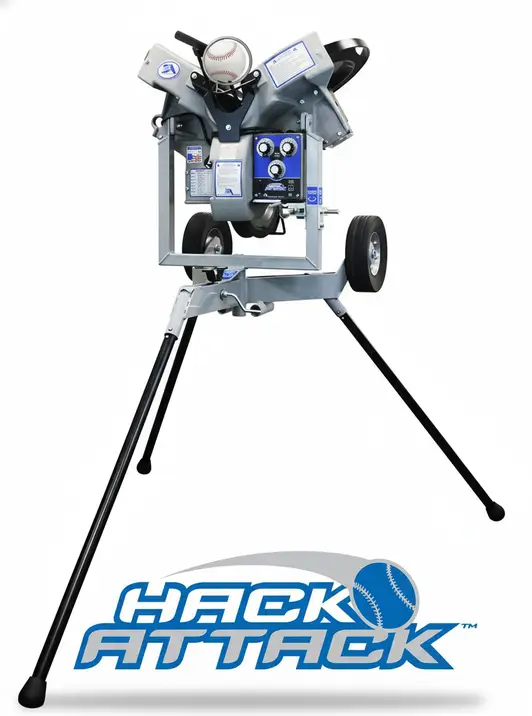
🔴 Hack Attack Baseball Pitching Machine by Sports Attack
Best For: Elite high school programs, college organizations, and serious competitive programs that demand the highest level of pitch realism, variety, and feed consistency available in any pitching machine for daily high-volume training use at the professional standard
Construction: Full-size three-wheel platform — Sports Attack's professional standard for serious baseball programs at every level from elite high school through the professional ranks — with three independently adjustable wheels mounted on a heavy-duty precision-engineered steel frame, a feeding mechanism that accepts regulation baseballs cleanly and consistently through thousands of pitches per session, and an adjustable positioning system that allows simulation of pitches from any arm angle and release point a competitive pitcher might use
Material: Professional-grade Sports Attack wheel compound and heavy-gauge steel frame construction throughout every mechanical component — the same construction standard found in machines used by MLB organizations, universities, and elite prep programs, built for the daily heavy use that professional program training demands across years of operation without the calibration drift and mechanical wear that lower construction standards develop under equivalent use loads
Performance Feel: The most realistic pitch feel available in any pitching machine currently on the market — three-wheel configuration generating authentic spin on every pitch type, velocity range covering everything from soft development speeds through professional-level fastball velocities, and ball movement that hitters describe as indistinguishable from a live arm in terms of trajectory and rotation
Ideal Player Type: Elite travel ball programs, high school varsity organizations, college programs, and any competitive environment where training quality directly translates into measurable competitive results and the program demands a machine that performs at the professional standard through years of daily heavy use without compromise
Performance Overview: The Hack Attack Baseball Pitching Machine by Sports Attack is the definitive choice for programs that demand the absolute best in pitching machine performance and training realism — the machine against which every other option in the category is measured and the one that serious programs at the elite level consistently return to when the investment threshold is justified by the competitive standard the program operates at. The three-wheel system generates genuine breaking ball movement, authentic fastball spin, and realistic changeup deception that forces hitters to develop real pitch recognition skills rather than machine-specific timing adaptations that do not transfer to live at-bats. The professional-grade construction holds calibration through the daily heavy use that elite program training produces across full competitive seasons without the mechanical wear and velocity drift that lesser machines develop under equivalent loads. For programs where the gap between a good training environment and a great one translates directly into competitive results, the Hack Attack is not simply the best option in this guide — it is the professional standard the rest of the category aspires to.
Why It Stands Out:
- Professional standard three-wheel system used by MLB organizations and elite collegiate programs.
- Delivers the most realistic pitch movement, spin, and ball trajectory of any pitching machine currently available.
- Generates authentic breaking ball, fastball, and changeup deception that builds genuine pitch recognition rather than machine timing.
- Professional-grade construction holds calibration through daily heavy use across years of elite program training.
- The benchmark machine against which every other pitching machine in the category is measured and evaluated.
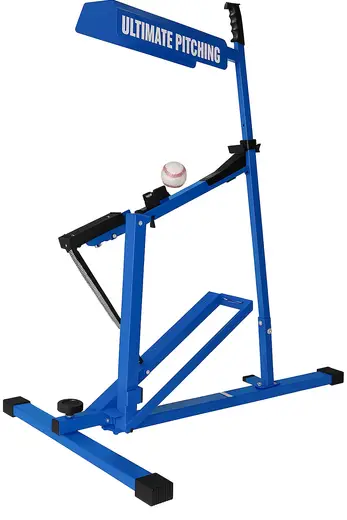
🔵 Louisville Slugger Blue Flame Pitching Machine
Best For: Youth players aged 6 through 12 in recreational leagues, Little League, and early competitive programs whose primary development need is consistent pitch repetition at a manageable speed that builds confidence and fundamental swing mechanics without the complexity and velocity of professional-grade machines
Construction: Youth-focused single-wheel design mounted on a lightweight adjustable stand that can be set up and broken down quickly without tools or mechanical experience — the simplified construction eliminates every variable that makes professional machines impractical for young players and their parents, delivering a consistent pitch at a youth-appropriate speed through a design that prioritizes accessibility and ease of use over the performance depth that young players are not yet developmentally ready to utilize
Material: Lightweight polymer frame construction with a durable rubber wheel compound appropriate for youth ball sizes — the polymer construction prioritizes portability and ease of handling over the heavy-gauge steel durability of professional machines, calibrated for the use volumes and impact loads that recreational and early competitive youth batting practice produces rather than the daily heavy use that program-level equipment handles
Performance Feel: Consistent, predictable, and manageable — the Blue Flame delivers the same pitch in the same location at the same speed every time, giving young players the repetitive contact opportunity they need to develop the fundamental swing mechanics and timing habits that everything else in their hitting development builds on top of
Ideal Player Type: Youth players developing their first real swing mechanics in recreational, Little League, and early travel ball environments — and the parents and youth coaches who support them and need a machine that can be set up, adjusted, and operated without mechanical experience or physical difficulty
Performance Overview: The Louisville Slugger Blue Flame Pitching Machine earns its position in this guide as the most accessible and developmentally appropriate option for families introducing young players to machine batting practice — the machine that removes every barrier between a young hitter and the consistent pitch repetition that fundamental swing development requires. The simplified single-wheel design delivers a consistent pitch at a youth-appropriate speed without the speed variability, pitch type complexity, and operational demands that professional machines place on operators who may be parents running solo practice sessions rather than program coaches with mechanical experience. The lightweight polymer construction makes the machine genuinely portable for the backyard and field transport situations that youth baseball families navigate regularly, and the straightforward adjustable stand allows height and angle changes between sessions as the player's developmental needs evolve. For the family investing in a first pitching machine for a young developing player, the Blue Flame delivers exactly what that investment needs to accomplish — consistent reps at the right speed for the right player at the right stage.
Why It Stands Out:
- Youth-focused design delivers consistent pitches at a manageable development speed for players building fundamental mechanics.
- Lightweight polymer construction makes the machine genuinely portable for backyard use and field transport.
- Simple setup and adjustment requires no mechanical experience from parents or coaches running solo practice.
- Accepts both youth baseballs and softballs for multi-sport family use without separate equipment.
- Eliminates every operational barrier between a young player and the consistent pitch repetition development requires.
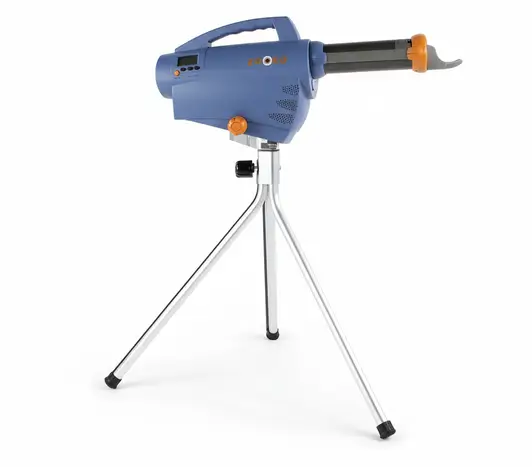
🌀 Zooka ZS740 Baseball Pitching Machine
Best For: Youth through high school players and families who prioritize genuine portability and power independence over pitch variety and maximum velocity — the player or program that trains in locations without consistent power access and needs a machine that works anywhere without extension cords, generators, or outlet proximity
Construction: Unique single-wheel compressed-air delivery system that sets the ZS740 apart from every other machine in this guide — rather than using a spinning rubber wheel to propel the ball, the ZS740 uses a compressed-air burst that delivers pitches with consistent velocity and trajectory without the warm-up time that electric wheel machines require before their wheel speed stabilizes at the target velocity
Material: Lightweight polymer and aluminum construction with precision-engineered compressed-air delivery mechanism and rechargeable battery power system — the polymer and aluminum combination keeps the machine's total weight low enough for genuine solo portability while maintaining the structural integrity required for consistent compressed-air pitch delivery through a full practice session
Performance Feel: Clean and consistent — the compressed-air delivery produces a straight pitch without the spin that wheel machines generate, which is a meaningful difference for pitch recognition training but an irrelevant one for the timing development and contact rep work that most players using a battery-powered portable machine are prioritizing in the training contexts where the ZS740 is the right tool
Ideal Player Type: Youth to high school players and families who train in locations without reliable power access — backyard fields, public parks, school fields without outlets, and any training environment where the power cord dependency of standard machines creates a practical barrier to consistent machine practice
Performance Overview: The Zooka ZS740 Baseball Pitching Machine closes out this guide as the most portable and location-flexible option available for players and families whose training environment makes the power cord dependency of standard machines a genuine obstacle rather than a minor inconvenience. The compressed-air design eliminates the warm-up time that electric wheel machines require before reaching stable operating speed, the rechargeable battery removes the outlet proximity constraint that limits where every other machine in this guide can be set up, and the lightweight construction makes solo transport between training locations genuinely practical rather than a two-person production that makes spontaneous practice sessions logistically difficult. The pitch consistency is solid for timing development and contact rep work — the machine delivers the same pitch in the same location reliably enough to build the batting practice habits that consistent machine sessions produce. For players who have been limited in their machine practice by lack of power access at their primary training location, the ZS740 eliminates that barrier entirely.
Why It Stands Out:
- Compressed-air delivery system eliminates the warm-up time that electric wheel machines require before stable operation.
- Rechargeable battery power removes electrical outlet dependency — practice anywhere without cords or generators.
- Lightweight polymer and aluminum construction makes solo transport between locations genuinely practical.
- Consistent pitch delivery provides reliable timing development reps across a full battery-powered session.
- The only option in this guide built specifically for the player whose training environment lacks reliable power access.

📊 Pitching Machines Snapshot (2026)
- ⚡ Jugs BP1 Baseball Only Pitching Machine — Professional-grade single-wheel machine with Jugs' industry-standard feed consistency and breaking ball capability built for high school and competitive program use.
- 🔧 JUGS PS50 Baseball and Softball Pitching Machine — Dual-sport professional Jugs machine handling both baseballs and softballs with quick conversion and wide speed range for multi-sport programs and families.
- 🏟️ Junior Hack Attack Baseball Pitching Machine by Sports Attack — Three-wheel pitch variety and realistic ball movement in a more accessible package than the full Hack Attack for competitive travel ball and high school programs.
- 🔴 Hack Attack Baseball Pitching Machine by Sports Attack — Professional standard three-wheel machine delivering the most realistic pitch movement and variety of any pitching machine available for elite program training.
- 🔵 Louisville Slugger Blue Flame Pitching Machine — Youth-focused lightweight single-wheel machine with consistent speed and easy setup built for young players developing fundamental hitting mechanics.
- 🌀 Zooka ZS740 Baseball Pitching Machine — Battery-powered compressed-air machine delivering genuine portability and consistent timing reps for players who need practice flexibility without power access.
❓ FAQ
What type of pitching machine is best for a youth player?
- Single-wheel machines with consistent, manageable speeds are the right starting point — the Louisville Slugger Blue Flame is designed specifically for this developmental stage.
- Avoid machines that exceed the player's current competition velocity range — too much speed at the wrong stage slows development rather than accelerating it.
Can one machine work for both baseball and softball?
- Yes — dual-sport machines like the JUGS PS50 are specifically built to handle regulation baseballs and softballs from a single machine without wheel changes.
- Always confirm ball compatibility before purchasing — some machines are designed for one ball size only and damage or feed inconsistency results from using the wrong ball type.
Do I need a three-wheel machine or will single-wheel work?
- Single-wheel machines are adequate for timing development and high-volume fastball work at the youth and recreational level.
- Three-wheel machines are worth the investment for competitive players whose primary development need is pitch recognition and realistic ball movement — the Junior Hack Attack or Hack Attack are the correct choices at that stage.
What balls should I use with a pitching machine?
- Always use balls specifically rated for pitching machine use — standard game balls accelerate wheel wear and create feed inconsistencies that degrade both machine and ball performance.
- Dimpled practice balls and machine-rated leather balls are the best options for maintaining consistent feed quality and extending machine wheel life across a full training season.
🧢 Final Thoughts
The pitching machine that produces the most development is the one that matches the player's level, the training environment, and the specific skill the practice session is targeting — not the one with the most features or the highest price tag. The Jugs BP1 and PS50 are the right machines for programs that need professional feed consistency and high-volume rep quality. The Junior Hack Attack and full Hack Attack are the right machines for programs that need realistic pitch movement and genuine recognition training. The Blue Flame is the right machine for youth players who need manageable consistent reps without operational complexity. The Zooka ZS740 is the right machine for any player whose training environment makes power access the primary constraint on how and where machine practice happens. Every machine in this guide was selected because it is the best available option for the specific player type and training need it serves — and any player or program that matches themselves to the right one gets a training tool that pays off in development, confidence, and plate performance from the first session forward. Players who want to build a complete training setup around their pitching machine should explore 🛠️ Best Baseball Training Equipment (2026 Guide) for the full at-home development tool lineup that pairs with every machine in this guide. For the complete library of baseball and softball gear guides and buying breakdowns across every category and player level, visit 📝 Diamond Sports Equipment Blog & Gear Reviews.